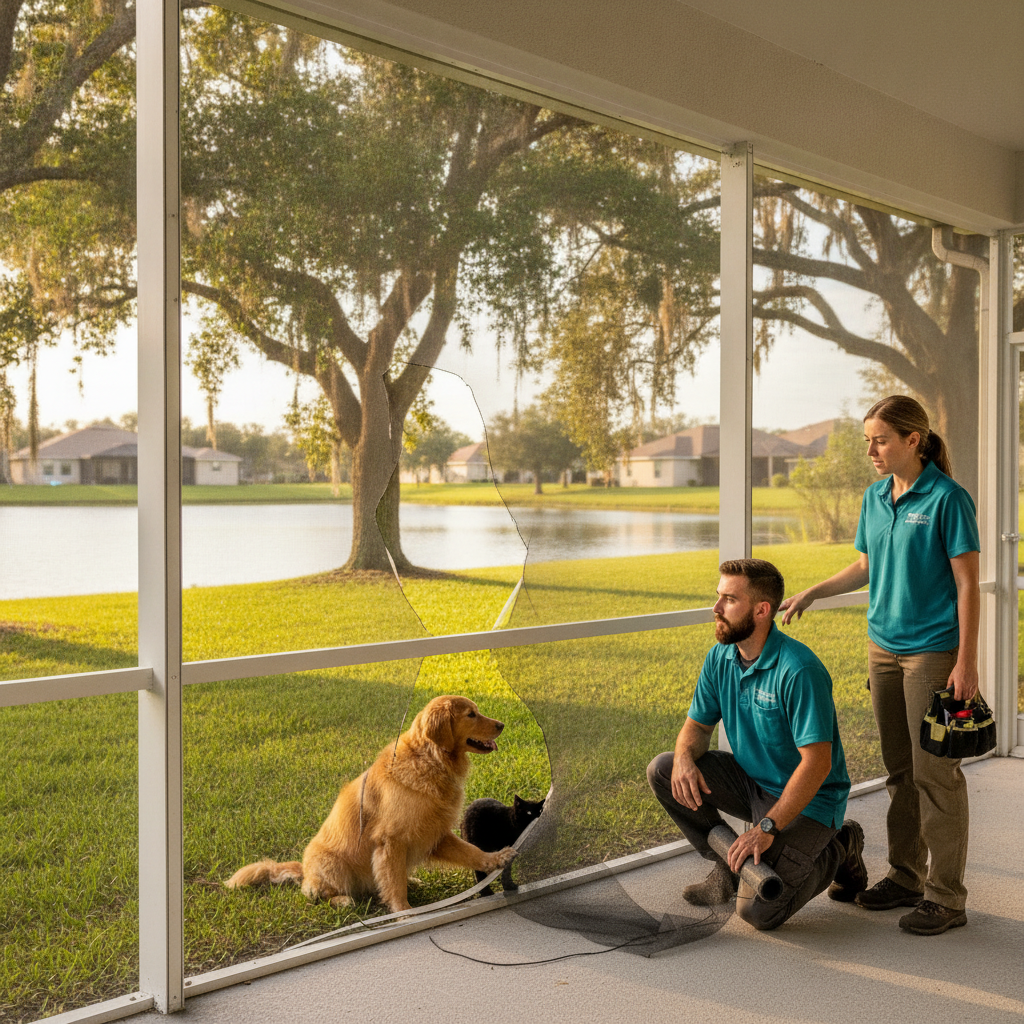
The dog hits the same lower panel on a Dixieland lanai, the spline walks out of the channel, and the mesh hangs like a curtain. After a summer thunderstorm, oak litter and mosquitoes come through that opening as if the wall were never there. Patio screen repair in Polk County is usually that panel, that door, or that kick-height strip, not a new room.
A ground-level panel held by rubber spline can come out and go back in. Framing, anchors, and pool-gate hardware cannot. That split is the whole job.
A patio screen vs a pool cage
A patio screen is the mesh walls on a porch or lanai that already has a roof. A pool cage is a full aluminum structure over the water, roof and all. Repair looks similar up close (channel, spline, panel) and lives in different worlds once you step back.
On a covered patio in South Lakeland or around Lake Morton, the roof is already there. The screen is infill. The crews we send pull the old spline, set new mesh, and roll a new spline into the same channel. On a Winter Haven or Cypress Gardens cage, the roof is screen too. Sun cooks those top panels and the south and west walls years before the shaded north side looks tired. Central Florida mesh commonly lasts roughly seven to twelve years, and it fails unevenly for that reason.
| Patio or lanai screen | Pool cage | |
|---|---|---|
| What it is | Mesh walls under a roof you already have | A full aluminum enclosure over the pool |
| Typical repair | Individual wall panels, doors, loose spline | Wall and roof panels, more height, more UV |
| When a permit shows up | When structural or infill framing is added | The frame itself is the structure |
Florida’s Residential Swimming Pool Safety Act never names “screen enclosure” as a category. Section 515.29 asks a barrier to stand at least 4 feet high on the outside, to have no gap a child could crawl under, squeeze through, or climb, and to carry a gate that opens out, self-closes, and self-latches with the release on the pool side, out of a child’s reach. Whether a given cage does all of that is what the building official signs off on. A patio that does not enclose a pool does not inherit that question. A screened structure that does reach the water does, and a loose door panel or a missing latch is not a cosmetics problem.
If the “patio” is really a 1990s cage on the Chain of Lakes, treat it as a cage. If it is a builder-covered lanai in Davenport or Four Corners that was left bare, screening it in is a screen room job, not a patch.
Pets, splines, and a kick plate
Screen sits in a groove in the aluminum. A rubber spline wedges the mesh into that groove. Pull the spline and the panel comes out. Roll a new one in and the panel is a wall again. That is why a single torn bay can be swapped without rebuilding the lanai.
Pets do not tear the middle of a wall first. They hit the door and the lowest row, right where a nose or a paw lands. A cat works a loose corner. A dog shoulders the kick-height panel until the spline pops and the mesh balloons. Once that corner is free, every storm finishes the job. On a west-facing patio off US-98, afternoon sun also makes that lower mesh brittle, so the same panel opens again after a cheap restretch with tired cloth.
A kick plate is the solid band at the bottom of a door or a wall bay. It gives the pet (and the broom, and the cooler) something to hit that is not mesh. Adding a kick plate means adding infill at the bottom of the opening. Swapping mesh in an existing channel is a panel job. Changing the frame is a different conversation, including with the building department.
Mesh choice is the other half of a repair that stays closed. Standard fiberglass in an 18x14 weave is what most Polk County patios already wear. Phifer’s 18x14 fiberglass is built to take debris from harsh winds and storms, keep out most insects, and still let breezes through. Phifer No-See-Ums uses a 20x20 mesh for smaller flying insects. Phifer PetScreen is pet-resistant screening, tear and puncture resistant against most dogs and cats, and the manufacturer calls it out for patio and porch enclosures as well as windows and doors. The maker does not publish a mesh count for PetScreen, so do not shop it by a number. Phifer Glas-Shield is 18x14 fiberglass that has been vinyl-laminated. It is a wall and lower-panel product. It is not intended as roofing, and it is not for horizontal runs. Put it on a cage roof and you have used it wrong.
April under the live oaks off Lake Morton is its own test. Catkins mat on coarse mesh, someone shoves a broom through a dirty panel, and the spline leaves the channel. A finer mesh sheds more of that litter. It will not save a panel a dog has already learned to open. For the mix of weaves and where each one belongs, see screen mesh types in Central Florida.
What repair includes
A typical patio screen repair is a panel count, not a mystery. The crew walks the enclosure, marks every bay with a hole, a popped spline, or mesh so chalked it will split when restretched, then replaces those panels in the existing frame. Individual screen panels run $35 to $90 each. Standard fiberglass rescreen is about $2.50 to $4.00 installed per square foot of screen. Screen door work (rehang, rebuild with new hardware, or full replacement) runs $180 to $500. Those are the site’s published ranges for those jobs. They are not a quote for your patio.
A full pool cage rescreening is a different ticket. Full-cage rescreen runs $1,400 to $3,200. Do not stretch that range onto a three-bay lanai, and do not stretch a lanai panel price onto a two-story mansard over a pool. Screening in an existing covered lanai, as a new enclosure rather than a patch, is published at $1,500 to $3,500. Once you add an insulated roof panel, a longer clear span, or a new slab, a screen room moves into the $6,000 to $14,000 band, because the work is no longer “put cloth in a channel.”
Permits follow the framing, not the tear. Unincorporated Polk County’s Building Division FAQ lists “Screening of any space, which requires structural or infill framing to be added.” Inside the City of Lakeland, Building Inspection publishes its own permit requirements, and that list includes screening of any space that requires structural or infill framing, plus porches. A crew that mostly works unincorporated lots can hit friction inside city limits because the city runs that division and that list. Swapping mesh in channels that already exist is not the same act as adding infill. If the repair grows a kick-plate frame, a new door opening, or new uprights, ask the Building Division on the specific design before anyone cuts aluminum.
Florida law is plain on who may contract the work. Florida Statutes 489.113 says a person must be certified or registered to engage in the business of contracting in this state. Several licence classes lawfully build and repair aluminum structures. Ask which class the contractor holds, then verify it yourself with the state’s Verify a License tool. The crews we send are licensed and insured. Lakeland Outdoor Pro matches you with those crews. It is not the licensee.
The Atlantic hurricane season runs from June 1 to November 30. That is when a loose spline on a west wall stops being a nuisance and starts taking neighboring panels. Inland Polk does not sit in salt air or a coastal wind zone. The load is still wind, daily summer thunderstorms, and the oak litter that rides them. The Florida Building Code assigns an ultimate design wind speed to a specific address. The engineered drawing in a permit package states the value a new structure was designed to. A panel restretch does not change that drawing. A new frame does.
A hardware-store kit is real, and it is small. Ace and Home Depot sell spline, a roller, and mesh by the roll. That is how a lot of Lakeland homeowners restretch one ground-level panel on a Saturday. They do not send a licensed crew to rescreen a lanai, add infill, or work a two-story elevation. If you can reach the channel from the slab, the spline is intact enough to pull, and the frame is still square, a single bay is a homeowner job. Erecting or modifying the aluminum frame, setting anchors in a slab, or touching pool-gate hardware is not.
On a thin 1950s patio slab in Dixieland, that last point matters even when the screen is the only thing that looks wrong. Those slabs were often poured without a perimeter footer. A panel swap does not care. A new upright does. If the repair estimate starts talking about posts and anchors, you have left patio screen repair and entered enclosure work.
How do you fix a torn patio screen?
You replace the panel, you do not patch the hole with tape and hope. From the slab, pull the old spline, peel the torn mesh out of the channel, cut new mesh oversized, press new spline in with a roller, and trim the cloth flush. Match the weave to the rest of the wall unless you are upgrading that bay on purpose (pet mesh at kick height, 20x20 where no-see-ums come off the lakes). If the aluminum is bent, the door is out of square, or the panel sits over a pool-access gate, stop and call a licensed contractor.
How much does it cost to rescreen a patio in Lakeland?
Individual panels are $35 to $90 each. Standard fiberglass, priced per square foot of screen, is about $2.50 to $4.00 installed. A door is $180 to $500 depending on whether it is a rehang, a rebuild, or a replacement. A full pool cage rescreen is $1,400 to $3,200, which is the wrong number for a small lanai and the right number when the “patio” is actually a cage. Screening in an existing covered lanai as a new room is $1,500 to $3,500. Longer spans, insulated roofs, and new slabs leave that band. No permit fee belongs in that math until the Building Division states it for the address.
Does Home Depot or Ace Hardware rescreen a patio?
They sell the consumables for one reachable panel: mesh, spline, roller. That is not rescreening a patio. Rescreening a patio is walking every bay, matching or upgrading the cloth, rolling spline that will stay in a Florida summer, and knowing when the frame or the door hardware is the actual failure. For that, you want a licensed aluminum or screen contractor, checked on the state’s Verify a License tool, not a kit aisle.
When to call us
Call when the same panel keeps opening, when the tear is at a door or over a pool, when the frame is bent, or when the repair would add infill or a new upright. The crews we send rescreen, rebuild doors, and tell you when a panel is enough and when it is not. Call us at (863) 777-5379.