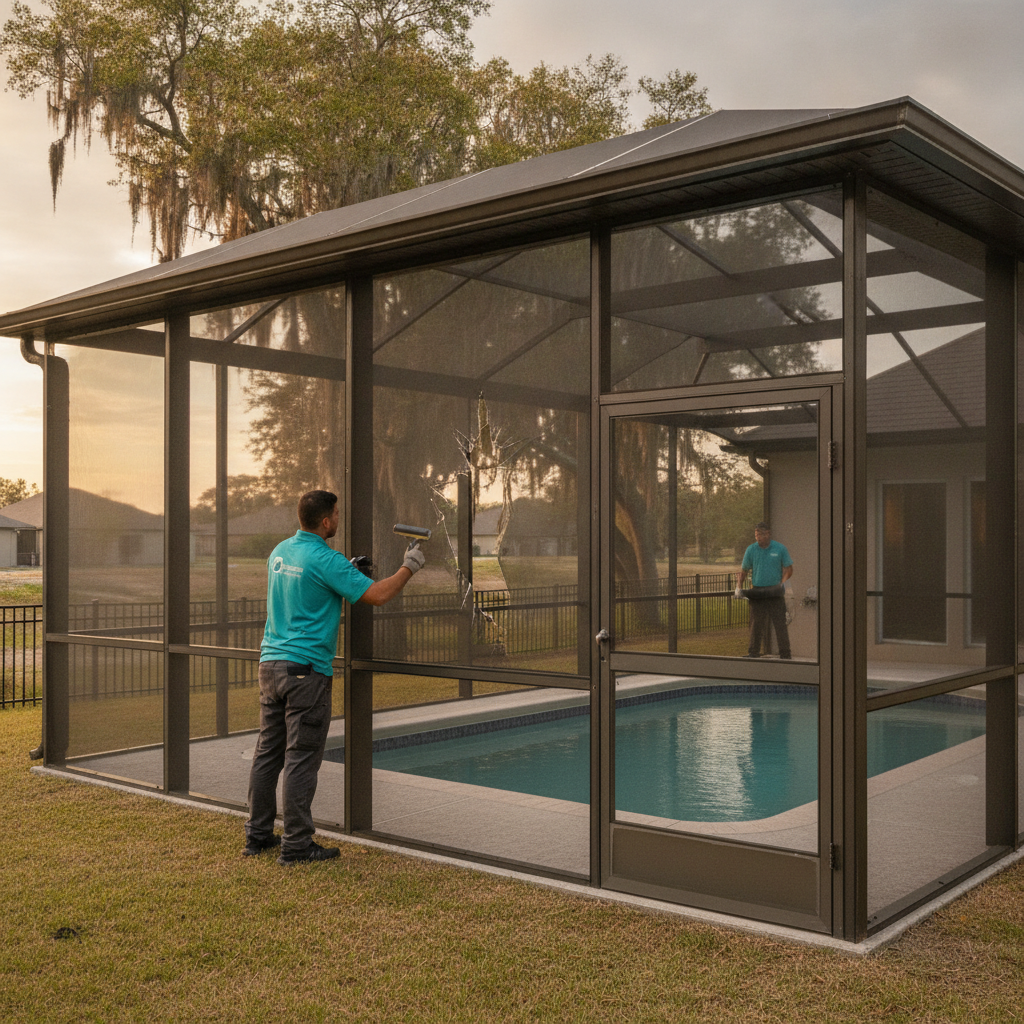
A dog goes through the lower panel of a 1990s cage in Cypress Gardens, or a June thunderstorm peels one roof panel on a Winter Haven lanai, and you are looking at a hole instead of a backyard. One clean tear with tight neighbors is a panel job. Mesh that billows on every elevation is a cage that is done.
One torn panel versus a cage that has stretched
A single cut, with the rest of the cage still drum-tight, is a panel swap. A cage that looks tired on every wall, with spline sitting proud of the channel and fabric that moves in a light breeze, is past honest patchwork.
Screen lives in an aluminum channel. A rubber spline presses the fabric into that channel and holds it. Pull the spline, lift the old mesh, lay in a new piece, roll the spline back, trim the extra. On a ground-level wall panel, that is a real homeowner job. On a roof panel, a two-story mansard, or any panel you would need a ladder to reach over a pool, it is not.
The tell is the neighbors. Walk the cage. Push the next panel with two fingers. If it stays taut and the spline is still seated, the hole is local. If three or four panels around it have already gone slack, the fabric has given up its tension. Putting one bright new rectangle in a wall of faded, stretched mesh does not buy you a cage. It buys you a patch that the next storm will find.
That pattern is common around the Chain of Lakes. Winter Haven, Auburndale, Eagle Lake, and Cypress Gardens still carry a large stock of 1990s cages. Those cages are in their rescreen window. The south and west elevations take the sun all afternoon. The north side, under the house shadow, still looks almost new. Central Florida screen generally lasts roughly seven to twelve years, and it fails in that uneven way. A crew that only replaces the ugly wall is doing you a short favor.
Price follows the same split. Individual screen panels on this kind of work run $35 to $90 each. A full-cage rescreen runs $1,400 to $3,200. Standard fiberglass, priced by the square foot of screen, installs at about $2.50 to $4.00. Those are different jobs, not a small version and a large version of the same job.
A door is a third object. A wall panel that is torn is mesh. A door that will not close, that scrapes the slab, or that has a missing sweep is hardware. Rehanging, rebuilding with new hardware, or replacing a screen door runs $180 to $500. Mixing the three numbers in your head is how a “quick fix” quote and a rescreen quote feel like they cannot both be true. They can. They are not describing the same work.
If the frame itself has moved, none of those panel numbers apply. An upright that no longer lands clean on the slab, a beam with a kink, a roof panel that has folded, or a cage that racks when you lean on a corner is enclosure repair, and sometimes it is a conversation about a new pool cage instead of another year of patches.
Pets, storms, and spline that has dried out
Most Polk County holes come from three ordinary things: an animal, a storm, or spline that has cooked in the sun until it will not hold.
Pets hit the lower third. Dogs use the kick plate as a launch, cats climb the corner, and the first failure is a puncture at paw height, not a roof panel. Phifer PetScreen is pet-resistant screening made to resist tears and punctures from most dogs and cats, and it is sold for patio and porch enclosures as well as windows and doors. The manufacturer does not publish a mesh count for it. What you are buying is toughness at the bottom of the cage, not a different insect rating. Pairing that on the lower course with standard fiberglass above is a common, honest upgrade on a rescreen. It does not turn a stretched cage into a new one. It stops the next dog from opening the same hole in a week.
Storms do the opposite. They get under a loose panel and peel. The Atlantic hurricane season runs from June 1 to November 30, and Polk County’s daily summer cells do not wait for a named storm. Inland wind, not salt air, is what works the mesh here. Once spline has shrunk and pulled out of the channel, the panel is a sail. The first time a gust gets under it on a Winter Haven cage, the spline pops the rest of the way out and the fabric slaps until it tears. That is why a “small” loose corner is not a cosmetic item on a roof panel. It is the start of a peel.
Spline itself is the quiet failure. It is a rubber cord. Years of heat make it hard and skinny. It still looks seated until you pick at it with a fingernail and it crumbles. New mesh in old, brittle spline is a repair that fails at the channel, not in the fabric. A crew that rescreens a cage pulls the old spline and rolls new spline with the new mesh. That is a large part of why a full rescreen outlasts a scatter of replacement panels.
Mesh choice is the other half of a repair that lasts. Phifer’s 18x14 fiberglass is built to take debris from wind and storms, keep out most insects, and still let a breeze through. That is the default wall and roof cloth on most cages in this county. Phifer No-See-Ums is a 20x20 mesh aimed at smaller flying insects: no-see-ums, gnats, sand flies. Finer mesh cuts glare a bit and cuts airflow a bit. On a west-facing patio in South Lakeland that already bakes after 3 p.m., that trade is worth naming out loud before you put 20x20 on every elevation. Phifer Glas-Shield is 18x14 fiberglass that has been vinyl-laminated. It is a wall and lower-panel product. It is not intended as roofing, and it is not for horizontal runs. Putting it on a cage roof because it looks tougher is the wrong product in the wrong place. More on how those cloths behave in this climate sits in our guide to screen mesh types in Central Florida.
Oaks make their own mess. Off Lake Morton and through Dixieland, catkins mat on a coarse roof screen every spring, and acorns follow in the fall. That load sits on the fabric and on the spline. It is not a tear, but it is why a roof panel that still looks intact can be one wet storm from pulling out. A screen room under live oak canopy has the same problem at a smaller scale: one stained, sagging roof panel over the table, and walls that are still fine.
A pool-cage door is not just another panel with hinges. Florida’s Residential Swimming Pool Safety Act, in section 515.29, asks a barrier to be at least 4 feet high on the outside, to have no gap, opening, or protrusion a young child could crawl under, squeeze through, or climb, and to use a gate that opens out, self-closes, and self-latches, with the release on the pool side and out of a child’s reach. A screened structure is not named as a category in that statute. Whether a given cage does those things is what the building official signs off on. Do not treat a floppy door, a missing latch, or a propped-open gate as a screen-repair sidebar. That hardware is the part of the job a child can fail.
When repair is honest and when rescreen is the job
Repair is honest when the failure is local and the rest of the cloth still has life. Rescreen is the job when the sun, the spline, or the frame has already decided the next six panels are next.
| What you see | Honest job | Why it is that job |
|---|---|---|
| One clean tear, neighbors still tight | Swap that panel | The mesh around it is still doing its work |
| South and west walls baggy, north wall still tight | Rescreen the cage | UV ages the fabric unevenly; a new patch will not match, and the rest is already in line |
| Door dragging, latch gone, sweep missing | Door work | The hole is the opening, not the wall |
| Spline dried out on several elevations | Rescreen, not a scatter of panels | New mesh in dead spline fails at the channel |
| Upright loose, beam bent, roof panel folded | Frame first, then screen | Cloth will not hold a cage that has moved |
A window you can carry to a service desk is not a pool cage. Hardware stores sell rolls of fiberglass and spline, and some shop counters will rescreen a small window frame you bring in. That is a useful service for a porch window. It is not a crew on a two-story mansard, and it is not a licensed contractor resetting a pool-cage door. Home Depot, Lowe’s, and a local ACE aisle will get you the materials for a ground-level panel. They will not diagnose a stretched Winter Haven cage, pull every spline, or tell you the frame has walked off the slab.
Permits follow the same line. Polk County’s Building Division says a permit is required for screening of any space that needs structural or infill framing added. The City of Lakeland publishes the same idea on its own list: screening of any space that requires structural or infill framing. Swapping mesh in an existing channel is not adding framing. Building a new screen room, screening a builder-covered lanai in a Davenport subdivision, or repairing a cage by adding members is. Inside city limits you are in Lakeland’s Building Inspection division. In unincorporated Polk you are in the county’s. A crew that mostly works one side of that line can still hit friction on the other. Ask which office will see the job.
Florida law is plain on who may contract the work. Section 489.113 says a person must be certified or registered to engage in the business of contracting in this state. Several license classes lawfully build and repair aluminum structures. Ask which class the contractor holds, then verify the license yourself at myfloridalicense.com. The crews we send are licensed and insured. The brand matches you with those crews. It does not hold the license.
A deposit on a larger rescreen has its own rule. If a contractor takes more than 10 percent of the contract price as an initial payment on residential repair or construction, Florida law requires that contractor to apply for the permits needed to do the work within 30 days of that payment. That is worth knowing before money leaves your account on a cage that needs more than a panel.
A bare builder lanai along I-4 in Davenport, Four Corners, or Haines City is not a repair, even if the search that got you here said screen repair. Screening that space is new infill on an existing cover. An older Dixieland patio slab poured thin, with no perimeter footer, is a different problem again: an upright has to land on concrete thick enough to hold an anchor, and a repair that ignores that will walk. South of Bartow, on agricultural parcels and older stock, the question is often unpermitted work someone already did. None of those are a $35 panel.
How much does it cost to have a screen fixed in Polk County
Individual screen panels run $35 to $90 each. A full-cage rescreen runs $1,400 to $3,200. Standard fiberglass, billed by the square foot of screen, installs at about $2.50 to $4.00. Screen door work, from a rehang to a full replacement, runs $180 to $500. Those ranges are for enclosure work, not a small window frame you can carry under your arm. A longer clear span, a two-story mansard, pet-resistant cloth on the lower course, or a frame that has to be repaired first all move a rescreen up. A single ground-level panel on a tight cage stays at the bottom of the panel range.
Does a hardware store rescreen a pool cage
A hardware store sells mesh and spline, and some counters will rescreen a window you bring in. A pool cage, a lanai roof, and a screen door over a pool are field work. They need a ladder, the right cloth for each elevation, new spline, and, on a pool door, hardware that still does what the barrier statute asks. That is licensed contractor territory, not a weekend kit.
Do I need a permit to replace one screen panel
Polk County and the City of Lakeland both require a permit when screening needs structural or infill framing added. Replacing fabric in an existing channel is not that. Adding members, tying in a new room, or rebuilding a damaged frame is. When the job leaves the channel and starts moving aluminum, the building official is in the conversation.
When to call us
If the hole is one panel at ground level and the rest of the cage is still tight, you can often see the job yourself. If the frame has moved, the roof panels are lifting, the door will not latch, the cage sits over a pool, or the mesh has gone slack on more than one elevation, that is licensed contractor work. Call us at (863) 777-5379.