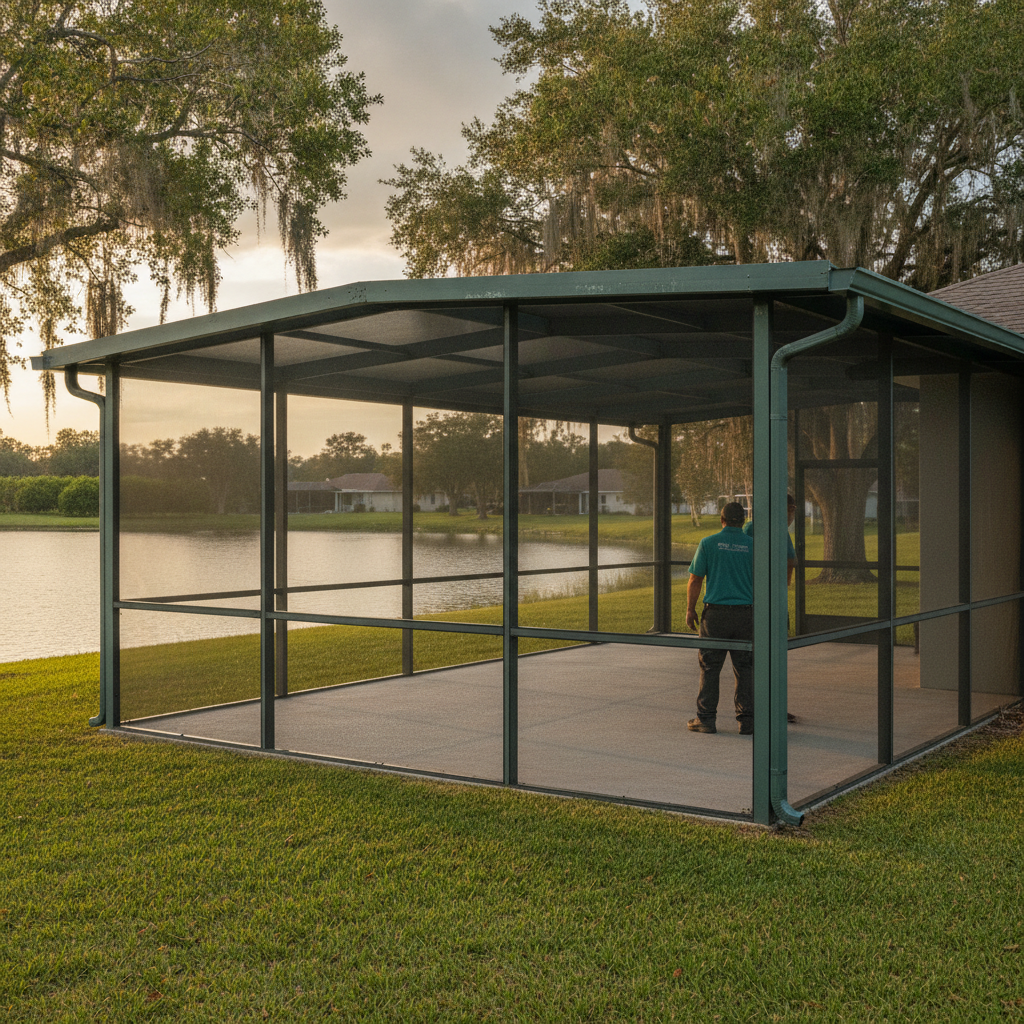
A west-facing slab on Lake Ariana takes afternoon wind and a light spray the oaks in Dixieland never throw at a patio. Screening that slab is a patio job. Wrapping the pool is a cage job, and on a tight lake lot those two are not interchangeable.
Patio screen versus a full cage on a Chain of Lakes lot
On most Auburndale lake lots, a patio screen is the right call when you already have a slab or a covered lanai and no pool to wrap. A full cage is the right call when the water you live around is in the backyard, not just in the lake.
Auburndale sits on the Chain of Lakes between Lakeland and Winter Haven. Lots run smaller than a rural Lake Wales Ridge parcel and tighter than a new Davenport tract with a builder-covered lanai left bare. Grass often ends a few steps from the water. A screen room that sits on the existing patio, or that screens in a roof already there, keeps the footprint honest. A pool cage has to clear the water, land posts on concrete that can hold an anchor, and still leave room for a gate that swings out.
That is a different animal from a Lakeland patio enclosure. Downtown and Dixieland work often starts with a thin pre-1960 patio slab poured without a perimeter footer. The crews we send spend real time asking whether that slab will take a post. Around Lake Mariana or Lake Arietta, the usual fight is width, not thickness. The house is closer to the water. Neighbors are closer still. A mansard that would look ordinary on a South Lakeland lot can eat the whole yard here.
| Job | What it actually covers | Why a lake lot cares |
|---|---|---|
| Patio screen or screened lanai | An existing slab or an already-covered porch, with screen walls and a roof that matches the opening | Fits a narrow backyard that ends at the lake, and it does not have to wrap water |
| Full pool cage | Posts, beams, and roof over the pool deck, with screen on every elevation | Needs a deck wide enough for posts and a door swing, which many Auburndale lots barely have |
Local companies advertise entry-level screen rooms near $1,499 plus permit, and that number is real for a small standard-size room. Screening in an existing covered lanai, or a basic screen enclosure over an existing slab with an aluminum mansard roof, commonly lands in the $1,500 to $3,500 range. Add an insulated roof panel, a longer clear span, or a new slab, and the same kind of room runs $6,000 to $14,000 because the beams get heavier and the roof stops being a simple mansard.
A new residential pool cage in the Lakeland area is a $9,000 to $18,000 job on a typical deck. Stretch it into a large deck, a two-story mansard tied into the house wall, or a high clear span, and it moves to $20,000 to $35,000. On a Chain of Lakes lot, the high-clear-span version is the one that starts to look oversized. The cheaper, better fit is often the patio screen, unless the pool is already there and you need it covered.
Winter Haven sits next door, and the same lakes feed both towns. If your lot is closer to Cypress Gardens than to downtown Auburndale, the Winter Haven screen enclosure picture is the closer cousin: high pool density, 1990s cages, and a rescreen conversation that starts before anyone talks about a new room. We cover Auburndale as its own lake town, not as a footnote on that page. The Auburndale outdoor living hub is the local starting point for that match.
A rigid-roof carport is a third structure. It is not a patio screen with a parking space glued on. Polk County’s published permit list treats carports as their own item, and the crews we send price and permit them that way.
Lake wind, spray, and 1990s cages now in the rescreen window
Screen on a lake lot fails from the water side first. Afternoon wind comes across open water with nothing to break it, and a fine spray rides that wind onto the west and south elevations. Mesh there goes brittle while the shaded north side still looks new.
That is the same sun pattern you see on a 1990s cage in Cypress Gardens, only the lake adds moisture to the UV. In Central Florida, screen lasts roughly seven to twelve years, and it fails unevenly. A cage built in the 1990s around Auburndale or Winter Haven has already been through more than one of those cycles. The frame can still be straight. The spline can still sit in the channel. The panels on the lake side are the ones that bag, chalk, and then pop a spline the first time wind gets under a loose run.
A full-cage rescreen commonly runs $1,400 to $3,200. Standard fiberglass, priced per square foot of screen, installs at about $2.50 to $4.00. Individual panels run $35 to $90 each, which is the right move when one lake-facing bay failed and the rest still has life. Screen sits in a channel held by a rubber spline, so a ground-level panel can come out and go back in without touching the frame. Anything that means climbing a two-story mansard, resetting an anchor, or changing door hardware on a pool enclosure belongs with a licensed crew.
The Atlantic hurricane season runs from June 1 to November 30. Inland Polk does not see storm surge or salt air. What it does see is wind across the lakes and summer storms that find every loose panel. A baggy west elevation in August is not a cosmetic complaint. It is the wind’s way in.
If the frame itself is chalking, that is a paint-and-prep conversation, not a mesh one. Chalking is the fine white powder that weathering leaves on a paint film, and it can look like fading. Wash, rinse, and let it dry before anyone talks about a recast. Painting a cage and restoring the frame is a $2,800 to $6,500 job in the ranges this site already publishes. Replacing the cage starts at $9,000 or more. On a small Auburndale lot, painting a sound 1990s frame is often the saner path, as long as the posts still land clean and the door still closes.
gnats and smaller flies show up around still water in warm months. Phifer’s No-See-Ums is a 20×20 mesh designed to keep out most smaller flying insects like no-see-ums, gnats, and sand flies. Standard Phifer Fiberglass 18x14 is built to withstand debris from harsh winds and storms, keep out most insects, and still let cooling breezes through. The 18x14 is the usual wall and roof cloth. The 20x20 is the lake-lot upgrade when the evening air is the problem, not the oak litter.
Pets change the lower panels. Phifer PetScreen is pet-resistant screening designed to be tear and puncture-resistant to resist damage by most dogs and cats, and the manufacturer calls it out for patio and porch enclosures. It is a wall product. Do not put a laminated wall cloth on a roof. Phifer Glas-Shield is an 18x14 fiberglass mesh that has been vinyl-laminated, and it is not intended for use as roofing material or in horizontal applications.
City permit versus unincorporated Polk next door
Screening that needs framing needs a permit in unincorporated Polk, and the house next door can sit in a city instead. That split is the friction on this side of the county.
Polk County’s Building Division FAQ names the work in plain language. Screening of any space which requires structural or infill framing to be added is on the list. All carports or similar structures with rigid roofs are on the list. In-ground pools are on the list, and so are above-ground pools and spas more than 24 inches deep. Patio covers are not separately named on that page. The honest line is that the county published screening-with-framing and rigid-roof carports, and a patio cover’s status is a question for the Building Division on the specific design.
Auburndale city limits and unincorporated Polk weave around the lakes. A crew that spends most of its week in unincorporated Polk can hit a different counter, a different portal, and a different inspection clock the moment the lot sits inside a city. The City of Lakeland is the documented version of that split: it runs its own Building Inspection division and publishes its own permit requirements. The same pattern is why the Lakeland versus Polk County building department distinction matters even when your address says Auburndale. Confirm which office covers the parcel before anyone draws the beam layout.
Florida law is blunt about who may contract the work. Florida Statutes 489.113 says a person must be certified or registered in order to engage in the business of contracting in this state. Several license classes lawfully build screen enclosures, pool cages, carports, and patio covers. Ask which class the contractor holds, and verify it yourself at myfloridalicense.com. The crews we send are licensed and insured. The brand matches you with those crews. It does not hold the license, pull the permit, or own the brake in the shop.
If the job is a pool enclosure, read the barrier rules as a checklist of hardware, not as a verdict on your cage. Section 515.29 asks a barrier to be at least 4 feet high on the outside, to have no gap, opening, or protrusion a young child could crawl under, squeeze through, or climb over, and to carry a gate that opens outward, is self-closing and self-latching, with the release on the pool side and out of a child’s reach. Whether a given cage does all of that is what the building official signs off on. The statute never names “screen enclosure” as a category.
Pay attention to the deposit clock before money changes hands. A contractor who takes more than 10 percent of the contract price up front on residential work must apply for the permits necessary to do that work within 30 days after the payment. That rule lives in Florida Statutes 489.126, and it is the consumer protection most lake-lot jobs actually turn on.
What does a patio enclosure cost on an Auburndale lot
A basic screen enclosure over an existing slab, or screening in an existing covered lanai, commonly runs $1,500 to $3,500. Local companies advertise entry-level screen rooms near $1,499 plus permit for a small standard-size room. Once you add an insulated roof panel, a longer clear span, or a new slab, the range moves to $6,000 to $14,000. A new pool cage is a different ticket: $9,000 to $18,000 in the Lakeland area, and $20,000 to $35,000 when the deck, the height, or the span grows. The number follows the roof, the span, and whether the posts have a slab that can hold them.
Do I need a permit to screen a patio in unincorporated Polk
Yes, when the screening needs structural or infill framing added. That is the line Polk County publishes. A rigid-roof carport needs a permit on that same list. A lot inside a city can sit under a different building official than the unincorporated parcel across the street, so the address, not the lake name, decides the office.
How does Florida treat a cage next to a pool
Florida lists several ways a residential pool may be made safe, including an enclosure that meets the barrier specifications in section 515.29. Those specifications are height, no climbable gap, and a self-closing, self-latching gate with the release on the pool side. A screened structure only satisfies that option if it independently meets those specifications. The building official reviewing the permit is the one who decides whether a particular cage does.
When to call us
Call when the lake-facing panels are baggy, when a 1990s cage needs a rescreen rather than another patch, or when you want a patio screened and the lot line, the slab, and the permit office are not obvious. The crews we send are licensed and insured, and they will tell you whether the job is a screen room, a cage, or a repair before anyone cuts a post. Call us at (863) 777-5379.