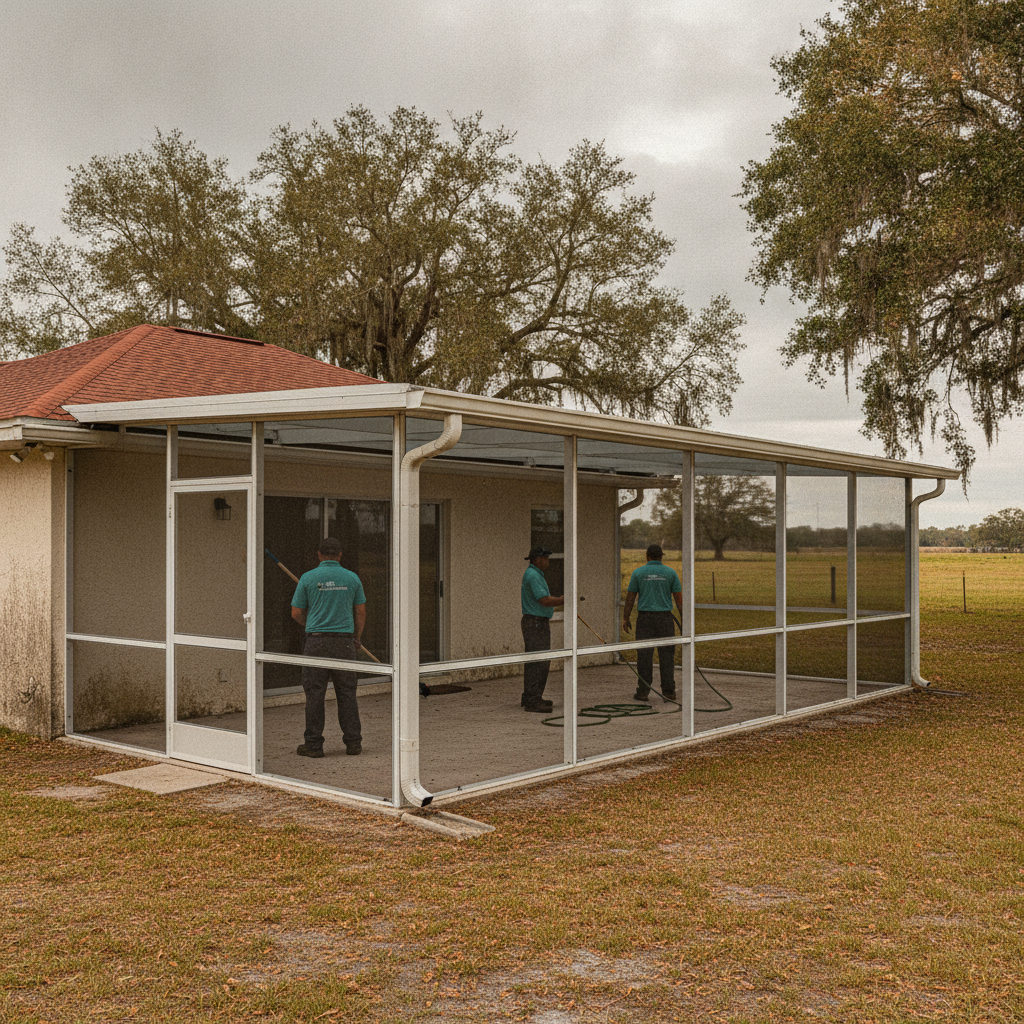
Outdoor living spaces in Bartow, FL usually start with the lot you already have. On a south Polk parcel the house may be a 1960s ranch, the patio may be a thin poured slab, and the back line may still run into pasture. The crews we send design the screen around that mix, then follow the permit path that runs through the county seat.
Older lots, agricultural parcels, and mixed vintage
Bartow outdoor living is mixed-vintage housing on lots laid out for a different backyard. A downtown street near the courthouse sits on a tight older lot. A few miles out toward Homeland, Fort Meade, or Mulberry, the same county opens into acreage, leftover citrus rows, and phosphate country. The enclosure has to fit the house and the parcel, which is why a Bartow outdoor living job reads the courthouse lot and the pasture lot as two different builds.
The aluminum uprights have to land on concrete thick enough to hold an anchor. On an older patio that edge is often the weak point. A slab poured decades ago for a grill and two chairs was poured as a patio, not as a beam. If the crew can’t get a clean bite at the perimeter, the work turns into a new footer or a new slab before any screen goes up. That is a cost driver, and it shows up on south Polk’s older stock more than on a new builder lanai along I-4.
Agricultural parcels add a second conversation. Setbacks, drainage swales, and easements come up before screen color does. A wide lot looks easy until the enclosure walks toward a utility strip or a septic field. Read the property first: where the slab actually ends, where water already runs in an August storm, and where the west sun hits the longest wall.
That west and south exposure is what ages the mesh. In Central Florida, screen generally lasts roughly seven to twelve years, and it fails unevenly. Sun kills the south and west elevations years before the shaded north side looks tired. On a Bartow cage that sits in open pasture light, lanai rescreening is often a panel-by-panel job on those hot walls. Individual screen panels typically run $35 to $90 each. A full-cage rescreen typically lands between $1,400 and $3,200. Standard fiberglass, priced per square foot of screen, is about $2.50 to $4.00 installed. Lanai rescreening in Polk County follows the same sun pattern. The west wall goes first.
Live oaks still drop catkins and leaf litter onto the roof and the gutter line. The Polk County zone forecast comes from the National Weather Service Tampa Bay Area office. Summer afternoons here build thunderstorms that fill a gutter in a hurry. The Atlantic hurricane season runs from June 1 to November 30. Inland wind is what the engineered drawing is written for. The building official assigns the design wind speed for your address, and the drawing in the permit package states the value the structure was designed to. Inland Polk carries a lower number than a Gulf-front county, which is why the same cage prices differently here.
Unpermitted work and the county-seat permit path
Screening that needs framing takes a permit in unincorporated Polk County, and Bartow is the county seat where that Building Division works. Polk County’s Building Division FAQ lists “Screening of any space, which requires structural or infill framing to be added.” The same list includes all carports or similar structures with rigid roofs. Patio covers are not separately named on that page, so a patio cover’s permit status is a question for the Building Division on the specific design.
Pull the parcel’s jurisdiction first. Unincorporated Polk County work goes through the Polk County Building Division, which sits in Bartow. A lot inside the City of Bartow can sit with a different office than a lot just outside the city line. The City of Lakeland publishes its own permit requirements through its own Building Inspection division, a different desk than the county’s. A crew that mostly pulls unincorporated Polk permits can hit friction inside a city limit. Ask which office signs the card for your address before the aluminum is cut.
South Polk has a long owner-builder streak, and a long unpermitted-enclosure streak to match. Polk County’s Owner-Builder Disclosure Statement is blunt: state law requires construction to be done by a licensed contractor, and the owner-builder permit is an exemption with restrictions. You, as the owner of the listed property, may act as your own contractor under that exemption even though you do not have a license. That is the county’s wording, and inspections still apply. If a prior owner already built the cage without a permit, the clean path is an after-the-fact permit in Polk County, which is a process conversation with the Building Division.
Florida law is also plain on who may contract for the work. Florida Statutes 489.113 states that a person must be certified or registered in order to engage in the business of contracting in this state. Several license classes lawfully build screen enclosures, pool cages, carports, and patio covers. Ask which class the contractor holds, then verify it yourself with the state’s Verify a License tool. The crews we send are licensed and insured.
If you pay more than 10 percent of the contract price up front on residential work, Florida Statutes 489.126 requires the contractor to apply for the permits necessary to do the work within 30 days after that payment. That clock is one of the more useful consumer protections on this kind of job. An owner-builder permit in Polk County is a different path than hiring a licensed contractor, and it is worth reading before you sign either way.
Patio screen versus a full cage in south Polk
Most Bartow yards choose a patio screen room or a full pool cage based on whether there is a pool and how far the existing slab can carry the frame. A screen room over an existing patio is the smaller outdoor living move. A cage covers water, deck, and the walk from the sliding door. A lot of lanais in Polk County started as a covered slab the builder left open, and screening that space is its own job.
Local companies advertise entry-level screen rooms near $1,499 plus permit, and that number is real for a small standard-size room. A basic screen enclosure over an existing slab, with an aluminum mansard roof, typically runs $1,500 to $3,500, and screening in an existing covered lanai sits in the same band. Once you add an insulated roof panel, a longer clear span, or a new slab, a screen room typically moves to $6,000 to $14,000. A longer clear span means heavier beams carrying the same roof, and heavier beams cost more per foot.
In the Lakeland area, a new residential pool cage typically lands between $9,000 and $18,000. A cage with a large deck, a two-story mansard tied into the house wall, or a high clear span typically runs $20,000 to $35,000. Those ranges move with height, span, and whether the deck already exists. The same comparison shows up in Lakeland patio enclosures, on tighter lots with a heavier oak canopy than a south Polk pasture lot.
If the house already has a pool, the door hardware becomes part of the conversation. Florida’s Residential Swimming Pool Safety Act, in section 515.29, asks a barrier to be at least 4 feet high on the outside, to have no gap, opening, or protrusion a young child could crawl under, squeeze through, or climb over, and to carry a gate that opens outward, self-closes, and self-latches, with the release on the pool side and out of a child’s reach. The statute does not name “screen enclosure” as a category. Whether a given cage does all of that is what the building official signs off on when the permit is reviewed.
| Option | What it does on a Bartow lot | What usually moves the job |
|---|---|---|
| Patio screen room | Screens a rear slab or a covered lanai so you can sit out of the bugs | Slab thickness at the edge, roof type, and clear span |
| Full pool cage | Covers the pool, the deck, and the walk from the house | Height, door hardware, and the engineered drawing |
| Lanai rescreen | Puts new mesh on a frame that is still sound | South and west UV damage, spline that has pulled, and panel count |
A glass sunroom in Polk County typically runs $22,000 to $45,000, and a conversion of an existing lanai in the Lakeland area typically runs $8,000 to $20,000. Those are enclosed rooms. If you want breeze and shade, stay with screen. If you want conditioned space, you are in a different product.
Replacing one spline-set screen panel at ground level is a homeowner job. Erecting or modifying the aluminum frame, setting anchors into a slab, or changing pool-gate hardware belongs to a licensed contractor.
Do outdoor living spaces in Bartow need a building permit?
In unincorporated Polk County, screening of any space that needs structural or infill framing to be added is on the county’s published permit list, along with rigid-roof carports. Confirm the office that has jurisdiction for a City of Bartow parcel. The permit package is where the engineered drawing states the wind design for that address.
Does a screened pool cage handle Florida’s pool barrier rules?
The statute asks a barrier to be at least 4 feet high on the outside, to have no climbable gap, and to use a self-closing, self-latching gate with the release on the pool side. A screened structure belongs in that conversation only when it independently meets those specifications. The building official reviewing the permit makes that determination.
What does lanai rescreening in Bartow usually cost?
A full-cage rescreen typically runs $1,400 to $3,200. Individual panels typically run $35 to $90 each, and standard fiberglass is about $2.50 to $4.00 per square foot of screen installed. The south and west walls go first because that is where the sun sits.
When to call us
Call when the slab, the frame, or the permit path needs a licensed contractor: a new screen room, a pool cage, a rescreen of a whole elevation, or an enclosure you inherited without paperwork. We match Bartow and south Polk homeowners with licensed local crews and get a crew out to look at the lot. Call us at (863) 777-5379.