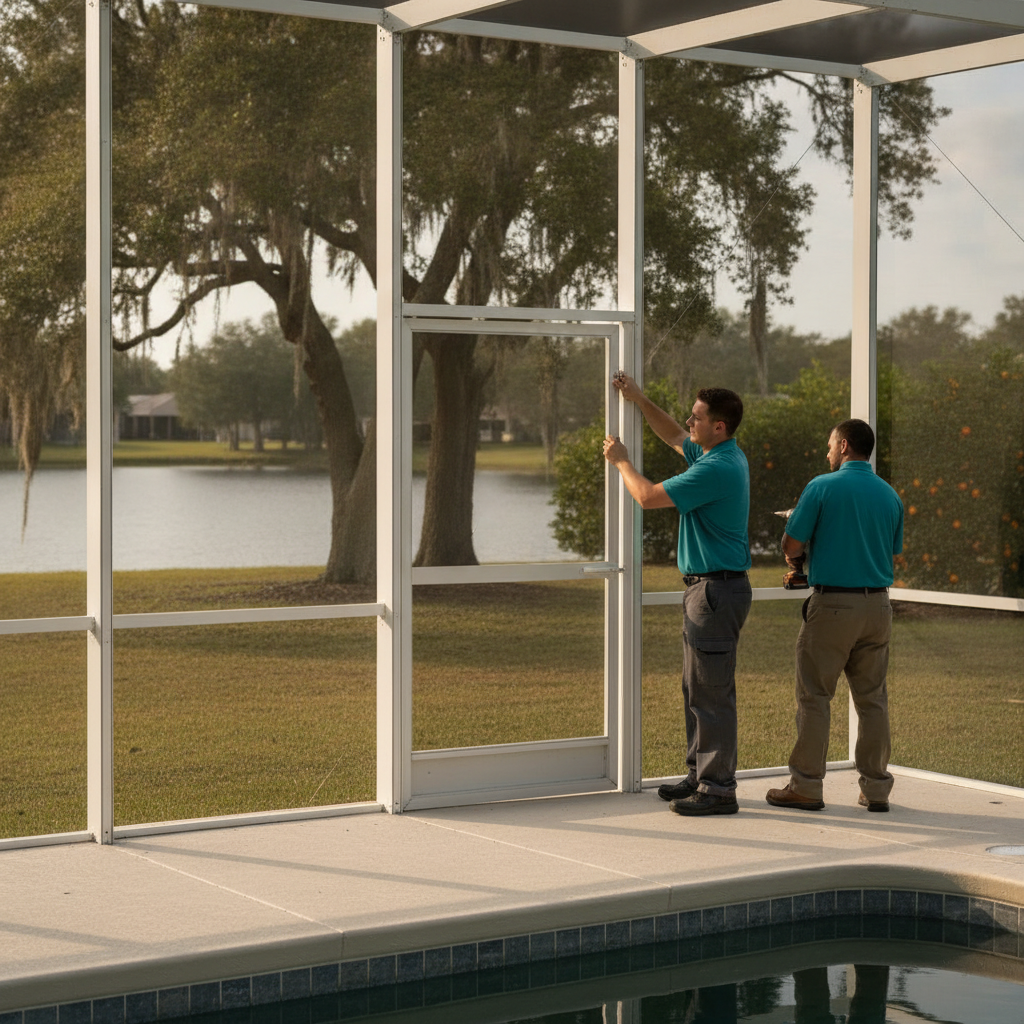
The door on a 1990s cage in Cypress Gardens that no longer clicks shut isn’t a screen problem. It’s the gate a child would actually use, and Florida’s pool statute talks about that gate, not about the mesh. If the framed opening is still square, the crews we send replace the leaf, the closer, and the latch as a door job. If the opening is racked, a new door won’t fix it.
Why the door is a safety device, not just a screen
The moving leaf is where Florida’s Residential Swimming Pool Safety Act does most of its talking. Section 515.27 lists the ways a residential pool may be made safe. One of those ways is an enclosure that meets the barrier rules in section 515.29. Neither section names “screen enclosure” or “pool cage” as a category. A screened structure only satisfies that option if it independently meets the specifications, and whether a particular cage does is a determination for the building official reviewing the permit.
What the statute asks is concrete. The barrier must be at least 4 feet high on the outside. It may not have gaps, openings, indentations, protrusions, or structural components a young child could crawl under, squeeze through, or climb over. Gates that provide access to swimming pools must open outward away from the pool, be self-closing, and carry a self-latching locking device. The release has to sit on the pool side, placed so a young child can’t reach it over the top or through any opening or gap.
That’s why a baggy wall panel and a dead door are different jobs. Mesh that’s gone brittle on the south and west elevations of a Winter Haven cage is a rescreen problem. A door that stands open after someone walks through with a towel is a gate problem. The wall doesn’t have to close itself. The door does.
A pool cage around the Chain of Lakes gets used like a room. Kids, dogs, guests, short-term rentals along I-4 in Davenport and Four Corners. The leaf takes that traffic every day. The closer fatigues. The latch stops catching. The kickplate loosens and leaves a strip of daylight at the sill. Those are the failures that turn a screened structure into an opening a small child can use.
A screen room door on a Lakeland lanai with no pool behind it is mostly a bug door. Same aluminum, same spline, same powder coat. Different job, because that leaf isn’t sitting on a pool.
Closer, latch, and kickplate
Three pieces decide whether the leaf behaves like a gate: the closer, the latch, and the kickplate. Mesh in the door is a fourth, and it’s the only one a homeowner can honestly swap at ground level with a spline roller.
The closer pulls the door shut after a hand leaves it. When it dies, the door drifts. On a still morning in Lake Wales that looks like a nuisance. During a summer thunderstorm, or with kids running in and out of a Haines City rental, it’s a gate that doesn’t gate. The crews we send set the closer so the latch actually catches, not so the door slams the jamb and racks the hinges.
The latch is the self-latching piece the statute describes. The release belongs on the pool side, out of a child’s reach from outside. A thumb-turn a toddler can work from the yard, or a catch that no longer lines up because the leaf has sagged, is the difference between a door that secures and a door that pretends to. Matching the powder coat to the cage is the easy part. Getting the strike lined up so the latch throws every time is the work.
The kickplate is the solid lower panel. Feet, pool toys, coolers, and dogs hit that zone first. It keeps the mesh from taking the punch, and it fills the bottom of the opening so there isn’t a crawl space under the screen. A kickplate that’s pulled off the rail leaves the kind of gap the statute is written to stop. Replacing the whole door is the cleaner job when the bottom rail is bent.
Screen in the door sits in a channel, held by a rubber spline. A torn door panel can be swapped on its own. Individual screen panels run $35 to $90 each. Pet-resistant mesh is built for dogs that lean on the door. A pet flap cut through the leaf is a gap, and the gap rule is why that opening belongs in a conversation with the building official, not a weekend add-on.
A rehang, a rebuild with new hardware, or a full replacement runs $180 to $500. That range is the door job: the leaf, the closer, the latch, hanging it in an opening that’s still true. It isn’t a new cage, and it isn’t a full-cage rescreen. Hurricane season runs from June 1 to November 30. A door that won’t latch is a sail, and wind under a loose leaf is how a hardware failure becomes a racked jamb.
When a door swap is enough and when the opening is racked
A new door only works if the hole it hangs in is still a rectangle. Look at the gap along the latch side, from head to sill. An even reveal means the uprights are still plumb. A wedge means the opening has racked. Measure the two diagonals. If they don’t match, a square door will bind on one corner and leave a triangular gap on the other. That gap is exactly what the barrier language is about.
Racking shows up on older Lakeland stock more than on a new I-4 subdivision cage. Pre-1960 bungalows in Dixieland and around Lake Morton often sit on thin rear patio slabs poured without a perimeter footer. Anchors in thin concrete creep. An upright that has to hold a swinging door feels that creep first. After a storm, a two-story mansard that took a hit can be just out of plumb, and the door is the tell.
When the opening is square, screen door replacement is the job. New leaf, hinge, closer, latch, kickplate, screen, matched finish. The old door comes out. The new one hangs in the same framed opening.
When the opening is racked, the door is the symptom. Truing the jamb or rebuilding the opening is frame work. Unincorporated Polk County’s Building Division lists screening that requires structural or infill framing as work that needs a permit. The City of Lakeland Building Inspection list says the same. A like-for-like leaf in an existing opening is a different question than cutting a new opening between uprights. Ask the building official on the specific design.
A pair of leaves with no center post shows up on Winter Haven cages so furniture can pass. Both leaves need closers and latches, and the inactive one has to lock at the head and the sill so the meeting line isn’t a gap.
If the south elevation is already brittle, and the door is the third panel that’s failed this year, stop thinking in doors. Central Florida screen lasts roughly seven to twelve years, and it fails unevenly because the sun kills mesh on the south and west years before the shaded north side. A new door on a cage that’s due for a rescreen is a short-term patch.
Florida law says a person must be certified or registered to engage in the business of contracting in this state. Several license classes lawfully repair aluminum structures. Ask which class the contractor holds and verify it yourself at myfloridalicense.com. Replacing spline-set screen in the leaf at ground level is a homeowner job. Changing the closer, the latch, or the way the gate swings is not.
The closer body, the strike, and the pool-side release are covered in our guide to pool cage door hardware and the barrier rules. This page is the replacement decision: new leaf, or new opening.
Common questions
Can you just replace a screen door on a pool cage?
Yes, when the framed opening is still square and the uprights haven’t drifted. A new leaf with a closer, a latch, and a kickplate in a true opening is the usual job, and it’s the one that sits in the $180 to $500 range. A retractable cassette door is a patio product, not how a pool cage door is built. Pool cage doors are hinged aluminum leaves with spline-set mesh. If the reveal along the latch is a wedge, a new door will bind or leave a crawl gap, and the opening has to be trued first.
How much does a replacement screen door cost?
A rehang, a rebuild with new hardware, or a full replacement runs $180 to $500. That figure is the door, not the cage. A torn mesh panel in the leaf is priced with individual screen panels at $35 to $90 each. Widening an opening, truing a racked frame, or hanging a pair of leaves is outside that door range because the frame is now part of the job.
How do you replace a pool screen enclosure if the door is only the start?
You don’t replace the whole enclosure because the door failed. The door is a leaf in an opening. If the rest of the cage is sound, swap the door. If the mesh is at the end of its life and the frame is out of plumb, that’s rescreening or a larger enclosure conversation. The door still has to close, latch, and sit in a square hole either way.
When to call us
Call when the pool-side door won’t self-close, won’t latch, or shows a wedge-shaped gap along the strike. That’s licensed contractor work, not a spline-roller afternoon, because the closer and the latch are barrier hardware. We match Polk County homeowners with licensed local crews who hang the leaf, set the hardware, and say when the opening itself is the problem.
Call us at (863) 777-5379.