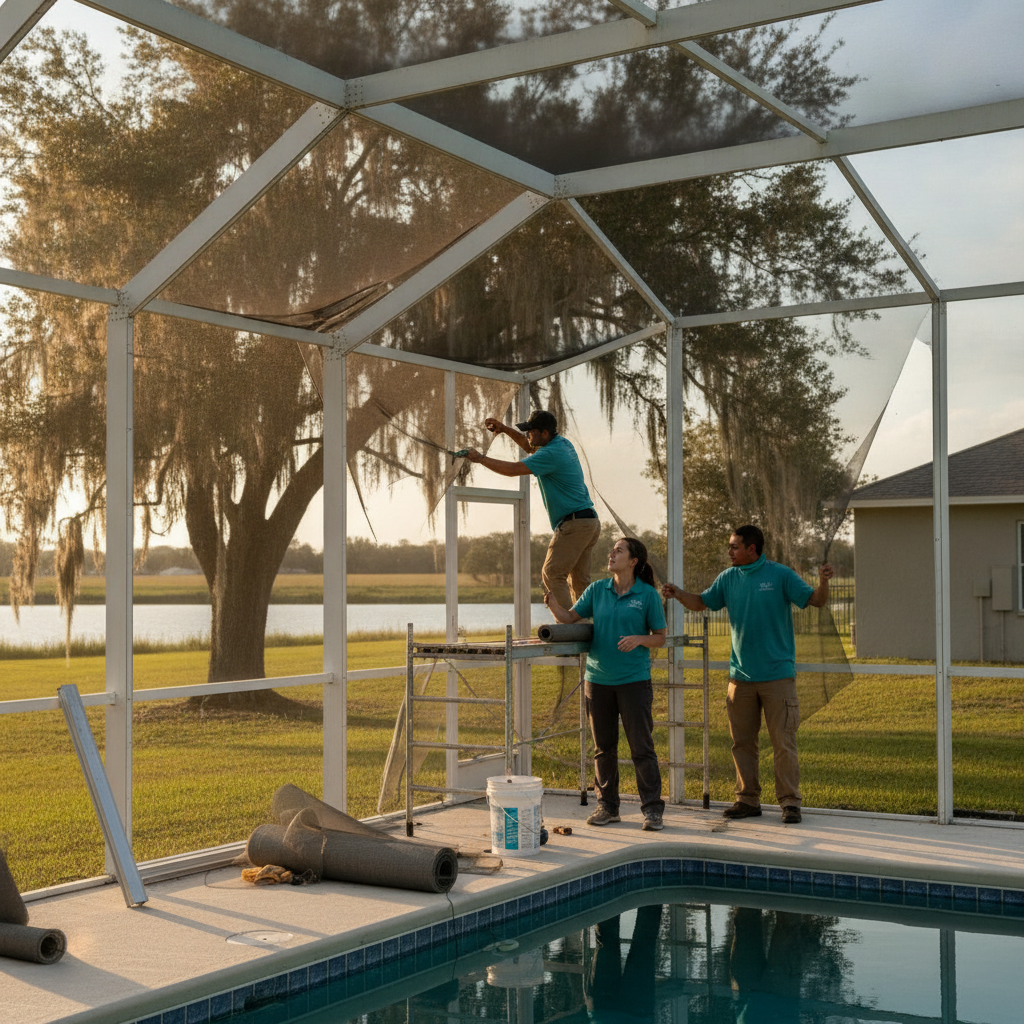
A 1990s cage in Cypress Gardens usually fails in a pattern. Mesh on the south and west walls goes chalky and brittle first. The shaded north side still looks almost new. If the aluminum is still plumb and the posts still sit tight in the deck, that is a rescreen. If a corner has walked, a beam has a kink, or the cage racks when you put a hand on a post, new screen is money on a frame that is already finished.
Screen-only vs a frame that is done
Rescreen when the mesh is the problem and the frame is still doing its job. Replace the cage when the aluminum, the fasteners, or the anchors have given up.
Screen sits in a channel. A rubber spline holds it there. A crew can pull that spline, lift the old mesh, and set new mesh panel by panel without touching the posts. That is why a few torn panels around a Winter Haven pool can be a small job, and why a full pool cage rescreening is still a mesh job, not a new building. Individual panels typically run $35 to $90 each. A full-cage rescreen is published in the $1,400 to $3,200 range. Standard fiberglass, priced by the square foot of screen, is about $2.50 to $4.00 installed.
A new pool cage is a different animal. Posts come out. Beams come out. Anchors come out of the deck. New aluminum is cut, assembled, and tied to the house wall, then screened. A new residential pool cage in the Lakeland area is published at $9,000 to $18,000. A cage with a large deck, a two-story mansard tied into the house wall, or a high clear span runs $20,000 to $35,000. Against painting, replacement is described as $9,000 or more. Those are the ranges already on this site, each for that job, not a number to stretch onto a neighbor’s yard.
Central Florida screen lasts roughly seven to twelve years, and it fails unevenly. Sun kills mesh on the south and west elevations years before the shaded north side. That is the Cypress Gardens tell, and it is also the tell on west-facing cages along US-98 in South Lakeland. If the south wall is crispy and the north wall is still flexible, the frame may still be fine. You are looking at a rescreen, maybe with a heavier mesh on the dog-traffic wall and a finer 20x20 on the lake side if no-see-ums have been coming through. Phifer No-See-Ums is a 20×20 mesh designed to keep out most smaller flying insects like no-see-ums, gnats, and sand flies. Pet-resistant screening is a wall and door product for cats and dogs that lean. Vinyl-laminated privacy mesh belongs on walls and kick panels. It is not a roof product.
The frame tells a different story. Walk the cage. A post that rocks in the deck has lost its bite. A beam with a crease from a fallen live-oak limb is done in that bay. Fasteners that have walked out of the extrusion, or left rust streaks down a white post, mean the connections are tired. A cage that you can rack by leaning on a corner is no longer a screen problem. New mesh will only make a failing frame look newer until the next summer storm.
Chalking on the aluminum is its own conversation. It is the fine white powder that weathering leaves on a paint film, and it can look like the color is fading. A frame that is chalked but still true may want stripping, priming, and paint rather than a teardown. Finish life after a properly stripped and primed repaint is generally eight to fifteen years here. That path lives next to this one, on painting versus replacing. Do not let a chalky post talk you into a new cage if the posts are still standing where they were set.
One more local mix-up. A builder-covered lanai in a Davenport or Four Corners subdivision, sitting bare because screening was a separate line item, is not a pool cage. That is a screen room on an existing cover. The quote, the permit, and the anchors are different from a cage over water.
| Decision | Rescreen the mesh | Replace the cage |
|---|---|---|
| What changes | Mesh and spline in the existing channels | Posts, beams, anchors, roof members, and new mesh |
| What stays | The standing aluminum, if it is still true | The pool and the deck, if the deck can still take anchors |
| The usual tell | Brittle, faded, or torn mesh on a plumb frame | Racked corners, pulled anchors, bent beams, posts that rock |
| How the money moves | Square footage of screen, height, and mesh type | Span, height, roof shape, deck work, and the design for that address |
A few torn panels with the rest still flexible is a panel job. Sagging, unraveling, or UV-brittle mesh in more than a couple of bays is a full rescreen, because the remaining original panels are on the same clock. Storm-torn roof panels on a cage whose posts still ring solid when you tap them are still a rescreen. A cage that leaned, a beam that folded, or anchors that pulled out of a thin pour is a replacement.
What each quote should include
A rescreen quote prices mesh, spline, and the labor to pull and reset the panels. A replacement quote prices a designed, permitted cage. If those two packets look the same on paper, one of them is incomplete.
A rescreen line should name the mesh, the elevations getting it, and whether the roof is included. It should say what happens to the doors. Rehanging, rebuilding with new hardware, or replacing a screen door is its own published band, $180 to $500, and a sticky closer on a Winter Haven cage is often the first thing a homeowner notices after the mesh. It should say whether loose screws get reset as the panels come off. Height matters in the labor. A one-story cage in Highland City is ladder work. A two-story mansard off a new I-4 house is walk-board and staging work, and that shows up in the number even when the mesh is the same.
A replacement line should name the design, the roof style, how the cage ties to the house, and who pulls the permit. Florida law is plain on the licensing side. A person must be certified or registered in order to engage in the business of contracting in this state. Several licence classes can lawfully build aluminum structures, so the useful move is to ask which class the contractor holds and verify the licence yourself. The crews we send are licensed and insured. Confirm the name on the quote against the name on the licence.
Permits split by address inside this county. Unincorporated Polk goes through the Polk County Building Division, which lists screening of any space that requires structural or infill framing to be added. Inside the city, Lakeland Building Inspection publishes its own list, and screening of any space that requires structural or infill framing is on it, along with porches and carports. A crew that mostly works unincorporated lots can hit friction inside city limits. Ask which office has the lot before anyone prices the job. A new cage is designed to the wind the code assigns to that address, so the packet should include engineered drawings. A pure mesh swap in existing channels is a different conversation with the same office. Do not guess which box your job falls in. The building official does.
Deposits have a clock. A contractor who takes more than 10 percent of the contract price up front on residential work must apply for the permits necessary to do the work within 30 days after that payment. That is Florida Statutes 489.126, and it is the consumer-protection fact that matters on a replacement contract. Read the deposit against that duty before money moves.
Door hardware belongs in both quotes, for a reason that is about a child, not about looks. Florida’s Residential Swimming Pool Safety Act asks a barrier to be at least 4 feet high on the outside, to have no gap a young child could crawl under, squeeze through, or climb, and to carry a gate that opens out, self-closes, and self-latches, with the release on the pool side and out of a child’s reach. Whether a given cage does all of that is what the building official signs off on. A rescreen that leaves a broken closer in place, or a new cage whose gate hardware is an afterthought, has skipped the part of the job a parent actually lives with. The hardware details are spelled out with the statute.
Insurance is a declarations-page question, not a guess from the street. Coverage for screened enclosures and aluminum-framed carports damaged in a hurricane commonly rides on an endorsement rather than the base policy. Some carriers also tuck pool cages and awnings into that same endorsement. Read your own page. Photograph the cage before anyone pulls a spline if a storm is the reason you are quoting. The storm-damage insurance walkthrough is the longer version of that conversation.
Wind load and a new cage
A new cage is designed to the wind speed the code assigns to that specific address. A rescreen puts new mesh on the old design. That is the whole split, and it is why two houses on the same Winter Haven chain can get very different replacement numbers.
The Florida Building Code assigns an ultimate design wind speed to the lot. The engineered drawing in the permit package states the value the structure was designed to. Inland Polk carries a lower number than a Gulf-front county does, which is why the same cage prices differently here. No page on this site should pretend to know the mph for your street. The drawing knows. The building official knows. Ask to see that value on a replacement quote.
Polk County has no coastal mean high water line, so the first test in the wind-borne debris region definition cannot apply here. The second test, the higher-speed threshold, is the one in play. That is a map-and-code fact, not a reason to talk about salt air or storm surge. This county is inland. The real loads are hurricane wind, daily summer thunderstorms, and the live-oak debris that rides those storms into a cage roof off Lake Morton.
The Atlantic hurricane season runs from June 1 to November 30. A cage that made it through last season with baggy roof panels and a spline already creeping out of the channel is telling you the mesh is done. A cage that shifted on its anchors, or that took a limb through a beam, is telling you the frame is done. New screen will not straighten a racked bay. New aluminum will not be cheaper because you waited until September. The wind-load explainer for Polk screen enclosures is the place to sit with the design side of a replacement.
Anchors are the quiet half of a replacement on older lots. South Lakeland and Dixieland still have patio slabs poured thin, without a perimeter footer, and those slabs are a poor place to hide a new post. A pool deck is usually a better pour, but it is not automatically thick enough at the edge where a crew wants to land a corner. If the deck has spalled, or if an old post was set in a shallow pad that has cracked out, the replacement quote should say what happens at the slab. Leaving that as a field decision is how a number moves after the old cage is already down.
HOA review shows up on the I-4 corridor more than it does on a Bartow acreage lot. A new cage elevation, a roof style, or a bronze versus white frame can sit in architectural review while the mesh on the old cage keeps tearing. A rescreen in the same color and the same openings usually has less of that delay. Ask the association before you pay a deposit on a shape they have not seen.
Common questions
How much does it cost to rescreen a pool cage in Florida?
A full-cage rescreen on this site is published at $1,400 to $3,200, with standard fiberglass around $2.50 to $4.00 per square foot of screen installed. A handful of panels is $35 to $90 each. Height, roof shape, access, and a shift into pet-resistant or 20x20 mesh all move a given job inside or above that band. The Polk County rescreening cost page keeps the ranges with their scope.
How much does it cost to replace a pool screen enclosure in the Lakeland area?
A new residential pool cage is published at $9,000 to $18,000. A large deck, a two-story mansard tied into the house wall, or a high clear span is $20,000 to $35,000. Replacement as the comparison against painting is $9,000 or more. Span, height, roof, deck work, and the wind design for the address are what move the number. New-cage cost in Lakeland is the companion page for that quote.
How long does pool cage screen last in Central Florida?
Screen here generally lasts roughly seven to twelve years, and it fails unevenly. South and west elevations take the sun first. North elevations lag. A 1990s cage around the Chain of Lakes is often in that window now, even if one wall still looks serviceable. The frame is on a longer clock, which is why a rescreen can be the right call two or three times before the aluminum is actually done.
Are pool screen enclosures covered by insurance?
Hurricane damage to screened enclosures and aluminum-framed carports commonly comes through an endorsement, not the base policy. Some companies also include pool cages and awnings on that same endorsement. Carriers differ. The answer is on your declarations page. There is no typical payout figure on this site, and a rescreen versus replace decision after a storm still starts with whether the frame is true.
When to call us
Call when the mesh is torn across more than a couple of bays, when a post moves in the deck, or when you want a licensed crew to say which job you actually have before hurricane season gets another vote. Frame work, anchors, two-story mansards, and pool-gate hardware are licensed contractor work. The crews we send rescreen standing cages and build new ones across Lakeland, Winter Haven, Bartow, and the rest of Polk County. Call us at (863) 777-5379.