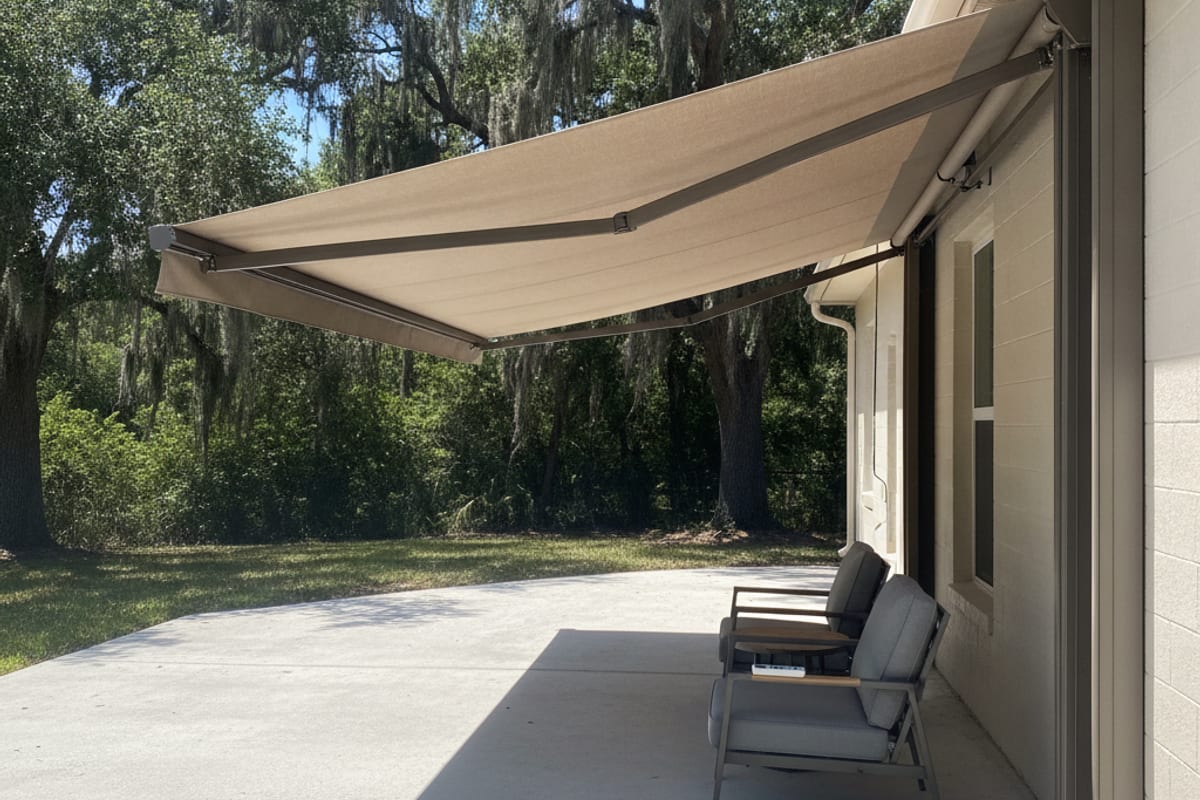
This site does not publish a verified dollar band for retractable patio awnings. Motorized units cost more than manual ones because of the motor, the controls, and the heavier hardware. For a homeowner who actually sits under the thing on summer afternoons, that convenience often earns the premium. A manual retractable makes sense if your patio is small enough that you’re close to the crank or if you don’t mind the extra step. The real decision isn’t whether retractable is worth it, it’s whether motorization justifies its cost in your actual life.
Polk County heat turns west and southwest-facing patios into unusable radiators from about 2 PM onward for half the year. An awning isn’t a luxury in that context, it’s the difference between sitting outside and giving up. A retractable awning gives you control, unlike a fixed cover that’s always there whether the weather calls for shade or the sun has already moved past your patio.
What a retractable patio awning actually costs
There is no standing retractable-awning range on this site. Get the number from an on-site measure. A typical residential quote still has to name the span, the fabric, and whether a motor is included.
A small motorized awning (8 to 10 feet wide) is a different product from a large motorized system over a sprawling deck (20 feet or wider). The math is straightforward: deeper spans need heavier material, stronger motors, and more structural engineering, so every foot of depth costs noticeably more than every foot of width.
Manual retractable awnings cost less than motorized ones. You pull a handle or crank to extend the arms and unfold the fabric, then crank back to pack it away when the weather turns or you don’t need the shade anymore. Manual systems are mechanically simpler, which keeps the cost down. They’re also simpler to maintain, since there’s no motor or wiring to service. If you’re going to use the awning only a few times a week on clear days, manual retractable makes honest financial sense.
The fabric itself ranges in price depending on material grade. Basic acrylic is the economy choice on a motorized retractable system. Solution-dyed marine-grade fabric costs more for the complete motorized installation, but it resists UV fade and mildew better and lasts noticeably longer in Central Florida humidity. For a patio that gets afternoon use four to six months a year, acrylic is economical math. For a year-round or heavy-use space, the premium fabric pays back in longevity.
Motorized versus manual, and what you actually get
Motorization costs extra on top of a manual retractable base. That buys you a motor that extends and retracts on the push of a button or a wall-mounted switch, sometimes even on a smartphone app if you go high-end. No cranking. No thinking about whether you’re close enough to the handle. No second trip outside if you forgot something. If you actually use the patio in the afternoon, motorization changes the equation. You extend it in the morning, retract it when the wind picks up or a storm approaches, and never think about it again.
Manual retractable makes sense only if you’re truly committed to cranking it regularly. A motorized system that sits in the closed position most of the time because nobody wants to walk to the crank is a waste of the motorization premium. Be honest about your patio habits before you decide. If you’re the type to say “I should open the awning” but then just stay inside instead, manual is cheaper honesty.
Frame material is almost always aluminum on retractable systems. It’s lightweight, which keeps the motor load reasonable and installation simpler. Stainless steel costs more and resists salt corrosion better, but Polk County is inland far enough that salt spray isn’t a real concern. Aluminum with a powder coat finish holds up fine to the humidity and sun exposure here. Make sure your quote specifies powder coat, not paint. Paint fails faster in this climate.
Installation and positioning on your patio
Installation takes one to two days on a standard residential patio. The frame anchors to your house fascia using lag bolts or a bolted ledger connection, and the arms extend out over the patio space when opened. The whole system has to be properly sealed where it meets the house so water doesn’t run behind the fascia or into the wall. Same principle as a patio cover.
The biggest installation consideration is positioning. A west-facing patio or deck gets the hottest afternoon sun and benefits most from an awning. East-facing patios get morning sun but cool off by afternoon, so an awning is nice but less critical. North-facing patios often stay shaded naturally and may not need an awning at all unless you want the design element.
Wind exposure matters too. If your patio sits on a hill or in an open area, the awning gets more wind load during storms. The frame and motor have to be sized accordingly, which costs more. A patio tucked into a sheltered yard with windbreaks costs less to awning properly. Your installer will assess the site and specify the right frame weight and motor capacity for your location.
Maintenance and seasonal operation
A retractable awning requires less maintenance than a fixed cover or a pool cage because it gets put away seasonally. Most Polk County owners close up their awning by June and leave it closed through September, when hurricane season and afternoon thunderstorms make an extended awning a liability. That seasonal closure means the fabric doesn’t weather as hard as something sitting out year-round.
What maintenance it does need is simple. Rinse the fabric once or twice a year with a soft brush and mild soap to clear the pollen and dust buildup that accumulates here. The underside collects more debris than the top, so focus there. A motorized awning occasionally needs service on the motor or spring tension, but it’s rare and not expensive if it happens. A control that stops responding is often just a corroded connection rather than a dead motor. Make sure your installer seals where the control wire enters the housing.
When a retractable awning makes sense for you
A west-facing patio in Polk County is genuinely unusable on a hot sunny afternoon without shade. The concrete holds heat. Furniture radiates it back at you. Anything living under a clear sky and the direct sun after 2 PM is in pain by 4 PM. A retractable awning is what turns that space into somewhere you actually sit.
A motorized retractable awning makes sense if you’ll use that extended and retracted flexibility regularly. If you’re opening it in late April and closing it in early June, then opening again in September through November, motorization pays for itself in convenience. If you’re only extending it a couple times a season, manual is fine.
A manual retractable is the honest choice if your patio is small and close to your house, or if you don’t mind the extra step. It’s cheaper and mechanically simpler. But if you’re far from the control, or if you use the patio often, motorization buys peace of mind that’s worth the cost.
Consider also whether you want full coverage or just a section of your patio shaded. A small motorized awning over a lounge area costs less than one over your entire deck. Some homeowners use two smaller awnings instead of one large one, spreading the cost and getting more directional control.
Retractable awning versus fixed cover versus screen
A fixed patio cover (aluminum frame with a solid roof panel) costs $3,500 to $9,000 or more and provides permanent overhead protection from sun and rain. It doesn’t retract, it doesn’t need fabric maintenance, and it lasts for years with minimal care. The trade-off is it’s always there. You can’t pull it away if you want full sun or if a storm approaches.
A retractable awning gives you control but requires annual fabric care and occasional motor service. It sits in a middle ground for both cost and capability, and the number still has to come from a measure.
A screen room costs $6,000 to $14,000 when the roof and enclosure are built together, and it gives you weather protection plus the ability to sit outside during rain without getting wet, and it works year-round. It’s the most capable option and the most expensive of these three.
For seasonal afternoon shade on a patio you use April through November, a retractable awning is the answer. For year-round outdoor living or rainy-day use, a screen room or fixed cover is the better move.
Frequently asked questions
How much does a motorized retractable patio awning cost in Polk County?
This site does not publish a verified retractable-awning dollar band. Size of the span, frame material, and motorization drive the price most. Manual retractable costs less than motorized. Get the number from an on-site measure.
Is motorization worth the cost?
Yes, if you’ll actually use the extended and retracted flexibility. The convenience of opening and closing with a button instead of cranking a handle saves effort and time on a patio you use regularly. On a patio you use occasionally, manual is fine.
Do I need a permit for a retractable patio awning in Polk County?
Ask the issuing jurisdiction. Polk County’s published permit-not-required list does not name awnings. Unincorporated questions go to the Bartow Building Division at (863) 534-6080. Ask for a plans examiner. That is the county’s published line, not ours. Cities run their own departments.
How long does retractable awning fabric last?
Acrylic fabric typically lasts five to eight years before fading noticeably. Solution-dyed marine-grade fabric lasts longer. Retractable awnings wear slower than fixed covers because they’re closed seasonally. Regular cleaning extends fabric life.
Can I leave a retractable awning extended during a storm?
No. You should retract it before heavy wind or a thunderstorm. A motorized system lets you do that quickly from inside. A manual system requires you to go outside to crank it closed, which is why motorization is valuable in Florida’s storm-heavy climate.
Will a retractable awning work on a covered patio or lanai?
Only if the existing roof has gaps or you want to awning the sides. Most people install an awning on an open deck or patio. If you already have a solid overhead cover, an awning doesn’t add shade value.
If you need a quote on a retractable patio awning for your specific patio or deck, call (863) 777-5379. The on-site measure is free.