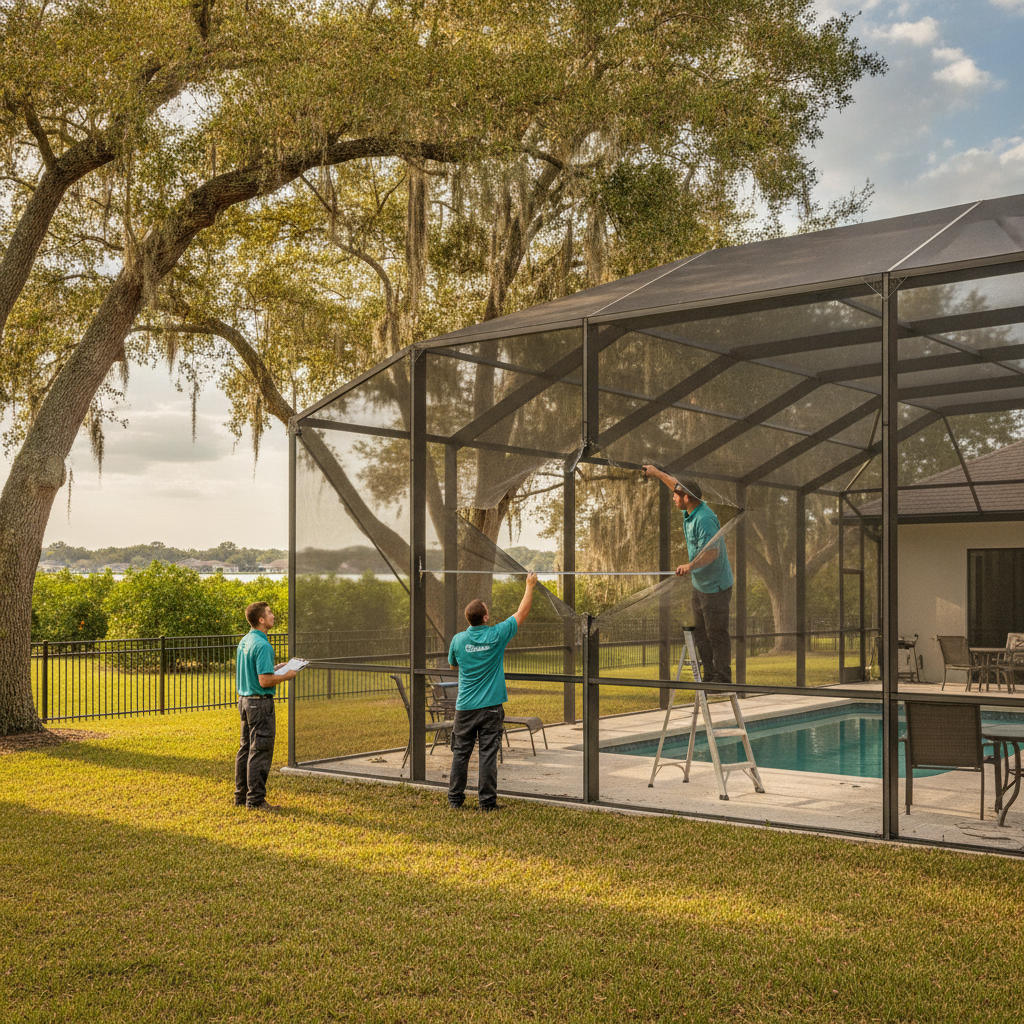
A torn west-elevation panel on a South Lakeland cage is a different job than a full rescreen on a two-story mansard near Lake Morton. Individual screen panels typically run $35 to $90 each. A full-cage rescreen in this market sits at $1,400 to $3,200. What you pay follows how much mesh is actually failing, how high the work sits, and whether the aluminum is still sound.
That is the Lakeland answer in one pass. The rest of this page is what moves the number, and which way.
What a Lakeland repair quote is actually pricing
A repair quote is pricing the opening, the access, the mesh, the spline, and any hardware that has to come off to get the panel in. It is not a mystery tax on the word repair.
The crew that shows up in Lakeland is looking at the same things you can see from the patio, plus a few you cannot. Panel size is the first one. A kick-plate opening at the bottom of a Dixieland cage is a short, stiff rectangle. A roof panel on a mansard is a long, sloped sheet that has to be stretched, splined, and trimmed while someone is standing above the water. Same trade. Different labor.
Wall versus roof is the next split. Wall work is usually a ladder and a roll of mesh. Roof work is walking the frame, keeping tension even, and not putting a knee through the next bay. That extra handling is why two openings that look similar from the pool deck do not price the same.
Spline and channel condition sit under the mesh. Screen is held in a groove by a rubber spline. When the groove is clean and the spline is still round, a panel swap is a short visit. When the channel is packed with oak grit from the Lake Morton canopy, or the old spline has cooked into a hard bead, the crew is picking and cleaning before a new panel will seat. That time is in the quote even if you only counted one hole.
Hardware is its own line when the door is involved. Rehanging, rebuilding with new hardware, or replacing a screen door typically runs $180 to $500. A door is not a wall panel with a handle. It has a closer, a latch, a sweep, and a swing that has to clear the slab.
If you want the county-wide picture of how those same pieces add up outside city limits, the Polk County screen repair cost breakdown walks the same drivers without the Lakeland street-level detail. For the decision of whether this is a patch or a bigger job, start with pool screen repair in Lakeland. This page stays on what the invoice is actually buying.
A written quote should name the mesh, the openings, the height, and anything that is not screen. If those four things are missing, you are comparing two different jobs.
One panel, a wall, or a full rescreen
One isolated tear is a panel job. A whole south wall going papery at once is a wall job. Mesh that cracks in your fingers on every elevation is a rescreen. Those three scopes are why neighbors on the same street hear three different numbers.
Individual panels at $35 to $90 each are the right fit when the damage is local and the neighboring mesh still flexes. A limb punched one bay on the west wall. A dog went through the lower panel by the door. The spline popped on a single opening the first time summer wind got under a loose sheet. Nearby panels still have color and give. In that case you are paying for setup, one opening, and a matching patch, not for the whole cage.
Several matching failures change the math. On a Lakeland cage the south and west elevations take the inland sun all afternoon. Those walls go brittle years before the shaded north side still looks new. If three or four bays on the west wall are already chalky and the spline is walking out of the channel, grouping them on one visit shares the ladder time. It also keeps you from paying a second trip when the next bay lets go in August.
A full-cage rescreen is the honest scope when the mesh is done. Standard fiberglass rescreen is about $2.50 to $4.00 installed per square foot of screen, and a full-cage rescreen typically lands at $1,400 to $3,200. That range is for putting new mesh on an existing frame that is still structurally sound. It is not a new cage, and it is not a paint job.
Screen in Central Florida lasts roughly seven to twelve years, and it fails unevenly. A 1990s cage in Crystal Lake or Highland City is often in that window right now. The roof still looks acceptable from the kitchen window. The west wall is already tearing at the spline. Once you are replacing panels in clusters every season, you are paying panel prices for what is really a rescreen.
Mesh choice moves the square-foot number inside that band. Phifer Fiberglass 18x14 is the common insect screen: it is built to take debris from harsh winds and storms, keep out most insects, and still let cooling breezes through. Phifer No-See-Ums is a 20x20 mesh meant for smaller flying insects like no-see-ums, gnats, and sand flies. Pet-resistant screen is tear and puncture resistant for dogs and cats on walls and doors. Vinyl-laminated privacy mesh belongs on walls and lower panels. It is not a roof product, and it is not intended for horizontal applications.
| Scope | When it fits | What moves the number |
|---|---|---|
| One or two panels | Isolated tear or a single spline pop, nearby mesh still flexible | Opening size, wall versus roof, height |
| A wall or a cluster | South and west bays failing together under the afternoon sun | Shared setup, matching mesh, how many bays share a ladder |
| Full rescreen | Mesh brittle around the cage, spline failing on more than one elevation | Square footage, mesh type, whether the frame is still worth screening |
If the frame is sound and the mesh is the only thing spent, pool cage rescreening is the path. For how that same full-cage number behaves across Polk County, see pool cage rescreening cost in Polk County.
A ground-level panel in an existing channel is work a careful homeowner can do with spline, a roller, and a roll of matching mesh. Anything that changes the aluminum, the anchors, the door hardware on a pool cage, or work at height on a two-story mansard belongs with a licensed contractor.
Height, sun, and a frame that may already be tired
Height is the quiet multiplier on a Lakeland quote. A single-story cage off a ranch in Kathleen is a ladder job. A two-story mansard tied into the house wall in South Lakeland is staging, extra hands, and more time per opening. Roof panels on that taller cage sit farther from the slab and closer to the afternoon sun. The crew is not charging for the view. They are charging for getting a taut panel into a high, sloped channel without wrecking the bays around it.
Sun does the rest of the sorting. Inland Central Florida does not have salt air. It has daily UV and a west wall that cooks from lunch until the thunderstorm. Mesh on that elevation goes chalky and brittle while the north side still feels like fabric. Live oaks over Dixieland and Lake Morton add a second beating: catkins mat on the roof in April, acorns rattle the spline in fall, and coarse debris sits on the mesh until someone climbs up and brushes it off. A cage that lives under that canopy does not age the way a cage on an open lot along US-98 ages.
The frame decides whether you are still in screen territory. Chalking on the paint is a fine white powder from weathering, and it can look like fading. Loose screws, a kicked corner, a door that no longer latches, or an upright that has started to walk on an old patio slab are not screen problems. Thin 1950s patio slabs in Dixieland were often poured without a perimeter footer. If an upright is trying to hold an anchor in that pour, the quote stops being a panel swap and becomes enclosure repair. New mesh on a tired frame is a short-lived patch.
Door hardware is the other place a repair quote grows, and it is the one that matters around a pool. Florida’s Residential Swimming Pool Safety Act asks a barrier to be at least 4 feet high on the outside, with no gap a young child could crawl under, squeeze through, or climb over. Gates that give access to the pool must open outward, be self-closing, and carry a self-latching device with the release on the pool side, placed so a child cannot reach it over the top or through an opening. The statute is in section 515.29. Whether a given cage does all of that is what the building official signs off on. A repaired screen does not, by itself, settle that question.
Permit status follows the work, not the word repair. The City of Lakeland lists screening of any space that requires structural or infill framing among the items that need a permit, and it runs that list through its own Building Inspection division. Pulling a spline and putting mesh back in an existing channel is a different scope than adding framing. Unincorporated lots go through the Polk County Building Division instead. A crew that mostly works the county can hit friction inside city limits. Ask the division that actually covers the address before anyone cuts a new member.
Florida law requires a person to be certified or registered to engage in the business of contracting in this state. Several license classes can lawfully work on aluminum structures. Ask which class the contractor holds, and verify it yourself at myfloridalicense.com.
How much does a new pool cage cost in Lakeland?
A new residential pool cage in the Lakeland area typically runs $9,000 to $18,000. A cage with a large deck, a two-story mansard tied into the house wall, or a high clear span typically runs $20,000 to $35,000. Repair and rescreen prices on this page are for mesh and related work on a frame that is staying. They are not a down payment on a replacement.
How long do pool cage screens last in Lakeland?
Screen in Central Florida lasts roughly seven to twelve years. It fails unevenly because sun exposure kills mesh on the south and west elevations years before the shaded north side. A cage under live oaks picks up a second wear pattern from debris on the roof. Once the west wall is brittle and the north wall is only tired, you are looking at a rescreen, not a long string of $35-to-$90 panels.
Does replacing pool screen need a permit in Lakeland?
Adding structural or infill framing does. The city’s published permit list names that work. Putting new mesh in an existing channel, with no new members, is a question for Lakeland Building Inspection on that specific job. Do not assume a panel swap and a new wall are the same paperwork.
When to call us
Call when the west wall is letting go in clusters, when the work sits above a first-story ladder, or when the frame, door, or anchors are part of the problem. The crews we send are licensed and insured, and they will price the openings that are actually failing rather than a guess from the street. Call us at (863) 777-5379.