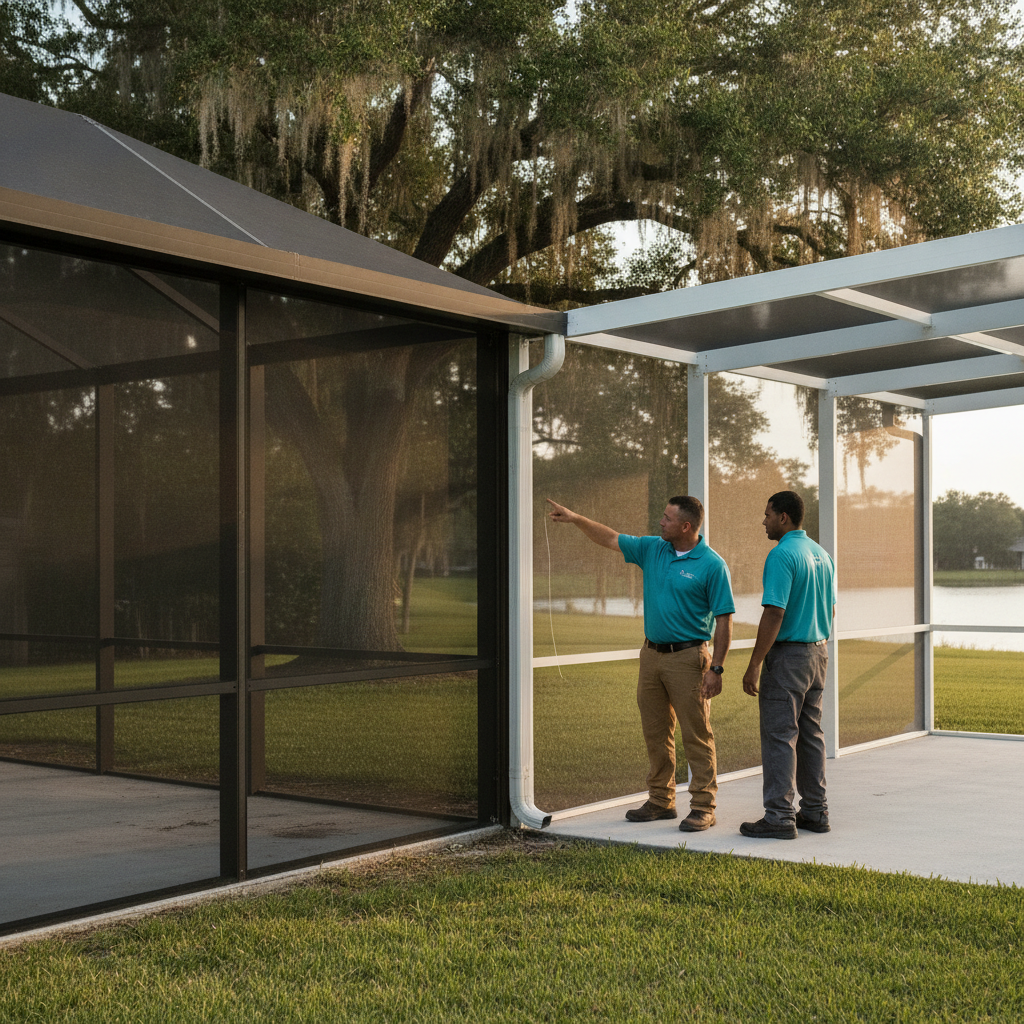
A vinyl kit in a warehouse photo looks like a finished room. On a Polk County slab it is still only walls. The permit drawing names the frame: posts, beams, roof, and the anchors that have to hold in real concrete.
If you typed aluminum screen enclosure, you already named the material local crews set from Dixieland to Four Corners. Vinyl is a different product. Mix the two and a west-facing Winter Haven patio ends up with sagging rails the first summer the afternoon sun cooks the wall.
The frame is the decision, the mesh is a later choice
The frame carries wind. Mesh only keeps bugs and oak debris out, and you will replace the mesh long before you replace a properly set aluminum frame.
An aluminum screen enclosure is extruded posts and beams with a groove in the metal. A rubber spline presses the screen into that groove. When a panel tears at ground level, the spline comes out, new mesh rolls in, and the extra gets trimmed. The posts stay put. That is why mesh is a later choice, not the purchase.
Everyday insect mesh is 18x14 fiberglass. It keeps out most insects and still lets cooling breeze through. A 20x20 no-see-um mesh is built to keep out most smaller flying insects like no-see-ums, gnats, and sand flies. Pet-resistant screening is tear and puncture resistant for patio and porch walls. Vinyl-laminated fiberglass is a different product, and the maker says it is not roofing and not for horizontal use. None of those is a frame. They sit in a frame. Pick mesh after the structure is set, then use our screen mesh types guide when you get there.
In Central Florida, screen lasts roughly seven to twelve years, and it fails unevenly. The south and west elevations go brittle while the shaded north side still looks new. That is UV on the mesh. The aluminum stays. A 1990s cage in Cypress Gardens shows it every time: the sunny wall is chalky and brittle, the north wall still looks serviceable.
A screen room over an existing slab with an aluminum mansard roof commonly lands in the $1,500 to $3,500 range. Screening in an existing covered lanai sits in the same band. Local companies advertise entry-level screen rooms near $1,499 plus permit, and that number is real for a small standard-size room. Add an insulated roof panel, a longer clear span, or a new slab, and the same job type moves to $6,000 to $14,000 because the beams and the foundation got heavier.
Individual screen panels run $35 to $90 each. A full-cage rescreen is $1,400 to $3,200, or about $2.50 to $4.00 per square foot of standard fiberglass, installed. Those numbers are mesh and labor on a frame that already exists. They are not a vinyl kit price, and they are not a reason to buy a light wall system and hope it permits.
| Decision | Aluminum frame | Vinyl kit |
|---|---|---|
| What you are buying | Extruded posts, beams, and screen channels that carry the roof and the wind | A light wall or panel system, often meant to sit between structure that already exists |
| What the permit looks at | Screening that adds structural or infill framing, plus the roof and the anchors | A product that may never show up on an engineered drawing |
| How the mesh attaches | Spline-set, swapped panel by panel | Sometimes fused to a panel, sometimes a separate roll |
| What fails first here | Mesh on the south and west walls | The plastic itself: heat, UV, and sag at the fasteners |
| Typical Polk job | Patio room, pool cage, or screened lanai tied to a house | A filler wall on a porch that already has posts |
Aluminum in Florida sun and a vinyl kit’s limits
Aluminum is the outdoor frame material because it does not rot and it does not swell after a July thunderstorm. The finish is what ages. Chalking is the fine white powder that forms on a paint film from weathering, and it can look like the color is fading. On a cage that has already chalked, the prep is wash, scrub if needed, rinse with clear water, and let it dry fully before anyone recoats. After a properly stripped and primed cage repaint, the finish here commonly runs eight to fifteen years. That is paint life, not a warranty.
Vinyl in this climate fails a different way. Afternoon sun on a west wall in Cypress Gardens or south Lakeland heats a dark plastic rail until it creeps. Fasteners oval out. Rails belly. The next wind gets under a loose panel the way it does when spline pops out of a Winter Haven cage, except now the channel itself has moved. Live oak catkins from the canopy over Lake Morton and Dixieland mat on whatever roof you chose. They do not care which catalog the walls came from. The frame still has to hold that load and the wind behind it.
A vinyl kit also tends to assume you already have a structure. Many patio enclosure systems are non-structural on purpose: they infill between wood posts, columns, or a block wall. That can be a porch conversation. It is not a free-standing pool cage over a Winter Haven pool, and it is not a new room on a thin 1950s patio slab in Dixieland that was poured without a perimeter footer. An aluminum upright has to land on concrete thick enough to hold an anchor. A kit that never planned for that footer does not become a cage because the listing used the word enclosure.
A new residential pool cage in the Lakeland area is $9,000 to $18,000. A cage with a large deck, a two-story mansard tied into the house wall, or a high clear span runs $20,000 to $35,000. Those are aluminum structures with engineered drawings. They are not warehouse kits.
The Atlantic hurricane season runs from June 1 to November 30. Inland Polk does not get coastal surge, but it does get hurricane wind and daily summer storms. Coverage for screened enclosures and aluminum-framed carports damaged in a hurricane commonly comes from an endorsement rather than the base homeowners policy. Some carriers fold pool cages and awnings into that same endorsement. Some do not. The answer is on your declarations page, not in a product brochure.
Wholesale shopping is the wrong door for this job. Licensed crews order extrusion, roof pans, fasteners, and mesh through trade supply. A homeowner hunting a wholesale aluminum screen enclosure kit is usually looking at a non-structural wall system, or at a kit that still needs a local permit, an engineered drawing, and someone licensed to set it. Florida Statutes 489.113 is plain: a person must be certified or registered to engage in the business of contracting in this state. Several license classes can lawfully build aluminum structures. Ask which class the contractor holds, then verify it yourself with DBPR’s Verify a License tool.
If the mesh on an existing aluminum cage is the only thing that failed, that is a rescreen, not a reason to rebuild in vinyl.
Wind load and what Polk permits will accept
Polk County will not treat a vinyl wall kit and an aluminum screen enclosure as the same permit. In unincorporated Polk, the Building Division’s published list includes screening of any space that requires structural or infill framing to be added. Rigid-roof carports are on that list too. Read it on the county’s building FAQs. A patio cover is not named separately there, so its status is a question for the division on the specific design, not a guess from a kit page.
Inside the City of Lakeland, Building Inspection publishes its own permit requirements. That page lists screening of any space that requires structural or infill framing, along with porches and carports. A crew that spends most of its week in unincorporated Polk can still hit extra paperwork inside city limits because the city runs that shop. The rest of the county goes through the Polk County Building Division. If the house is in Lakeland proper, start with the city page. If it is in Auburndale, Bartow, or a Davenport subdivision outside the city, start with the county.
Wind load is why the frame material matters more than the mesh color. The Florida Building Code assigns an ultimate design wind speed to a specific address. The engineered drawing in the permit package states the value that structure was designed to. Inland Polk carries a lower number than a Gulf-front county, which is why the same cage prices differently here. Nobody needs a kit-maker’s snow table. We do not have snow. We have wind, and the drawing has to match the lot. The longer write-up is our Polk County wind load page.
Polk County has no coastal mean high water line, so the coastal-mile test in the wind-borne debris definition cannot apply here. The remaining test is about ultimate design wind speed on the code map. That still is not a number you pick from a catalog. It is a value the building official and the engineer handle for the address.
HOAs along the I-4 corridor in Haines City, Davenport, and Four Corners add a second review on color and roof style. That review does not replace the permit. A builder-covered lanai left bare in a new subdivision is still a framing-and-screen job once you enclose it, which is why it shows up on both the city and county screening lists.
If the enclosure surrounds a pool, Florida’s Residential Swimming Pool Safety Act lists ways a pool may be made safe. One option is an enclosure that meets the barrier specifications in the statute: at least 4 feet high on the outside, no gap or climbable protrusion a young child could use, and a gate that opens out, self-closes, and self-latches with the release on the pool side, out of a child’s reach. The statute does not name screen enclosure as a category. Whether a given cage does all of that is what the building official signs off on. Door hardware and latch height decide it, not the word vinyl or the word aluminum.
Owner-builder permits exist, with restrictions. Polk County’s own disclosure says state law requires construction to be done by a licensed contractor, and the owner-builder path is an exemption. Erecting or modifying an enclosure frame, setting anchors in a slab, or changing pool-gate hardware is licensed work. Rolling a new panel into a spline groove at ground level is the homeowner-scale job.
For the permit path itself, start with our screen enclosure permits guide, then call the division that actually has the lot.
How much does an aluminum screen porch cost?
A basic aluminum screen enclosure over an existing slab, with an aluminum mansard roof, is $1,500 to $3,500. Screening in an existing covered lanai is the same range. Local companies advertise entry-level screen rooms near $1,499 plus permit for a small standard-size room. Once you add an insulated roof panel, a longer clear span, or a new slab, the published range is $6,000 to $14,000. A new residential pool cage in the Lakeland area is $9,000 to $18,000, and a large-deck or two-story mansard job is $20,000 to $35,000. What moves the number is span, roof, slab, and height, not a vinyl catalog price.
Are aluminum screens better than vinyl?
Aluminum is the frame. Screen is the mesh. An aluminum frame is what Polk County crews set for a permitted enclosure because it takes the wind load and holds a spline groove through years of UV. Vinyl kits are usually walls, not the structure. Mesh choice is separate: standard fiberglass, tighter no-see-um weave, or pet-resistant wall mesh. Split the purchase that way, then pick mesh for bugs, pets, or visibility.
Can I buy a kit and screen a porch myself?
You can replace a ground-level panel: pull the spline, roll new mesh, trim the extra. Building the frame, adding infill framing, anchoring into a slab, or hanging a pool-side gate is contracting work under Florida law. Unincorporated Polk and the City of Lakeland both list screening that needs structural or infill framing as permitted work. Buy the mesh. Let a licensed crew set the aluminum.
When to call us
Call when the decision is a new enclosure, a pool cage, or any job that adds framing, anchors, or a roof, not when you only need a single baggy panel at ground level. We match Polk County homeowners with licensed local screen and aluminum crews, from Lakeland and Winter Haven out through Bartow and the I-4 corridor. Call us at (863) 777-5379.