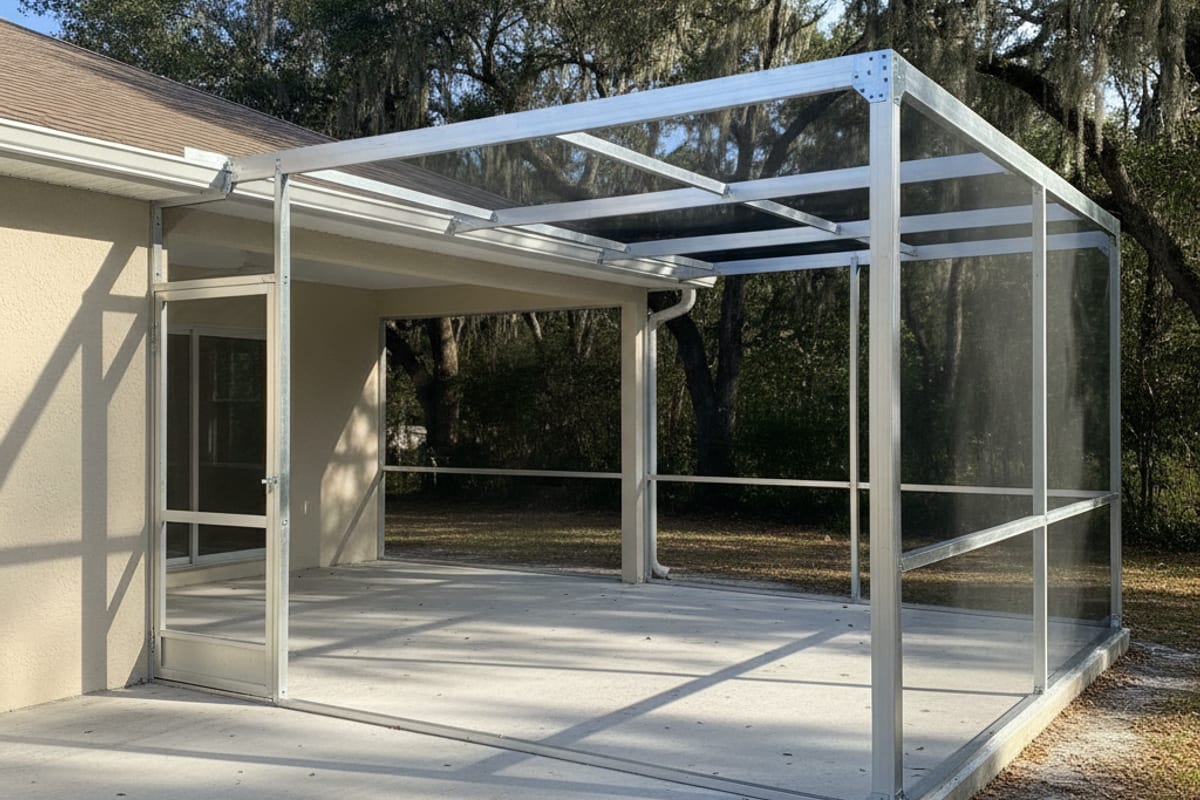
Every so often someone offers to build a screen room without a permit, for noticeably less money, and it sounds like a reasonable way to save a few hundred dollars on paperwork.
It is not paperwork. On a screen enclosure the permit is what forces the engineering to exist, and the engineering is most of what you are buying. Here is how the process actually works in Polk County and what to expect at each step.
Yes, a screen enclosure needs a permit
Screen enclosures are structures. Every Polk County jurisdiction requires a permit, an engineered design for the wind speed at your address, and at least one inspection. So do carports, patio covers, and pool cages.
The two costs of skipping it show up later rather than sooner. Insurance is one: an unpermitted structure can complicate a claim, and it is exactly the kind of thing that gets discovered at the worst moment. The other is resale. A buyer’s inspector or the title work turns up a structure with no permit history, and now you are either pulling a retroactive permit on work you cannot document or discounting the house.
Neither of those shows up on the day the enclosure goes in, which is why the shortcut keeps getting sold. Our guide to selling a house with unpermitted work in Polk County covers what a seller owes a buyer and what it takes to permit the structure first.
Which jurisdiction is yours
Polk County is a patchwork, and this is the first question to answer.
Unincorporated county property permits through Polk County. The incorporated cities each run their own building departments: Lakeland, Winter Haven, Bartow, Lake Wales, Haines City, Auburndale, Mulberry, Fort Meade, Dundee, Lake Alfred, Polk City, Eagle Lake, and others. Each has its own review queue, its own fees, and its own setback and lot-coverage rules.
That matters practically. A crew that mostly works unincorporated county can hit friction the first time they pull inside Lakeland city limits, and the reverse is true too. It is a fair question to ask a bidder: have you pulled a permit in my jurisdiction before?
If you are in one of the newer subdivisions along the I-4 corridor, around Davenport, Loughman, Four Corners, or the Haines City growth ring, there is a step in front of the permit: architectural review through the homeowner association. That review governs anything visible, including frame color. Start it first, not in parallel. This page does not publish how long that review takes.
The contractor pulls it, under their own license
This is the single most important thing in this post.
The contractor performing the work should pull the permit under their own license. If someone asks you to pull an owner-builder permit for work they are doing, that shifts liability onto you: you become responsible for the work, for the inspections, and for the code compliance of a structure you did not build and cannot evaluate.
There are legitimate reasons a homeowner pulls an owner-builder permit, and all of them involve the homeowner actually doing the work. None of them involve a crew showing up the next morning. What you are actually signing on a Polk County owner-builder permit walks through the disclosure statement line by line, including the one-year resale rule and the payroll duties that come with unlicensed help.
It is also the simplest verification you get for free. A contractor who pulls the permit under their own license has demonstrated that the license exists, is current, and is in a class that covers this work. You can confirm it yourself at myfloridalicense.com in about a minute, and you should, but the permit is the corroboration. Which contractor license covers this work explains what you are looking at when you check.
Once the work is done, you can confirm the permit landed. A Polk County permit search walks through the county’s public portal, and the record-type quirk that makes a real enclosure permit look missing.
What a clean permit package contains
A signed and sealed engineered drawing for your address. Not a generic detail sheet photocopied for every job. It should reflect your dimensions, your roof style, and the design wind speed assigned to your specific location under the Florida Building Code.
Anchor and connection detail. This is what the inspector actually checks. Member sizing, anchor type, anchor spacing, and how load transfers into the deck.
Site information showing setbacks. The structure has to sit inside the required distances from your property lines, and lot coverage limits apply on top of that. Screen enclosure setbacks in Polk County walks through unincorporated Table 2.2 and the city-versus-county split.
Inspection schedule. Typically an anchor or footer inspection and a final. The final inspection is the document you want in your file forever.
One piece of paper sits in front of that first inspection, and it is the owner’s to sign rather than the contractor’s. On any contract over $5,000 the building department needs proof of a recorded notice of commencement before it will approve an inspection.
Keep all of it. At sale, at renewal, and after a storm, the permit and the final inspection are what answer the questions.
Timeline, honestly
The build on a screen room is two to four days. A pool cage is one to two weeks on site. This page does not publish how long permit review takes.
How long the issued permit stays valid is a different clock. How long a building permit is good for in Polk County covers that.
Storm season is what really compresses things: after a named storm, plan review queues fill with damage-related work and every aluminum shop in Central Florida is triaging.
Practical advice that costs nothing: if you want an enclosure for next summer, start it in the fall.
The slab question, which is not a permit question but decides the permit
The engineering assumes the anchors land in sound concrete. Whether yours will is a separate question, and it is the one that most often changes a project scope.
Older Polk County patios were frequently poured thin, with no perimeter footer, because nobody was planning to stand a structure on them. That is common in the pre-1960 stock around Dixieland, Lake Morton, Bartow, and Fort Meade. A crew should probe or core the slab edge during the measure. If it will not take anchors, the fix is a perimeter footer or a new slab, and that cost belongs in the original quote rather than arriving as a change order after demo.
On reclaimed phosphate ground around Mulberry, Homeland, and parts of Bartow, add settlement to the list of things to check. Anchoring into concrete that is still moving is how a permitted, engineered enclosure still ends up needing repair.
If the property sits in a Special Flood Hazard Area, there is a second set of requirements layered on top of the building permit, including the county’s floodplain paperwork and a setback measured from the top of the bank. Screen enclosures in a Polk County flood zone covers what changes and what does not.
Where the slab can go is its own constraint, decided on the recorded plat rather than by the building department. Polk County keeps slabs and decks out of recorded easements, so a utility or drainage strip along the back line takes that ground off the plan entirely. Building on an easement in Polk County covers how to find yours and whether it can be vacated.
Does a rescreen need a permit
Generally no. Replacing screen in an existing permitted enclosure is maintenance, not new construction. Same for replacing a screen door or swapping hardware.
What changes the answer is structural work. If members are being replaced, if the footprint is changing, or if you are converting an open lanai into an enclosed room, that is a permit conversation. A good contractor will tell you which side of the line your job is on rather than guessing.
The bid that is dramatically cheaper
When one bid comes in $2,000 under everyone else, look for the permit line and the engineering line before you look at anything else. Their absence is usually the entire explanation.
You are not being offered the same product at a discount. You are being offered a structure with no sealed design, no inspection, no record, and no recourse, built by someone who has told you in advance how they handle rules.
Do I need a permit for a screen room in Polk County?
Yes. Screen enclosures are structures, and every jurisdiction in the county requires a permit, an engineered design for your address’s wind speed, and an inspection.
Can I pull the permit myself to save money?
You can pull an owner-builder permit, but it shifts liability for the work onto you, and it is not appropriate when a crew is doing the building. The contractor should pull it under their own license.
How long does a screen enclosure permit take in Polk County?
This site does not publish permit review times. How long a building permit is good for in Polk County covers the validity clock after issuance. HOA architectural review, where required, is a separate track.
What happens if my enclosure was built without a permit?
It typically surfaces at sale or during an insurance claim. Options are a retroactive permit, which requires documenting work you cannot see, or discounting the property. Both are worse than permitting it correctly the first time.
Does replacing screen require a permit?
Generally not, since rescreening an existing permitted enclosure is maintenance. Replacing structural members or changing the footprint does.
If you want a quote where the permit and the engineering are line items rather than quiet omissions, call (863) 777-5379. Ask what jurisdiction your address falls in, and ask who is pulling the permit. Both answers tell you a lot.