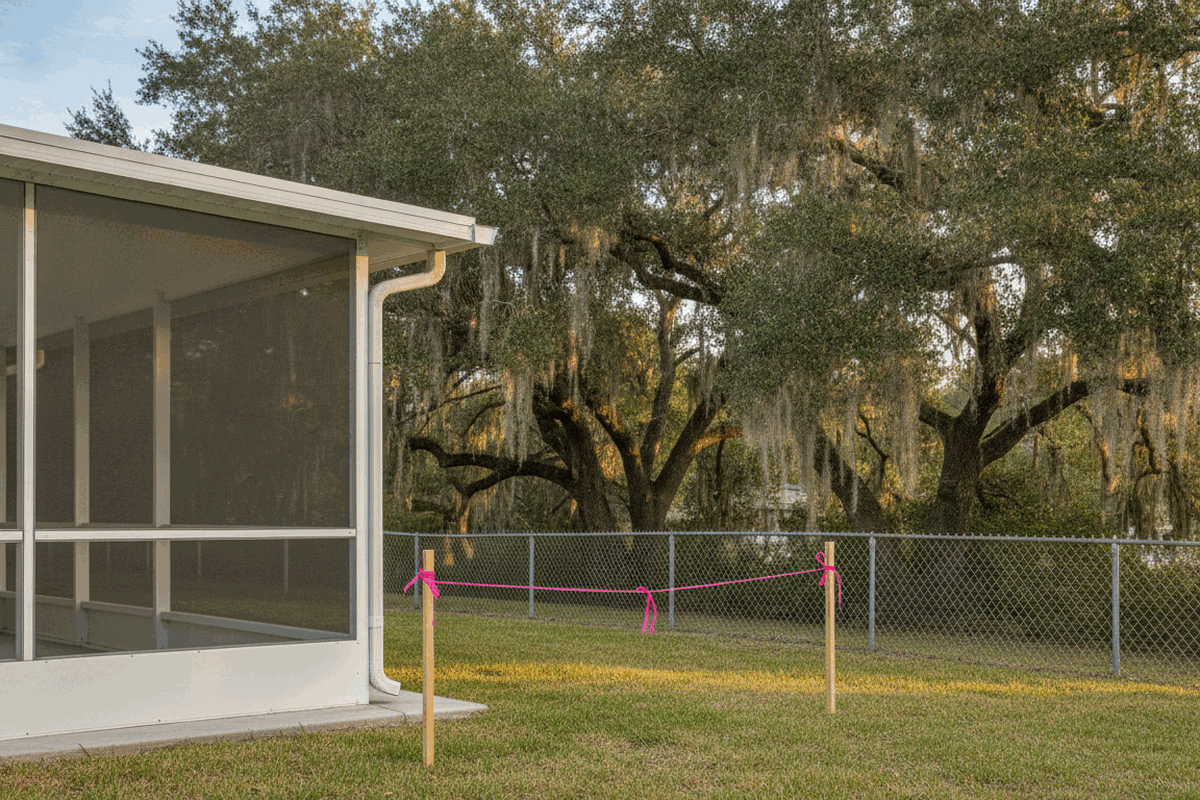
An easement is a recorded right on your land, not a zoning setback. Whether a pool cage or screen room can occupy that strip depends on the instrument, the holder, and the rules that apply to that parcel. UF/IFAS publication FE108 is a general Florida fence and property-law handbook. It is not a decision on your lot, and it is not current county building or land-development code.
The work that belongs on this page is identifying the easement and reading it before anyone draws an enclosure. Clearing every setback still leaves that recorded right to check.
An easement is not a setback
A setback is a distance rule. Your jurisdiction sets it, measures it from the property line, and it can change by zoning district. That is a local zoning question.
An easement is somebody else’s right on your land. FE108 defines it as “a benefit based in land ownership, other than the sharing of profits, that gives someone the right of use or enjoyment of another person’s land for a special purpose not inconsistent with the general property rights of the owner.” You still own the dirt. Someone else holds a recorded right to use a piece of it for a purpose the grant described.
The same handbook notes how most easements start: “Usually, the title-holding landowner expressly grants an easement by means of a written agreement, deed, or deed reservation.” In a platted subdivision, that grant may appear on the recorded plat as well as in later deeds. The plat, the deed, and the easement instrument are the documents that matter. A setback conversation does not replace them.
Unincorporated Polk County has its own sentence. Section 209.D.2 of the Polk County Land Development Code says accessory structures “shall not be located in a required buffer, minimum accessory structure setback area, public rights-of-way, or easement (unless authorized by the easement or approval is obtained from the easement holder).” That is county land-development code for unincorporated Polk County. It is not a city rule. Lakeland, Winter Haven, Bartow, Lake Wales, Haines City, Auburndale, and Mulberry each run their own code. FE108 remains a general Florida handbook. It is not this local sentence.
Setback distances are a different tape. Screen enclosure setbacks in Polk County publishes unincorporated Table 2.2. Clearing a setback does not clear a recorded easement.
Do not treat a general handbook, a neighbor’s fence, or a site sketch as a no-build rule, a slab rule, or a drainage map for your address. Those claims need the actual instrument and the current local code that applies to the property.
How to find the easements on your own lot
Use this sequence. It is a records sequence, not a ranking of cost.
Start with your closing paperwork. An owner’s title policy lists recorded exceptions, and platted easements often appear there. If you still have the survey from the purchase, easements are often drawn on it with widths. Those drawings are only as current as the survey.
Next, pull the plat. The Polk County Clerk of the Circuit Court maintains official records from 1957 to the present, with historical deeds from 1861 through 1956 searched separately. The Clerk describes more than 350 record types, including deeds, mortgages, notices of commencement, liens, plats, and homeowners association documents when those have to be recorded. The plat for your subdivision is where dedicated easements and their widths are often shown on the face of the drawing.
Third, order a current boundary survey and have the easements staked if the enclosure will sit anywhere near the line. A stake in the grass is what a designer can actually work to. An old purchase survey is not automatically that stake.
Fourth, read the easement instrument itself. FE108 is explicit that use is limited by what the parties intended at creation: “Any use that was not intended by the parties at the time of the easement’s creation will not be allowed.” A drainage easement, a utility easement, and an access easement are not interchangeable labels. The grant, not a guess about what the strip is “probably for,” is the text to read.
What the easement holder is allowed to do with that strip
Not anything they like, and not nothing either. FE108 is a general statement of those limits, not a ruling on your holder.
On scope, the handbook says courts look to the grant: “Any use that was not intended by the parties at the time of the easement’s creation will not be allowed.” It also states the burden the other way: “The burden placed upon the landowner granting the easement must not be unnecessarily increased by uses that the parties did not intend.”
On location: “Once created, the location of the easement cannot be changed without agreement.” Shifting the strip because the pool, patio, or cage ended up somewhere else is not something the handbook describes as a unilateral owner right.
On blockage: “When an easement is blocked, the easement owner may pass over the adjoining land as far as is necessary to avoid the blockade.” That is the handbook’s general rule. It is not a permit to occupy the rest of the yard, and it is not a county building decision.
On maintenance: “usually, the owner of the easement is responsible for maintenance,” meaning the easement holder rather than you, though “the parties to an express easement may alter their responsibilities by agreement.”
On disputes, FE108 says a lawsuit may seek damages, breach of contract, “or an injunction to stop the easement’s obstruction.” On a fence blocking an entrance or exit, where a reasonable person should have known the easement existed, the handbook says a court first determines whether an easement exists, and then “the court may order the fence be removed.” It cites Prime West, Inc. v. Camargo, 906 So.2d 1112 (Fla. 3d DCA 2005). FE108 is still a handbook summary of that case, not a holding about any Polk County screen enclosure.
The handbook itself warns that the laws it relies on can change, that it is not a comprehensive guide, and that it is not legal advice. Treat it that way.
Can a recorded easement be vacated or released?
Sometimes recorded rights are vacated or released. That is a title and county-process question, not a design shortcut this page can certify.
FE108 does not decide whether your easement can be vacated. It also does not publish Polk County’s current vacating forms, sketch standards, or utility-consent checklist. Do not count on gaining a few feet of lanai through a process you have not confirmed with the recorded instrument, the easement holder, and the agency that actually handles vacating in that jurisdiction.
The practical design default is to keep the enclosure off the recorded strip until those documents say otherwise.
Designing an enclosure around an easement
Once the strip is staked and the instrument is in hand, the remaining question is design: can the enclosure do the job without occupying that right?
Pull the footprint forward where the easement runs along the rear lot line, if the side setbacks and the rest of the lot still work. Reshape instead of assuming the first rectangle is the only shape. Mixing screened space with an aluminum patio cover is a design choice some lots use to keep usable area while the enclosed footprint stays clear of the line. It is not a promise that a patio cover is cheaper, faster to permit, or allowed closer to the easement.
Watch where roof water goes. If the instrument is a drainage easement, the grant is about moving stormwater, and a new roof changes what arrives there. Seamless gutters and a planned outfall are ordinary water-control details. They do not prove the easement will accept the discharge, and they do not make a structure on the easement lawful. The same water question applies to a detached carport.
None of those moves is a guaranteed permit, engineering, or legal outcome. Ask where the property line and easements are before the design is treated as final.
A permit search will not answer this. Permit records show what was filed with a building department. Easements live in the Clerk’s official records, on the plat, and in the instrument. Those are separate searches.
If the next step is assembling a permit file for the enclosure itself, the screen enclosure permits guide can help organize that file. It is not legal authority on the easement.
Frequently asked questions
Can I put a screen enclosure over a utility easement in Polk County?
This page cannot give a universal yes or no for every Polk County lot. In unincorporated Polk County, Section 209.D.2 keeps accessory structures out of an easement unless the easement or the holder authorizes it. An easement is still a recorded right whose use is defined by the grant. Read the title exceptions, plat, survey, and instrument, then confirm the current local rules that apply to that parcel, before treating the strip as buildable.
Is an easement the same as a setback?
No. A setback is a distance rule your jurisdiction sets and measures from the property line. An easement is a recorded right another party holds over part of your lot. Clearing one does not clear the other.
How do I find out where my easement is?
Check the owner’s title policy and any purchase survey first. Then pull the plat from the Polk County Clerk’s official records, which run from 1957 to the present. For construction near the line, have a surveyor stake the easement, and read the easement instrument itself.
Can I get an easement removed from my property?
Vacating or releasing a recorded easement is a separate legal and county-process question. FE108 does not decide it, and this page does not publish a current Polk County vacating checklist. Confirm the instrument, the holder, and the agency process before you treat removal as part of the build schedule.
What happens if a structure is already sitting in the easement?
FE108’s general obstruction discussion still applies as handbook language, not as a verdict on your structure. A blocked easement owner may pass over adjoining land as far as needed to get around the blockage, and a lawsuit may seek damages or an injunction. If you inherited the structure with the house, pull the plat, a current survey, and the instrument before spending on repairs or a rescreen.
Does a permit search tell me about easements?
No. A permit search shows what was filed with the building department. Easements live in the Clerk’s official records and on the plat.
Getting the line settled before anyone draws an enclosure
An easement is a recorded constraint. Engineering does not erase it. Checking title, plat, survey, and the instrument first is what keeps the question on paper instead of in a finished slab.
Lakeland Outdoor Pro connects Polk County homeowners with insured local aluminum crews. We do not perform licensed work, and we do not provide legal advice. Call (863) 777-5379 if you want the property line, setback, and easement question on the table before a design is treated as final.