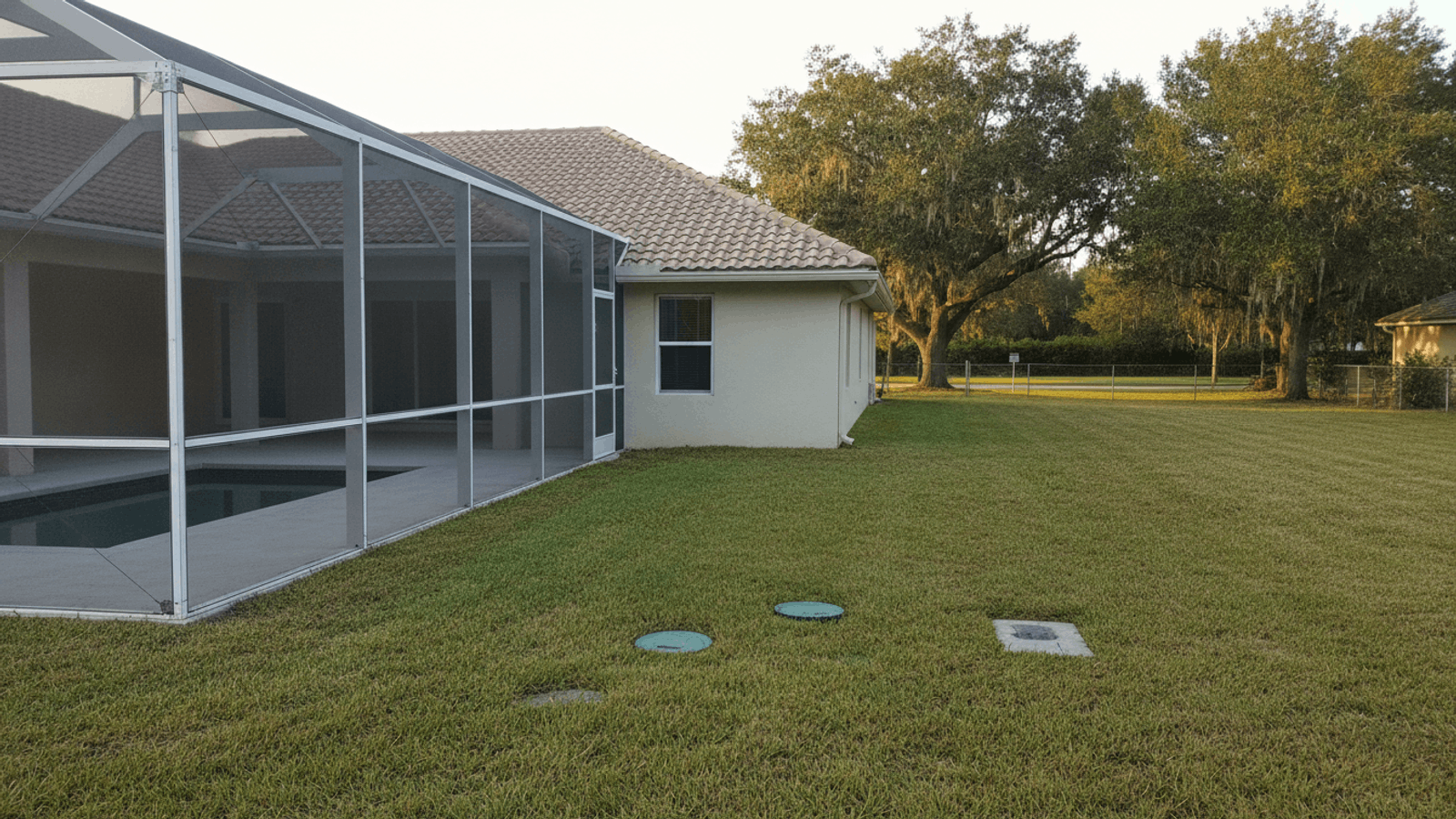
Can you build over a septic tank?
Not under a building, and not within five feet of a building foundation. Rule 62-6.005(2), F.A.C., is the current Florida setback, and it reads: “Onsite sewage treatment and disposal systems must not be located under buildings or within 5 feet of building foundations, including pilings for elevated structures, or within 5 feet of mobile home walls, swimming pool walls, or within 5 feet of property lines except where property lines abut utility easements which do not contain underground utilities, or where recorded easements are specifically provided for the installation of onsite sewage treatment and disposal systems for service to more than one lot or property owner.”
Then the turn that changes a lot of patio sketches. The same rule carves sidewalks, decks, and patios out of that five-foot setback. It does not let a drainfield go under them. Rule 62-6.005(2)(a) says “Sidewalks, decks and patios are not subject to the 5 foot setback, however, drainfields must not be installed beneath such structures.”
Those two lists are the whole fight. On one side the rule names buildings, building foundations, pilings, mobile home walls, swimming pool walls, and property lines. Five feet. On the other it names sidewalks, decks, and patios, and it says they are “not subject to the 5 foot setback”. The drainfield limit still stands.
The rule does not name screen enclosures, pool cages, lanais, carports, or patio covers. A screened cage on a slab has features of both lists. Which side a specific structure lands on is a determination the permitting authority makes on the site plan. It is not a call a web page can make for your lot.
Those distances are state rule. They are the same in every Florida county. The permit and the inspection for the system itself are still Polk County health department business. An unincorporated lot and a lot inside Lakeland city limits read the same 62-6.005 tape. They split on who stamps the structure.
The rule number most guides still get wrong
The current rule is 62-6.005, F.A.C., Location and Installation. It is a Department of Environmental Protection rule. It was amended effective 6/8/2026.
The number most guides still print is 64E-6.005. That was the old Department of Health chapter. It was transferred. The flrules.org page for 64E-6.005 now carries the title “Location and Installation (Transferred)”. Its History note ends “Transferred to 62-6.005.” Do not treat 64E-6.005 as current law. The current adopted text says “must”, not the older “shall”, and it spells out “onsite sewage treatment and disposal systems”.
DEP writes the chapter. DEP does not issue every septic permit in Florida. The Florida Department of Health in Polk County states that, since January 2, 2025, “the Florida Department of Environmental Protection (DEP) will manage septic system permitting in 16 counties: Bay, Calhoun, Escambia, Franklin, Gadsden, Gulf, Holmes, Jackson, Jefferson, Leon, Liberty, Okaloosa, Santa Rosa, Wakulla, Walton, and Washington.” It then says “If you live outside these 16 counties, your local county health department will still handle septic system permitting and inspections.”
Polk County is not on that list of 16. So DEP writes 62-6.005, and the Florida Department of Health in Polk County still issues the septic permit and does the inspection. Two agencies. The rule is statewide. The system file is the county health department’s.
What the rule actually measures from
Rule 62-6.005 publishes distances from named features. They are not the number on your lot. They are the published rule. Confirm your own tape against the site plan and the office that applies it.
| Feature named in Rule 62-6.005 | Published distance |
|---|---|
| Under a building | Not allowed |
| Building foundations, including pilings for elevated structures | 5 feet |
| Mobile home walls | 5 feet |
| Swimming pool walls | 5 feet |
| Property lines | 5 feet, with the easement exceptions in (2) |
| Private potable well or multi-family water well | 75 feet |
| Non-potable water well | 50 feet |
| Storm sewer pipe | 10 feet, and in every instance not less than 5 feet |
| Surface water body boundaries, measured laterally | 75 feet, with the statutory exception below |
The well and storm-pipe figures sit in 62-6.005(1). The private-well line is “Seventy-five feet from a private potable well as defined in Rule 62-6.002, F.A.C., or a multi-family water well as defined in Rule 62-6.002, F.A.C.” The non-potable line is “Fifty feet from a non-potable water well as defined in Rule 62-6.002, F.A.C.” The storm-pipe line is “Ten feet from any storm sewer pipe, to the maximum extent possible, but in every instance the setback must not be less than 5 feet.”
The water-body line is 62-6.005(3). It opens with a statutory exception that has to travel with it: “Except for the provisions of Sections 381.0065(4)(g)1. and 2., F.S.,” then “onsite sewage treatment and disposal systems must not be located laterally within 75 feet of the boundaries of surface water bodies.”
That last tape matters on any parcel where a pond, a canal or a lake edge is the rear line. The 75-foot well tape matters where a house still drinks from its own well. The storm-pipe line matters where a curb inlet or a drainage structure sits in the yard. None of those figures tells you what your own plan should show. They tell you what the rule published.
The five feet from a property line in 62-6.005(2) is a septic-system setback. It is not the county’s screen-enclosure setback, even when both numbers are five. The structure’s property-line tape is a land-development question. Unincorporated Polk County and the cities each keep their own books on that side.
Why clearing five feet still is not enough
A plan can clear five feet and still fail. Rule 62-6.005(4) requires a reserve of suitable unobstructed land around the drainfield. The stem is: “Suitable, unobstructed land must be available for the installation and proper functioning of the onsite sewage treatment and disposal system. The minimum unobstructed area must:”
It then sets three tests, and all three travel together.
“(a) Be at least 1.5 times as large as the drainfield absorption area required by rule. For example, if a 200 square feet drainfield is required, the total unobstructed area required, inclusive of the 200 square feet drainfield area, would be 300 square feet. Unobstructed soil area between drain trenches is included in the unobstructed area calculation.”
“(b) Be contiguous to the drainfield.”
“(c) Be in addition to the setbacks required in subsections (1), (2), and (3) above.”
That last clause is the one that stings. The unobstructed reserve is extra. It does not hide inside the five-foot setback. It does not hide inside the well setback. A short backyard between a pool and a rear fence can look fine on a tape and still eat the 1.5-times reserve. That is why a screen room footprint that fits the patio can still get rejected when the drainfield’s open ground is part of the same sketch.
The rule’s own example is 200 square feet of drainfield and 300 square feet of unobstructed area. Use that example. Do not treat it as the size of your field.
Which agency do you actually call?
Call the Florida Department of Health in Polk County about the tank, the drainfield, and the site plan. The published line is 863-519-8330. The mailing address is 2090 E. Clower St, Bartow, FL 33830. The office to name is the Bartow Environmental Public Health Office. The Florida Department of Health in Polk County issues the septic permit and does the inspection. It does not stamp a pool cage.
Call the Polk County Building Division about the structure, the slab, and the building permit, if the lot is in unincorporated county. The Bartow office is (863) 534-6080. Ask for a plans examiner. Lakeland, Winter Haven, Bartow, Lake Wales, Haines City, Auburndale, and Mulberry each run their own building department. A city lot uses that city’s building counter for the enclosure. The septic permit is still the county health department’s.
Both county offices are in Bartow. They are not the same office. Clower Street is health. The building line is (863) 534-6080. Our number stays (863) 777-5379. Do not mix them.
On the building side, Polk County’s permit-required list includes this slab line: “Concrete slabs adjacent to a principal or accessory structure, intended for support of a structure, elevated slabs, sidewalks and portions of driveways in the right of way or within the minimum setbacks.” A patio cover that needs a new slab is in that conversation. So is a cage that needs a new pad. The county’s required-document list on that same page includes “Individual Lot Plot Plan”. The list’s own framing travels with it: “These examples are not all inclusive and there will be situations that are not addressed here.” If the question is whether that slab needs a building permit, ask a plans examiner. The screen enclosure permit path is the structure half of the same yard.
The health department is not classifying your aluminum. It is locating the system. The building department is not relocating the tank. It is permitting the structure. Bring both files to the same sketch.
How to find your own tank and drainfield before you design anything
The septic paperwork is where the tank actually is. Guessing from a clean-out cap in the grass is how a carport lands on the field.
Rule 62-6.004(3)(a) requires “A plan or plat of the lot or total site ownership. The site plan must be drawn to scale and for the property where the system will be installed.” The stem for the feature list keeps “shall” in the current adopted text: “The site plan shall show boundaries with dimensions and any of the following features that exist or that are proposed:” The list includes structures, swimming pools, recorded easements, onsite sewage treatment and disposal system components, wells, obstructed areas, and surface water bodies.
The Florida Department of Health in Polk County holds the file for a permitted system. The current application form is Form DEP 4015, effective date June 2026, Application for Construction Permit. It is not DH 4015. That is the retired Department of Health name.
A Polk County permit search is the building-record half. Accela is the county’s building portal. It is not a substitute for the health-department site plan. Pull both. Draw the cage on the plan that already shows the tank, the drainfield, the wells, and the obstructed areas.
Do not “just shift the tank a few feet” on a napkin. Rule 62-6.003(1) says “A person may not construct, repair, modify, or abandon an onsite sewage treatment and disposal system without first obtaining a system construction permit approved in accordance with this chapter.” Moving the system is its own permitted job. It is not a courtesy the aluminum crew can fold into a cage bid.
What if the tank is exactly where you wanted the cage?
You have options. None of them is a promise that the original footprint survives.
You can reshape the enclosure so the slab and posts stay off the system and leave the unobstructed area intact. You can move the structure to another side of the house. You can apply to modify the system under its own health-department permit. The health department decides the system question. The building department decides the structure question. Walk both before anyone orders aluminum.
The property-line tape is a separate layer. Unincorporated Polk County publishes enclosure setbacks in its Land Development Code. That five-foot pool-enclosure floor is not the septic rule, even when the number matches. How close a screen enclosure can sit to the line is that land-development check.
Recorded rights are another layer. Rule 62-6.005 already names certain easements in the property-line exception. A utility strip can still block a slab the setback would have allowed. Building on an easement in Polk County is that recorded-right check.
Flood designation is a third overlay. A screened cage and a glass room do not get the same flood answer. Screen enclosures in a Polk County flood zone is that check. Do it before the slab is a sunk cost.
Frequently asked questions
Can you put a screen enclosure over a septic tank?
The rule does not name screen enclosures. Systems must not sit under buildings or within five feet of a building foundation. Sidewalks, decks, and patios skip that five-foot setback, but a drainfield cannot go under them. The health department decides which list a cage is on.
How far does a septic tank have to be from the house in Florida?
Five feet from a building foundation, under Rule 62-6.005(2). That is a statewide Florida rule, not a Polk County invention. The system also cannot sit under the building. Confirm the tape against the site plan on file with the Florida Department of Health in Polk County.
Can you pour a concrete slab over a drainfield?
Rule 62-6.005(2)(a) says drainfields must not be installed beneath sidewalks, decks, and patios. Those surfaces skip the five-foot tank setback. The drainfield still cannot sit under them. Whether your slab is one of those is a health-department call on the site plan.
How far from a drainfield can you build?
Clearing five feet from the tank or drainfield is not the whole test. Rule 62-6.005(4) still requires unobstructed land at least 1.5 times the drainfield area, contiguous to it, and in addition to the setbacks. That reserve is why a tape-measure plan still gets rejected.
Who issues the septic permit in Polk County?
The Florida Department of Health in Polk County. DEP writes Rule 62-6. It took over permitting in 16 named counties, and Polk is not one of them. Call 863-519-8330. The building permit for a cage or room is a separate office in Bartow.
Does a screen enclosure need its own septic permit?
No. Rule 62-6.003(1) covers constructing, repairing, modifying, or abandoning the septic system itself. It does not say a nearby screen enclosure needs a septic permit. Moving the tank a few feet is system work and does need that permit.
A free on-site measure with the septic file in hand
Lakeland Outdoor Pro connects Polk County homeowners with experienced, insured local aluminum crews. We do not pull the building permit, and we do not pull the septic permit. The crews in the Polk County network handle the structure side with the building department. The health department still owns the system.
The useful call is the one you make before the footprint hardens. A free on-site measure is the proof point that exists. Full Polk County coverage means the unincorporated lots along the Polk Parkway and the I-4 corridor, not only a Lakeland address. Call (863) 777-5379, Monday through Saturday, 7am to 7pm.