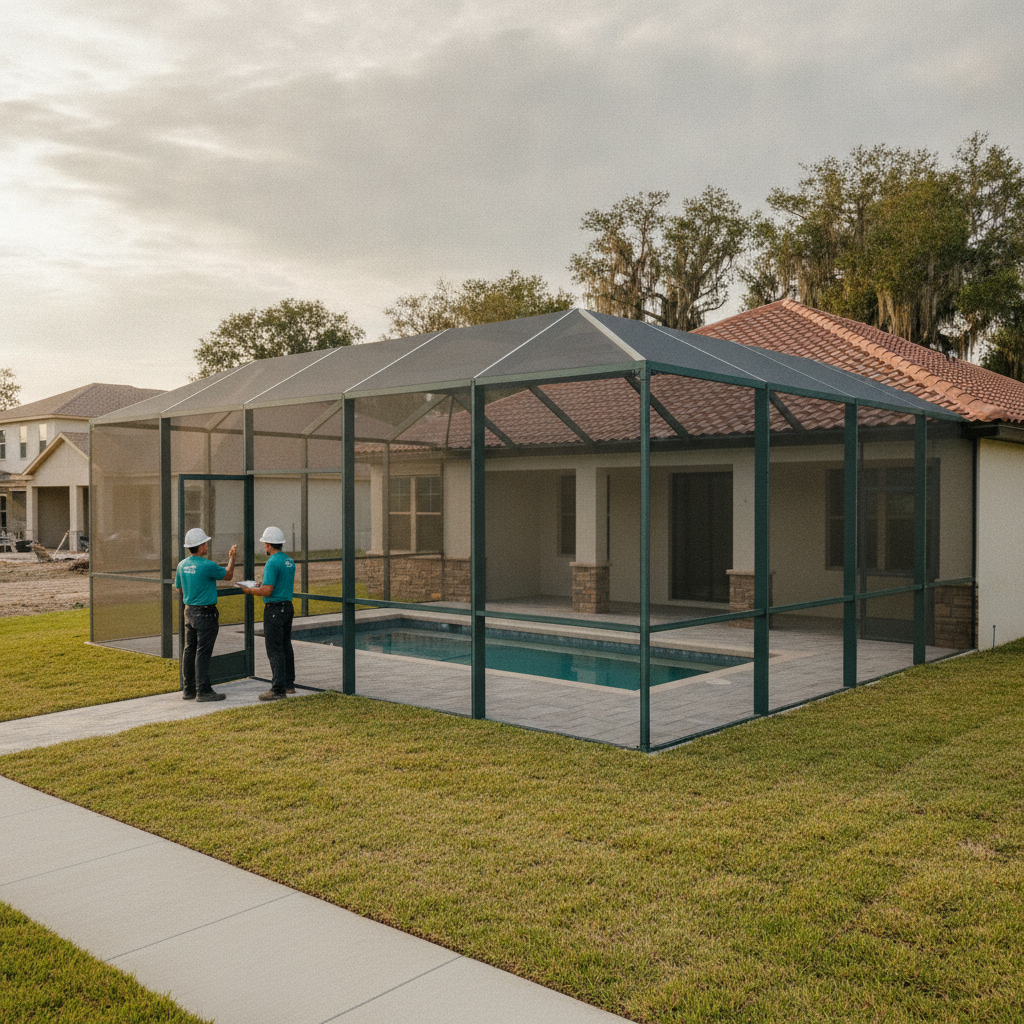
The builder left a pool and a covered lanai, and screening was never in the original price. That is the usual Davenport story along I-4 through Four Corners, Loughman, and Posner Park. The cage has to match the house, clear the HOA, and land on a pad that was often poured for the water, not for a full enclosure.
Davenport and Four Corners new-build cages
Most Davenport pool enclosures go on new subdivision lots, not on 1990s cages around Winter Haven. The stucco is still pale. The sod is thin. The pool deck stops a few feet past the waterline. A licensed crew is being asked to wrap that yard in aluminum that looks like it shipped with the house.
Two jobs show up on these streets. One is screening a builder-covered lanai the builder left bare because the screen was a separate line item. That path is a screen room on a roof and slab that already exist. Published ranges for screening in an existing covered lanai run $1,500 to $3,500, and screening in a builder-covered lanai is the same conversation from Davenport to Four Corners. The other job is a full pool cage around an open pool. That is a new aluminum structure, not a panel swap.
In the Lakeland area, a new residential pool cage typically lands between $9,000 and $18,000. Add a large deck, a two-story mansard tied into the house wall, or a high clear span, and the published range is $20,000 to $35,000. A longer clear span means heavier beams carrying the same roof, and heavier beams cost more per foot. Height works the same way. A two-story tie-in is not a one-story cage with extra posts. The cost walkthrough for a new pool cage in the Lakeland area is the right place to sit with those bands.
| What differs | Screening a builder-covered lanai | New pool cage |
|---|---|---|
| Structure | Uses the builder’s roof and slab | New aluminum frame around the pool |
| When it fits | The sitting area is already covered | The pool sits in the open yard |
| What moves the price | Panel count, doors, and mesh product | Clear span, height, deck size, and the house tie-in |
Color and roof profile are how the cage matches the house. Bronze on a bronze-trimmed elevation. White on a white fascia. A mansard that follows the house instead of a box dropped on the yard. HOAs in these subdivisions often lock those choices before anyone files a permit.
Short-term-rental pool homes along this corridor add guest traffic the original builder never designed for. Doors get slammed. Mesh takes chairs and coolers. That does not change the published price bands. It does change what you ask the bid to name: kick plates, extra doors, and a mesh product that can take more abuse.
Polk County is inland. There is no salt air eating hardware here. What you do get is afternoon thunderstorms all summer, and Atlantic hurricane season from June 1 to November 30. Wind still loads the cage. The Florida Building Code assigns an ultimate design wind speed to the specific address. The engineered drawing in the permit package states the value the structure was designed to. Inland Polk carries a lower number than a Gulf-front county, which is why the same cage prices differently here.
Standard wall mesh is often Phifer Fiberglass 18x14, built to withstand debris from harsh winds and storms, keep out most insects, and still let cooling breezes through. Phifer No-See-Ums is a 20x20 mesh designed to keep out most smaller flying insects like no-see-ums, gnats, and sand flies. Phifer PetScreen is pet-resistant screening designed to be tear and puncture-resistant for patio and porch enclosures. A bid should name the product, not just “screen.”
HOA, setback, and a pad that was poured small
The HOA packet often decides color, roof style, and how far the cage can sit from the lot line before the building official ever opens a drawing. New Davenport and Four Corners subdivisions run architectural review as a first gate. Submit the elevation, the color chip, and the roof profile. Wait for the letter. Then the permit file has something real to attach. The longer walkthrough is HOA approval for a screen enclosure in Polk County.
Setbacks and easements are the quiet problem on a still-new plat. Drainage easements, conservation tracts, and side-yard limits show up on the survey, not in the sales brochure. A cage that looks centered on the pool can still cross a line the plat will not give you. The number is on your lot, not in a county-wide slogan. Read the survey, then read how setbacks work for screen enclosures in Polk County.
The pad is the other local issue, and it is not the Dixieland version. Older Lakeland bungalows have thin 1950s patio slabs with no perimeter footer, which will not take a perimeter anchor. A new Davenport deck is usually thick enough. It is just small. The builder poured a ribbon around the water so the pool could close. Every aluminum upright still has to land on concrete thick enough to hold an anchor. If the deck dies two feet past the beam, the cage either crowds the water or you pour more concrete. Extra concrete is a different trade and a different line on the permit, not a free extra the aluminum crew absorbs.
Permitting follows the address. The City of Lakeland publishes its own permit requirements through its own Building Inspection division. Unincorporated Polk goes through the Polk County Building Division, which lists “screening of any space, which requires structural or infill framing to be added” among the work that needs a permit on its Building Division FAQ. A Davenport or Four Corners lot can sit in city limits or in unincorporated Polk. Confirm which office has the parcel before anyone treats “permit included” as a throwaway line.
Door hardware is not a trim choice on a pool. Florida’s Residential Swimming Pool Safety Act lists ways a residential pool may be made safe. One option is an enclosure that meets the barrier requirements in section 515.29. That section never names “screen enclosure” as a category. It asks a barrier to be at least 4 feet high on the outside, to have no gaps, openings, or protrusions a young child could crawl under, squeeze through, or climb over, and to use gates that open outward, self-close, and self-latch, with the release on the pool side and out of a child’s reach. Whether a given cage does all of that is what the building official signs off on. Hardware details live in the door. Read Florida Statutes 515.29 and the walkthrough on pool cage door hardware.
What a bid should include on a still-settling lot
A useful bid on a still-settling Davenport lot names the frame, the mesh, the doors, the permit path, and how the crew will handle a yard that is still moving. New fill around a pool shell keeps shrinking after the sod goes down. A cage tied to the house on one side and the deck on the other can rack if those two planes keep shifting. The bid should say how the house tie-in is detailed, whether extra deck is in the price, and what happens if an upright does not land on sound concrete.
- The bid names the roof style and the finish color so they can be checked against the HOA packet.
- It states whether the cage sits on the existing pad or needs more concrete, and it includes the engineered drawings that go in the permit package.
- It names the mesh product, the door count and swing, and the self-closing, self-latching hardware the statute describes, plus who applies for the permit after a deposit.
Florida law is plain on who may do this work. A person must be certified or registered in order to engage in the business of contracting in this state. Several license classes may lawfully build screen enclosures and pool cages. Ask which class the contractor holds, and verify it yourself at myfloridalicense.com. The crews we send are licensed and insured. Lakeland Outdoor Pro matches you with those crews. It is not the licensee.
If the initial payment is more than 10 percent of the contract price for this kind of residential work, the contractor must apply for the permits necessary to do the work within 30 days after that payment. That consumer-protection rule is why a deposit on a Davenport cage is not just a calendar hold. The walkthrough is Florida Statute 489.126 and contractor deposits.
Screen is the wear item. In Central Florida it lasts roughly seven to twelve years, and it fails unevenly, because sun exposure kills mesh on the south and west elevations years before the shaded north side. A west-facing cage in a Davenport subdivision will show that first. Plan on pool cage rescreening on that schedule. A full-cage rescreen publishes at $1,400 to $3,200. Individual panels run $35 to $90 each. Standard fiberglass, priced per square foot of screen, publishes at about $2.50 to $4.00 installed.
Hurricane damage to screened enclosures and aluminum-framed carports commonly comes from an endorsement rather than the base homeowners policy. Some carriers also include pool cages and awnings on that same endorsement. The answer is on your declarations page, not in a general promise.
How much does a Davenport pool enclosure cost?
In the Lakeland area, a new residential pool cage typically lands between $9,000 and $18,000. A large deck, a two-story mansard tied into the house wall, or a high clear span publishes at $20,000 to $35,000. Screening in an existing covered lanai is a different job, at $1,500 to $3,500. Florida is not one market. Inland Polk prices differently than a Gulf-front county because the code assigns a lower design wind speed inland, and the drawing in the permit package is what the structure is built to.
Do you need a permit for a pool cage in Florida?
Unincorporated Polk County lists screening of any space that requires structural or infill framing as work that needs a permit. A full pool cage is that work. The City of Lakeland publishes its own permit requirements through its own Building Inspection division. A Davenport address can sit in city limits or in unincorporated Polk, so the first step is which office has the parcel. The building official reviewing the file is who signs off on the design, including the door hardware.
How long do pool enclosures last in Florida?
The mesh is what ages out first. In Central Florida, screen lasts roughly seven to twelve years and fails on the south and west elevations years before the shaded north side. The aluminum frame is a longer-lived structure if fasteners and finish are kept up. A full-cage rescreen later is often the maintenance path, not a tear-down, as long as the frame is still sound.
Does a pool cage count as a Florida pool barrier?
The statute does not name “screen enclosure” as a barrier category. Section 515.29 asks a barrier to be at least 4 feet high on the outside, to have no gap a child could squeeze through or climb, and to carry a self-closing, self-latching gate with the release on the pool side. Whether a given cage does all of that is a determination for the building official reviewing the permit, not a verdict a website can give you.
When to call us
A new pool cage on a Davenport lot is licensed contracting work: framing, anchors, and the door hardware the building official will inspect. Call when the pad is in, the HOA packet is in hand, and you want a licensed crew to look at the span, the tie-in, and the permit path. Call us at (863) 777-5379.