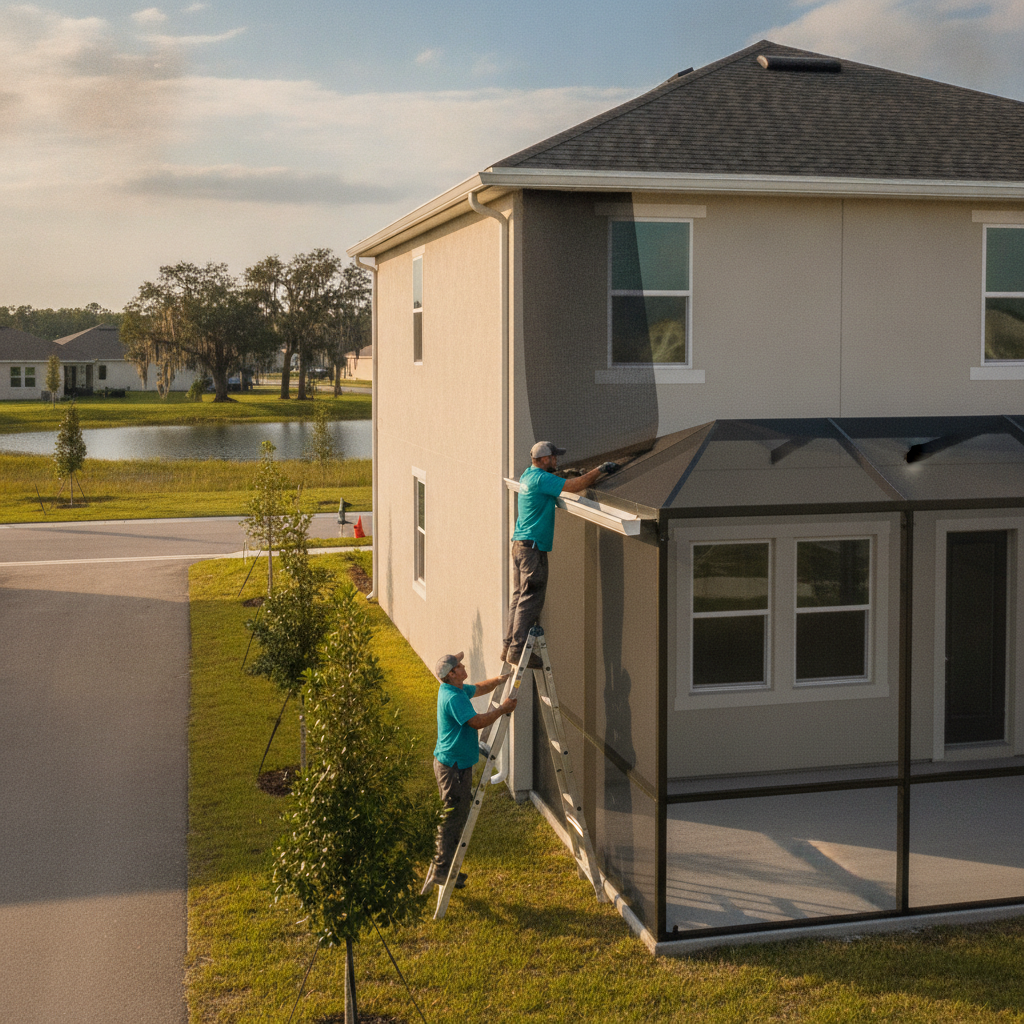
A builder in Posner Park or Four Corners often hands over a two-story house with a fresh seamless gutter run and a wide plastic screen already clipped into the lip. Six months later the trough is packed with sand, shingle granules, and construction dust from the lots still being graded off I-4. That screen was sized for leaves, and Davenport’s new roofs do not drop leaves the way a Lake Morton oak does.
The right gutter leaf guard for this corridor is the one that matches that debris, the pitch of a new roof, and the fascia a still-settling house is hanging from. Gutter guard installation on an I-4 house is a different job than clipping a screen onto an older Lakeland bungalow.
New-build roofs and why a wide screen clogs anyway
A wide gutter screen is a coarse grate. Water falls through the openings, and so does everything small enough to fit: sand from the fill, drywall dust from the last punch list, and the mineral granules a new asphalt roof sheds in its first wet season. Those particles drop into the trough, mix with pine needles that blow in from the lots still being cleared, and set up like grit in a rain barrel. The screen still looks clear from the driveway. The gutter underneath is already a planter.
Davenport, Loughman, and the Four Corners subdivisions sit on the growth corridor, not under the live oak canopy that mats a Lake Morton run every April. Catkins are not the main load here. Fine stuff is. A product built to stop oak flowers will still let Davenport’s dust through, because the openings that pass a summer thunderstorm also pass sand.
New shingles make it worse for a year or two. Asphalt sheds granules while it weathers in, and those granules are the exact size a wide screen cannot stop. They collect at the outlets first. Then the next storm overruns the front lip on the west elevation, the one that takes the afternoon rain, and stains the fascia. Homeowners see overflow and blame the downspout. The downspout is often fine. The trough is full.
Roof pitch on these two-story I-4 houses adds speed. Water comes off a steep field fast, hits the guard, and either punches through with the grit or sheets over the face if the hang is off. A screen that sat level on a low ranch in Highland City will not behave the same way on a Davenport two-story with a long front run and a valley dumping into one corner.
Builder gutters on these lots are often a 5-inch or 6-inch K-style, hung in a hurry so the certificate of occupancy can close. Building America notes that gutter channels are typically available in 4-, 5-, and 6-inch sizes, and that surface discharge should land at least 5 feet from the foundation, with underground catchment at least 10 feet out. That is program guidance, not a local code we verified. It still explains why a clogged trough on a new house shows up as puddles against the slab instead of as a dramatic waterfall. The water is leaving the roof. It is just leaving in the wrong place.
A gutter screen that came with the house is not a verdict on the rest of the system. If the hang is flat, if an outlet is undersized for the roof catchment on that run, or if a miter is already weeping, a new guard on top of that trough will overflow too. The crews we send start with the gutter itself. On a lot of these houses that means a new seamless gutter before any guard goes on, because you cannot filter a trough that already dumps at the seams.
For the oak-and-catkin version of this problem, the Lakeland write-up on gutter guard installation in Lakeland covers that canopy. This page stays on Davenport’s mix: sand, granules, construction dust, and the pine that blows in while the next street is still dirt.
Micro-mesh versus a cover on an I-4 house
Micro-mesh is a fine screen stretched over the trough. Water sheets through the mesh. Sand and granules stay on top and rinse off in the next storm if the roof has enough pitch to wash them. That is why it is usually the better match for a new Davenport roof. The debris that clogs a wide screen is the debris micro-mesh is built to keep out of the channel.
A solid cover, sometimes sold as a reverse-curve or hood-style leaf guard, uses the way water clings to a rounded nose. Rain follows the curve into a slot. Leaves and pine needles slide off the face. Fine dust can still wash in with the water, and a steep two-story run can throw water past the nose in a hard afternoon storm. Covers look clean from the street, which is why HOAs like them. They are not magic on a roof that sheds grit.
A wide gutter screen is the cheap clip-in the builder left. It is the product most people mean when they search gutter screen Davenport FL. It is also the product that packs first on these lots.
| Option | What it does on a new I-4 roof | Where it struggles |
|---|---|---|
| Wide gutter screen | Water and small debris both fall through large openings | Sand, shingle granules, and construction dust pack the trough while the screen still looks open |
| Micro-mesh | Water sheets through a fine mesh; grit stays on top and rinses off | Needs a true hang and a sound fascia, or water sheets over the face |
| Solid cover | Water follows the nose into the trough; most leaves slide off | Fine dust still washes in, and a steep two-story run can overshoot in a downpour |
The “best gutter guard Davenport FL” search is really a debris question. If the roof is new, the lots around you are still being graded, and the trees on the property are young pines rather than a mature oak, micro-mesh is the product that matches the load. If the HOA wants a clean cap and the roof is already past its granule shed, a cover can be the right look. A wide screen is the one to replace, not the one to keep.
None of those products fixes a trough that is the wrong size for the roof. Catchment per run, pitch, valleys, outlet spacing, and downspout cross-section decide whether 5-inch or 6-inch belongs on that elevation. Neither size is a default for Polk County roofs. The crews we send measure the run before they talk about a guard, because a fine mesh on an undersized gutter still overflows at the valley.
Guards on this site install in a published range of $5 to $14 per linear foot. A new aluminum seamless gutter installs at roughly $8 to $14 per linear foot, which puts most Polk County homes between $1,300 and $2,800 for the gutter itself. Those are installed ranges already on this site, not a quote for your street. Length, stories, color, fascia work, and how much of the old trough has to come off are what move a given house inside or outside those bands. The gutter guard cost guide for Polk County walks the drivers without turning one house into a county average.
Fascia, HOA color, and what install has to include
A new Davenport house is still moving. Trusses settle. The fascia can cup or pull at a hanger. A guard that only clips to the front lip will lift when that board twists, and then water gets behind the gutter and into the wood. That is how a two-year-old house gets stained fascia and soft corners. Fascia board damage in Polk County starts as a drip, not as a dramatic rot line, and a poorly fitted guard is one of the ways the drip gets there.
Install has to include a hang check, not just a clip. The existing trough needs pitch toward the outlets. Hangers that have already backed out of a settling board need to be reset or replaced before a mesh or a cover goes on. End caps and miters need to be dry. Outlets need to be open. If the fascia is already stained or soft, the board gets repaired or replaced as part of the same visit, because a new guard on wet wood is a short-term cosmetic.
HOA color is a real constraint on these streets. Architectural review in the I-4 subdivisions often wants the gutter and the guard to match the fascia or the window clad, usually white, bronze, or a clay that tracks the roof. A mill-finish mesh on a painted fascia is the thing that comes back as a violation letter. The crews we send match the guard and the trough to the board that is already there, and they leave the homeowner the spec sheet the association asked for. That is not a design flourish. It is how the house stays in compliance after the punch list.
Color also tells you whether the gutter itself should stay. A builder-white 5-inch with faded hangers and a mismatched screen looks worse with a new bronze cover on it than it did before. If the association cares about the elevation, replacing the trough and the guard in one color is the cleaner job.
Discharge still matters after the guard is on. Building America’s surface-discharge figure of at least 5 feet from the foundation is the mechanism: water that leaves the downspout against the slab will find the same settling joints the house is already working through. Splash blocks that dump at the corner, or a buried line that daylights in the bed, are part of the install, not extras. Underground catchment, when it is used, is guided at least 10 feet out. Again, that is program guidance.
Florida law is plain about who may contract this work. Florida Statutes 489.113 states that a person must be certified or registered in order to engage in the business of contracting in this state. Ask which class the contractor holds, then verify it yourself at myfloridalicense.com. Several license classes lawfully hang aluminum. Naming one class as the only correct one is not the useful answer. The useful answer is the lookup.
We cover Davenport with the rest of the I-4 corridor, and the Davenport outdoor living page is the hub for the other work these new houses queue up after the gutters: a builder-covered lanai left as a line item, a screen room, a patio cover. The gutter job is often the first one because overflow shows up in the first summer of afternoon storms.
Do gutter guards work on a new Davenport house?
They work when the product matches the debris and the trough is already hanging true. Micro-mesh keeps sand and granules out of a new I-4 gutter. A wide builder screen lets that same grit in. A cover sheds leaves and looks clean from the street, and it still lets fine dust wash through. The guard is only as good as the hang, the outlets, and the fascia under it.
How much does a gutter leaf guard cost in Polk County?
Installed gutter guards on this site run $5 to $14 per linear foot. Story count, color, fascia repair, and whether the existing trough stays are what move a house through that range. A new seamless gutter, if the builder run has to come off, is a separate line at roughly $8 to $14 per linear foot.
Will my HOA allow a gutter screen on the front elevation?
Most I-4 associations care about color and profile more than about mesh versus cover. A mill-finish clip-in on a painted fascia is the combination that draws a letter. Match the guard and the trough to the fascia, keep the front elevation consistent, and send the association the product sheet before the crew sets the first section.
When to call us
Call when a new Davenport gutter is overflowing with a screen that still looks open, when sand and granules are sitting in the trough, or when the fascia under a two-story run is already staining. That is licensed contractor work: height, hangers into a settling board, and a color match the HOA will inspect. The crews we send are licensed and insured, and they measure the run before they pick a product. Call us at (863) 777-5379.