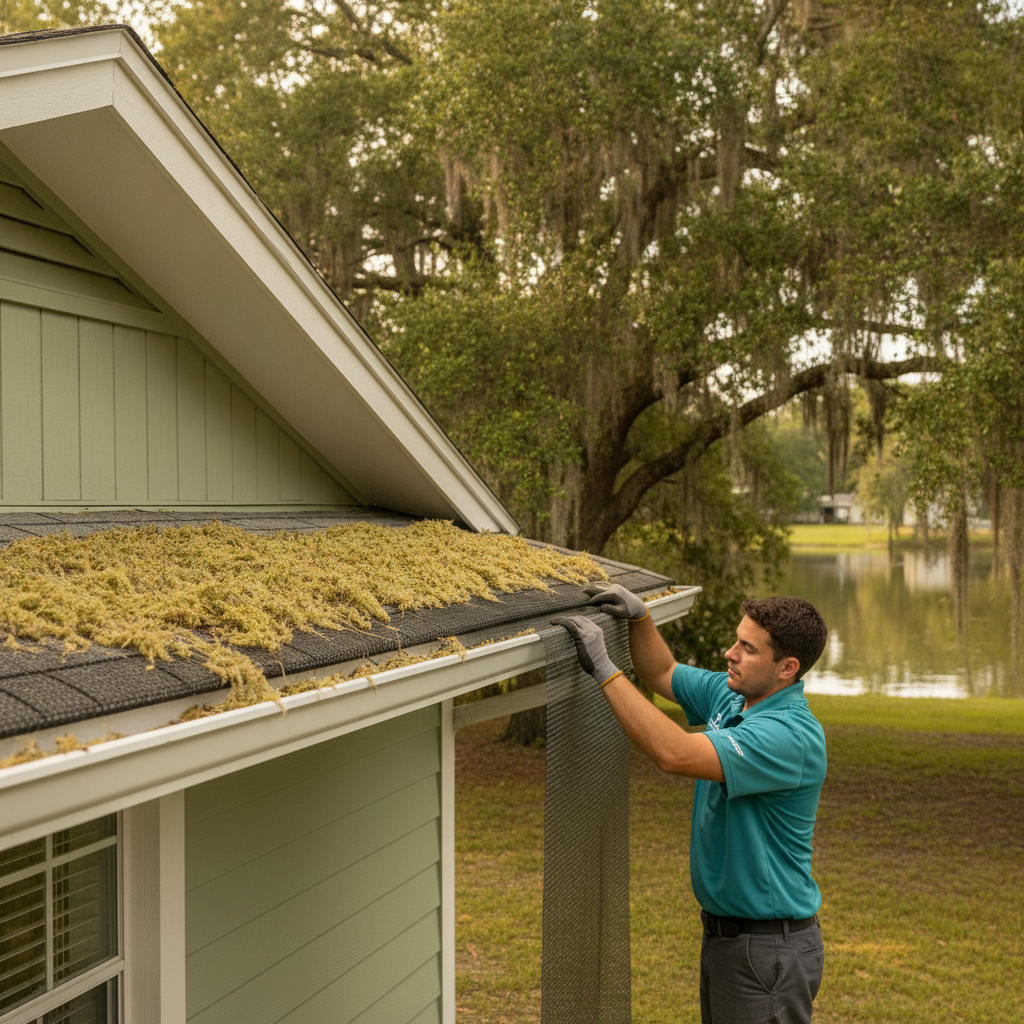
The live oaks off Lake Morton drop catkins in April, and those catkins felt into a pad on a wide-opening gutter screen until the next thunderstorm dumps the whole mat into the downspout. A coarse leaf guard that looks open and honest on a pine lot in north Polk fails on a Lakeland bungalow for that reason. The job here is matching the mesh to the debris, then fastening it to fascia that can actually hold the clips.
Why Lakeland oak catkins beat a wide gutter screen
A wide screen catches leaves and misses the thing that actually clogs a Lakeland trough. Catkins are small, slightly sticky, and they lock together once a few of them sit on the same wires. Water then sheets over the top of the pad instead of dropping into the gutter, and the overflow stains the fascia the same way an uncovered run does.
That is the April picture in Dixieland, around Lake Morton, and along Crystal Lake, where the canopy sits right over the eave. The same houses get a second load in fall, when acorns bounce into the trough and sit on the screen like marbles. A coarse opening that was sold as a leaf guard lets both problems through: the catkins mat on top, and the acorns either punch the mesh or roll into the outlet.
South Lakeland and the lots along US-98 open up, so the debris mix changes. You still get oak, but you also get longer runs and west-facing heat that cooks a cheap plastic screen until it warps off the hanger. Kathleen and Combee Settlement sit closer to mixed canopy, so the screen that looked fine in January is a brown felt by Easter.
A gutter leaf guard only works if water can still fall through it after the debris lands. On a live-oak eave, that means the opening has to be finer than the catkin, not just finer than a magnolia leaf. Hose the pad off a coarse screen in April and you will watch it reform after the next drop. That is the mechanism, not a brand preference.
Summer thunderstorms make the failure obvious. Central Florida gets short, hard rain, and an undersized or matted trough cannot take the burst. Water jumps the front edge, soaks the fascia, and finds the same thin 1950s patio slab a lot of these bungalows already have behind the house. The screen did not fail as a product category. It failed as the wrong opening for this canopy.
A new subdivision roof in Davenport or Four Corners is a different debris load. Builder shingles, young trees, HOA color rules. That house can often run a simpler cover than a Lake Morton bungalow under a century oak. Swap the two products and both jobs look wrong by the first spring.
Micro-mesh versus a cover on a Polk roof
Micro-mesh lets water through a fine stainless or aluminum weave and leaves the catkins, pine needles, and shingle grit on top, where sun and a hose can deal with them. A solid or hooded gutter cover asks water to sheet across a face and find a slot or hinge. Both can be installed well. They fail for different reasons on a Polk County roof.
The cover looks cleaner from the street. On a long west run in South Lakeland, that sheet of water from a summer cell can travel past the intake before it drops, so the trough underneath stays dry while the fascia gets wet. Micro-mesh avoids that sheet-flow problem if the weave stays open, which is why oak country leans that way. The tradeoff is simple: you still walk the oak side with a hose after the catkin drop. You just stop scooping sludge out of the trough.
| Micro-mesh | Solid or hooded cover | |
|---|---|---|
| How rain enters | Through the weave into the trough | Across the face and into a slot or hinge |
| Live-oak catkins | Sit on top, dry, then rinse or blow off | Can still felt at the intake slot |
| Hard summer rain | Works while the weave is clear | A long run can sheet past the slot |
| What you still do | Hose the oak elevation after April | Walk the eave; less sludge in the trough |
Neither 5-inch nor 6-inch is a default size for Polk County roofs. Building America notes that gutter channels are typically available in 4-, 5-, and 6-inch sizes, and that surface discharge should land at least 5 feet from the foundation. That is program guidance, not a local code we verified. The crews we send size the trough to roof catchment per run, pitch, valleys, outlet spacing, and downspout cross-section, then pick a guard that does not choke the outlet they just sized.
A guard on a trough that is already too small for the roof just hides the overflow. If the existing hangers are pulling, the seams are leaking, or the outlets sit on the wrong corners, gutter guard installation waits until the trough itself is right. On a lot of older Lakeland houses, that means a new seamless gutter run first, then the mesh. Guards installed on a failing trough last until the next blow-off, and then you pay twice.
Installed guards on this site run $5 to $14 per linear foot. What moves a job inside that spread is access, stories, the mesh you pick, and whether the fascia and trough have to be rebuilt before a clip goes on. The cost-driver walkthrough lives in our Polk County gutter guard cost guide. Do not treat a neighbor’s invoice as your number. A one-story Crystal Lake bungalow and a two-story west run in South Lakeland are not the same afternoon.
What installation has to include on fascia that is already tired
Clips and screws have to land in wood that can hold them. A lot of Lakeland fascia cannot. Overflow from an open trough, or from a matted coarse screen, keeps that board wet. Paint peels, the edge goes soft, and a clip that felt tight in March walks out in June.
The crews we send probe the board before they commit a fastener pattern. Soft spots, rusted spikes, and a wavy front edge are the tells. Hanging micro-mesh on that board just loads the same rot. Fascia repair, or a full board swap, belongs in the same visit as the guard, not as a callback after the first storm. Our notes on fascia board damage in Polk County cover how that wet edge actually fails.
A tired trough gets the same treatment. Hangers that have pulled, miters that weep, and outlets packed with old catkin felt are not a guard problem. They are a gutter installation in Lakeland problem. Guards sit on a trough that already drains. If the run has to come off, the new seamless gutter goes on with hangers into sound wood, outlets where the roof actually sheds, and only then the mesh.
Height work on a two-story eave is contractor work. Cutting into fascia, resetting hangers, and walking a wet oak-shaded roof is not a Saturday ladder job. Florida law is plain on who may contract that kind of improvement. Florida Statutes 489.113 says a person must be certified or registered in order to engage in the business of contracting in this state. Ask which class the contractor holds, then check it yourself at myfloridalicense.com.
A clean install on a Lakeland oak house usually includes a full trough cleanout, a fascia check, hangers reset where they have walked, mesh or cover fastened on a consistent plane, and outlets left able to take a summer burst. Skip the fascia check and the prettiest mesh still pulls the board apart. Skip the cleanout and last April’s felt sits under a brand-new screen.
Downspouts matter as much as the weave. A perfect guard over a crushed elbow still overflows. Building America’s surface-discharge guidance, at least 5 feet from the foundation, is the directional picture: get water away from the slab, not into the same thin patio pour a Dixieland bungalow already struggles to anchor. Underground catchment, where it exists, is a longer throw. Confirm the path on site. Do not assume the original builder left one that still works.
Will a coarse leaf guard work under Lakeland oaks?
It will catch leaves and still felt over with catkins. The opening is built for a different debris size than a live-oak drop, so the screen looks open from the yard and closed from above once April hits. Micro-mesh, kept clear with a hose on the oak elevation, is the pattern that matches this canopy.
Do I need new gutters before the guards go on?
Only if the trough, hangers, or fascia are already failing. Sound seamless gutter with solid wood behind it can take a guard. Soft fascia, pulled hangers, or a run that already overflows in a thunderstorm need that work first, or the new mesh inherits the same leak.
When to call us
Call when the oak side of the house overflows in April, when a coarse screen has matted shut, or when the fascia under the trough feels soft to a screwdriver. That is licensed contractor work: height, fasteners into wood, and a trough that has to drain after the mesh goes on. We match you with licensed local crews who install gutter guards across Lakeland and the rest of Polk County. Call us at (863) 777-5379.