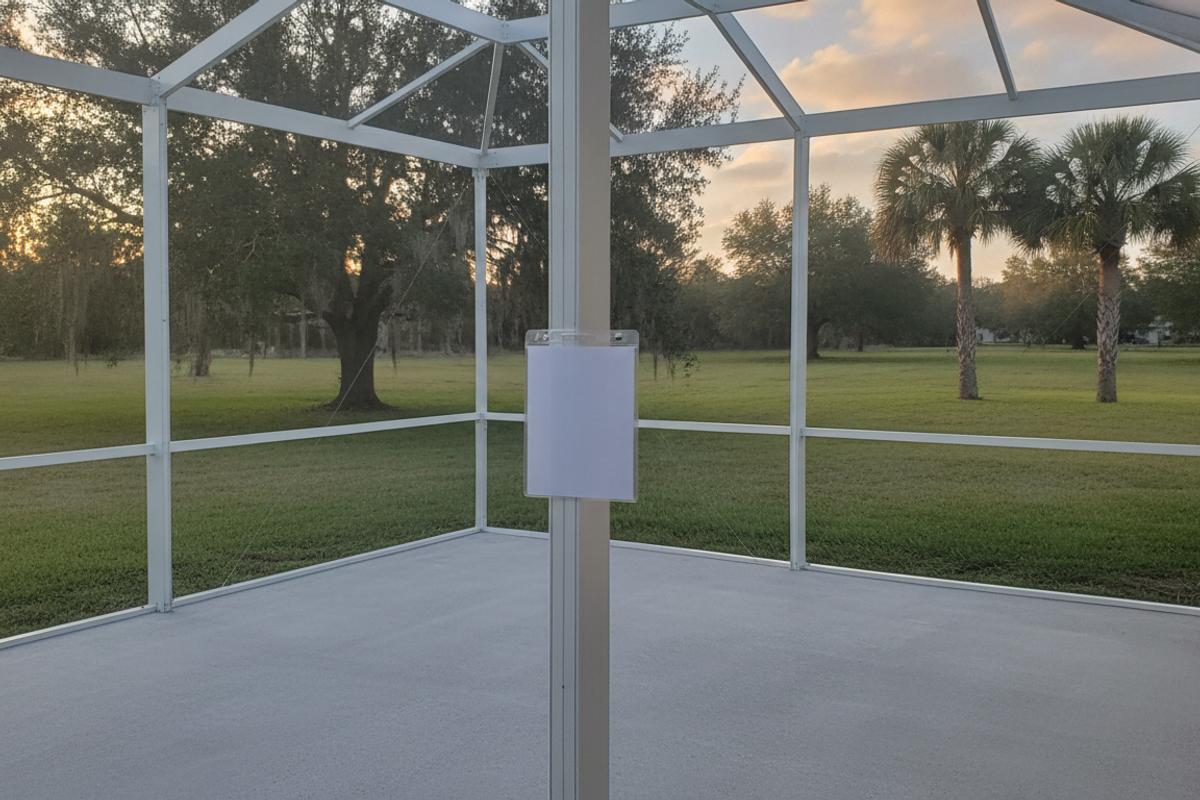
A notice of commencement is the document F.S. 713.13 requires an owner, or the owner’s authorized agent, to record in the clerk’s office before actually commencing to improve real property, except for an improvement exempt under F.S. 713.02(5). Recording it is not the whole requirement. The owner also has to post either a certified copy of the recorded notice, or a notarized statement that it has been filed for recording along with a copy, at the site of the improvement.
It is not a building permit, not a notice to owner, not a claim of lien, and not a notice of termination. F.S. 713.13(3) says recording a notice of commencement “does not constitute a lien, cloud, or encumbrance on real property.”
In Polk County, as elsewhere in Florida, the first-inspection copy rule is statutory. Once the direct contract is greater than $5,000, the issuing authority must have a copy on file before the first inspection. Skip the recording, and the usual result is not a stalled permit application. It is an inspection that cannot be performed or approved until one of the three accepted proofs is filed.
What a notice of commencement actually is
F.S. 713.13 exists so people who furnish labor, services, or materials can see who the owner, contractor, lender, and designated notice-recipient are, and so the owner has a recorded effective period for payments.
The reason it matters after that period is spelled out in the warning language the state requires on the form itself: “ANY PAYMENTS MADE BY THE OWNER AFTER THE EXPIRATION OF THE NOTICE OF COMMENCEMENT ARE CONSIDERED IMPROPER PAYMENTS UNDER CHAPTER 713, PART I, SECTION 713.13, FLORIDA STATUTES, AND CAN RESULT IN YOUR PAYING TWICE FOR IMPROVEMENTS TO YOUR PROPERTY.” An expired notice stops doing that tracking job. A notice of termination can end the notice’s effectiveness under its own rules. Termination is not a retroactive repair of every improper payment, and it is not a lien release.
Does a notice of commencement have to be filed before your permit is issued in Polk County
No. F.S. 713.135(1)(f) bars the issuing authority from requiring a notice of commencement to be recorded as a condition of applying for, processing, or issuing a building permit. Your permit application moves on its own timeline.
What the statute does require, at F.S. 713.135(1)(e), is that the applicant file a copy of the notice of commencement with the issuing authority before the first inspection if the direct contract is greater than $5,000. In the absence of that filing, “the issuing authority or a private provider performing inspection services may not perform or approve subsequent inspections until the applicant files” a copy.
“Copy of the notice of commencement” has three accepted forms:
- A certified copy of the recorded notice of commencement.
- A notarized statement that the notice of commencement has been filed for recording, along with a copy.
- The clerk’s official-records identifying information, meaning the instrument number or the book and page where it was recorded.
The copy must contain the name and address of the owner, the name and address of the contractor, and the location or address of the property being improved. The issuing authority is directed to verify that those items are consistent with the building permit application.
Some early-stage work is carved out. If a local government requires a separate permit or inspection for temporary electrical or other temporary utility service, land clearing, or other preliminary site work, those permits may be issued and those inspections may be conducted without a copy of the notice of commencement.
Your permit’s own progress is public once it is issued. A Polk County permit search shows how to pull it up by address. If you are assembling the enclosure file, the screen enclosure permits guide can help organize that next step. It is not a substitute for F.S. 713.13 or 713.135.
The $2,500 line and the $5,000 line are different rules
You’ll see $2,500 quoted as the number, often on the same page as the $5,000 one. Both figures are real. They answer different questions.
F.S. 713.02(5) says any improvement with a direct contract price of $2,500 or less “shall be exempt from all other provisions of this part except the provisions of s. 713.05.” F.S. 713.13 carries that exemption forward: the recording duty applies “except for an improvement that is exempt under s. 713.02(5).” So a qualifying job at or under $2,500 needs no notice of commencement. Direct-privity lien rights under F.S. 713.05 still remain. Do not read the exemption as a statement that no lien can exist, or as a waiver of the entire lien law.
Above $2,500, F.S. 713.13 requires the notice of commencement to be recorded before work actually starts, unless another exemption applies.
Above $5,000, F.S. 713.135 adds the first-inspection copy rule.
A third $2,500 figure lives in F.S. 713.015. That one is the qualifying-contract warning threshold, not the notice-of-commencement exemption. It is explained in the contractor lien guide.
Do not treat any of those thresholds as a market rule about what a full enclosure “never” costs.
What has to be on the form
F.S. 713.13(1)(a) requires all of the following:
The property. A description sufficient for identification, including the legal description plus the street address and tax folio number if available.
The work. A general description of the improvement.
The owner. Name, address, and interest in the property, plus the fee simple titleholder if that is someone else. A lessee who contracts for the improvements is an owner under this part and must be listed as the owner, with a statement that the interest is a leasehold.
The contractor. Name and address. The statutory form also includes a contractor phone number.
The money side. The surety and bond amount, if any, and the name and address of any person making a loan for the construction.
A Florida contact. A person in the state, other than the owner, who may be designated to receive notices. Service on that person constitutes service on the owner.
An expiration date. More on that below.
One line is about signing, not about who may record or post. F.S. 713.13(1)(g) is explicit: “The owner must sign the notice of commencement and no one else may be permitted to sign in his or her stead.” The statutory form’s signature block lists the owner or lessee, or an authorized officer, director, partner, or manager of the owner or lessee. A contractor signing in the homeowner’s stead is outside that rule. An authorized agent may still record and post, which is a different act from signing.
Polk County publishes a Notice of Commencement PDF. The county’s current template was parsed as two pages, with property, owner, contractor, and statutory warning fields. The parsed notary block did not show the current statute’s physical-presence and online-notarization checkboxes, so do not treat the county template as a field-for-field match of the 2026 statutory form. The statutory form in F.S. 713.13(1)(d) does include those checkboxes.
Where to record a notice of commencement in Polk County, and what it costs
The Polk County Clerk records official records at three offices: Bartow, Lakeland, and the Northeast Government Center in Lake Alfred. Official-record searches run from 1957 to the present, with historical deeds from 1861 through 1956 searched separately, across more than 350 record types.
The Clerk’s current general fee rows, not a flat notice-of-commencement price, are:
- $10.00 to record, index, and file the first page of an instrument up to 14 inches by 8.5 inches.
- $8.50 for each additional page or fraction.
- $1.00 to index each name past four.
- $1.00 per page for a photographic copy from the public record, not more than 14 inches by 8.5 inches.
- $2.00 to certify copies in the public record.
On a two-page document, that arithmetic is $18.50 to record and $4.00 for a certified two-page copy, before extra-name, card, or attachment charges. A service charge is applied to credit card transactions. If the recorded packet is not two pages, or if extra names or attachments apply, the total changes. The statute permits posting a notarized statement that the notice was filed for recording together with a plain copy.
How long a notice of commencement stays valid
Two clocks start from F.S. 713.13, both tied to the recording.
The first is short. If the improvement described in the notice has not actually commenced within 90 days after recording, “such notice is void and of no further effect.” You would have to record a new one before work could begin. A void notice is not a candidate for the amendment path below.
The second is longer. Unless a different date is specified, F.S. 713.13(6) makes the notice no longer effectual against a conveyance, transfer, mortgage, or lien, or against creditors or subsequent purchasers for value, after 1 year after the date of recording. The statutory form says so on its expiration line: “the expiration date will be 1 year after the date of recording unless a different date is specified.”
If the contract expresses a completion period greater than one year, F.S. 713.13(1)(c) requires the notice to state that it is effective for one year plus that additional period. Payments made after expiration are considered improper payments.
A notice that is still inside its effective period may be amended under F.S. 713.13(5)(a) to extend the period, correct erroneous information, or add omitted information. Changing contractors is outside that amendment: “in order to change contractors, a new notice of commencement or notice of recommencement must be executed and recorded.” A finished job, or a job whose notice should be closed out, is a notice of termination question, with its own payment, service, and 30-day rules.
Who has to post it, and when
Recording it with the clerk is half the job. Florida law also requires the owner or an authorized agent to post either a certified copy of the recorded notice, or a notarized statement that it has been filed for recording along with a copy, at the site of the improvement, before work actually begins.
The building permit card, by statute, has to carry this warning: “A NOTICE OF COMMENCEMENT MUST BE RECORDED AND POSTED ON THE SITE OF THE IMPROVEMENT BEFORE THE FIRST INSPECTION.”
Whether the property sits in unincorporated Polk County or inside Lakeland city limits, the recording and posting requirement is this state law. The two jurisdictions still run separate permit queues.
This post covers the notice itself. For the permit process it rides alongside, see screen enclosure permits in Polk County, carport permits and setbacks in Polk County, and sunroom permits in Polk County.
Frequently asked questions
What is a notice of commencement?
A notice of commencement is the document F.S. 713.13 requires an owner to record with the county clerk before starting an improvement to real property, except for a F.S. 713.02(5) small-improvement exemption. It identifies the property, the owner, and the contractor, and it has to be posted at the job site once it is recorded. It is not a lien.
Does a notice of commencement have to be filed before Polk County issues my building permit?
No. F.S. 713.135 specifically bars the issuing authority from requiring a notice of commencement to be recorded as a condition of applying for, processing, or issuing a building permit. It comes into play at the first inspection, not the permit application.
When does Florida actually require proof of it at inspection?
Before the first inspection, once the direct contract for the work is greater than $5,000, under F.S. 713.135. That is separate from the recording requirement itself, which F.S. 713.13 puts on the owner before work starts, except for an improvement exempt under F.S. 713.02(5).
Who has to sign the notice of commencement?
The owner. F.S. 713.13(1)(g) says the owner must sign the notice of commencement and no one else may sign in the owner’s stead. The statutory form also lists a lessee who contracted for the improvement, and an authorized officer, director, partner, or manager of the owner or lessee.
How long is a notice of commencement good for?
By default, one year from the date you record it, unless you list a different date on the form, under F.S. 713.13(6). It also becomes void earlier, after 90 days, if the work described in it has not actually started, under F.S. 713.13(2).
What does it cost to record a notice of commencement in Polk County?
The Clerk’s general recording rows are $10 for the first page and $8.50 for each additional page. On Polk County’s current two-page template, that arithmetic is $18.50, and a certified two-page copy is $4, before extra-name, card, or attachment charges. Those figures are not a flat all-in filing price, and not every recorded notice is two pages.
Getting the paperwork in place before the first inspection
At Lakeland Outdoor Pro, we connect Polk County homeowners with insured local crews. We do not perform licensed work or provide legal advice.
Call (863) 777-5379 to talk through a screen enclosure, pool cage, sunroom, carport, or patio cover, and ask the matched contractor who is recording the notice of commencement, and when.