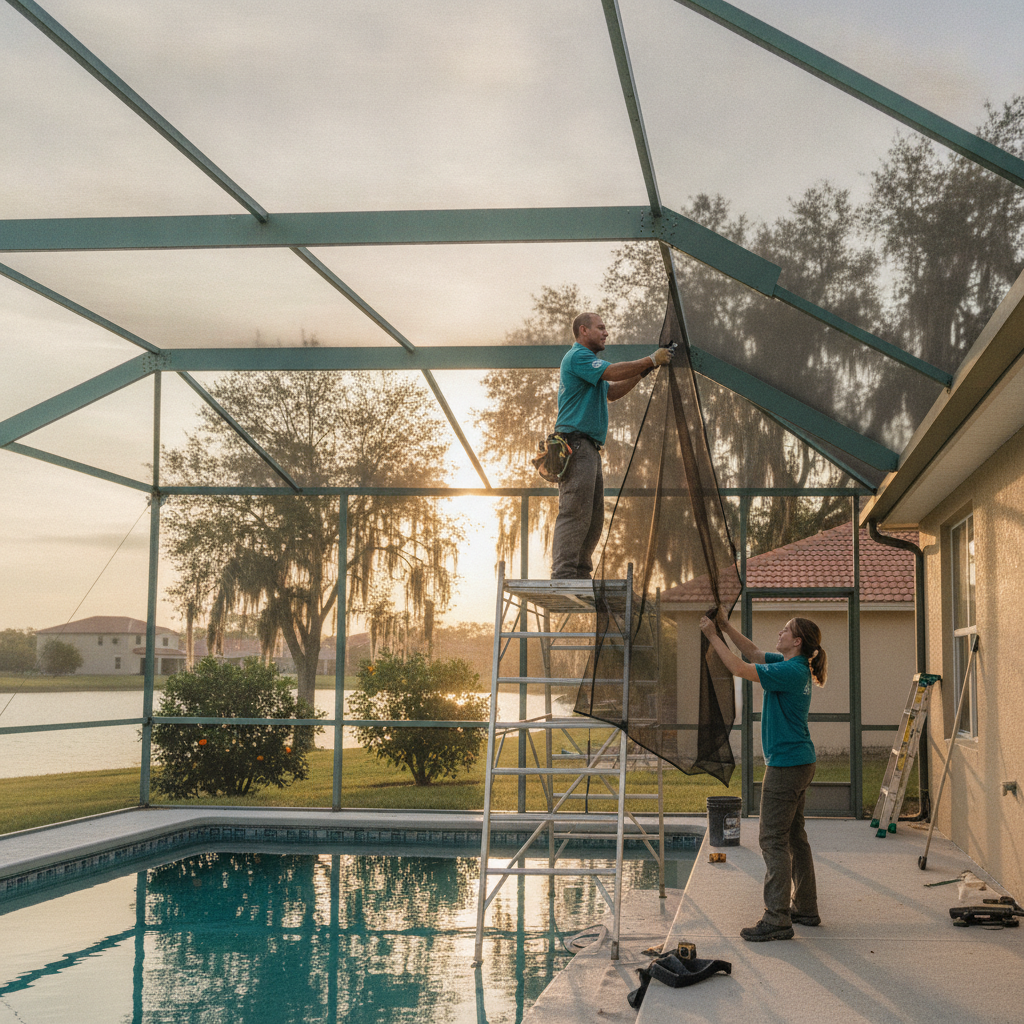
The south wall of a Lake Wales pool cage sits in open sun most of the afternoon. On the ridge there is less live oak shade than you get off Lake Morton, so the vinyl coating on that mesh goes chalky and brittle years before the north side looks tired. Then a summer thunderstorm gets under a loose panel, the rubber spline walks out of the channel, and the bugs have a door.
A hole you can cover with your palm is usually a panel. A roof that bags between the rafters is a rescreen. A beam that rolled, or a gate that will not latch, is a different job, and that is the work the crews we send handle.
Lake Wales sun and what it does to screen
Screen in inland Polk County lasts roughly seven to twelve years, and it fails unevenly. Sun kills the mesh on the south and west elevations years before it touches the shaded north side. That pattern is sharper in Lake Wales, Babson Park, and Frostproof than it is under the canopy in Dixieland, because the sand ridge is higher, the lots are more open, and a cage out by the groves has a long, clear shot at the afternoon sky.
The mesh is not glued on. It sits in a groove in the aluminum, held by a rubber spline. Heat shrinks and cooks that spline. UV makes the cloth stiff. The first real wind, often a June-through-November thunderstorm during Atlantic hurricane season, peels a brittle panel out of the channel like a sail. On a Winter Haven cage the same thing happens, but live oaks throw shade and drop catkins. On the ridge you get more sun and more blown sand than oak litter, so the roof screen and the west wall go first.
A single torn bay is still a panel job. The crew pulls the old spline, seats new cloth in the same channel, and rolls a fresh spline in. Individual screen panels typically run $35 to $90 each, and a ground-level bay with a true frame is the one repair a careful homeowner can do without a contractor. Once the cloth is brittle on a whole elevation, swapping one square leaves a checkerboard: new green next to old gray that will split in the next blow. That is when pool cage rescreening is the honest move, not another patch.
Standard fiberglass in this trade is an 18x14 weave. It keeps out most insects and still lets breeze through. If no-see-ums and gnats are the complaint around the lakes, a 20x20 no-see-um cloth is the tighter weave built for those smaller flies. Pet-resistant screening is a heavier, tear-resistant cloth for dogs and cats on a patio or porch; the maker does not publish a mesh count for it, so do not shop it by number. Vinyl-laminated 18x14 cloth is a wall and kick-panel product. It is not a roof product and is not meant for horizontal use. Matching the cloth to the elevation matters more than matching the color of a faded neighbor panel.
Citrus bloom and fine sand will dust a Lake Wales cage the way oak catkins mat a gutter in April off Lake Morton. That dust sits on the roof screen and holds heat. It does not punch holes by itself. The holes come from UV, from a ladder leaning on a bay, from a dog, or from wind working a spline that already let go. Walk the south and west walls in late afternoon. If the cloth sounds papery when you tap it, the next storm is the repair window, not next year.
Patio versus pool cage repairs
A patio lanai and a pool cage both use the same spline-and-channel trick. The jobs diverge in size, height, doors, and what happens if the frame itself is tired.
A few torn bays on a rear patio in town are usually panel swaps. Screening in an existing covered lanai, the job of turning a builder roof and a slab into a true screen room, is a different scope: new infill framing, new doors, new cloth, and a permit question once that framing goes in. Local published ranges for screening an existing covered lanai sit at $1,500 to $3,500. Individual panels stay in the $35 to $90 band. Screen door work, a rehang, a rebuild with new hardware, or a full replacement, runs $180 to $500.
A pool cage is the larger structure. It has wall bays, a screened roof, and at least one gate people treat as the everyday door. A full-cage rescreen in the ranges this site already publishes is $1,400 to $3,200, or about $2.50 to $4.00 installed per square foot of standard fiberglass. Those figures are for putting new cloth on an existing frame, not for a new cage. A new residential pool cage in the Lakeland area is a $9,000 to $18,000 job, and a large deck, a two-story mansard tied into the house, or a high clear span pushes that to $20,000 to $35,000. Do not stretch a rescreen number onto a rebuild.
| What you are looking at | Patio or lanai | Pool cage |
|---|---|---|
| A hole or a popped spline in one bay | Ground-level panel swap in the same channel | Same spline work, often from a ladder or on a mansard |
| Cloth brittle on a whole wall or the roof | Rescreen the tired elevations before the next blow | Full-cage rescreen, roof included, because the roof takes the sun |
| Door that drags or will not close | Hardware and a square opening | Hardware plus the latch geometry the statute cares about |
| Frame rolled, bay racked, or anchors walking | Past a patch: enclosure repair or a new room | Past a patch: repair the aluminum or replace the cage |
Pool-cage doors are where homeowners get bad advice. Florida’s Residential Swimming Pool Safety Act lists ways a residential pool may be made safe. One option is an enclosure that meets the barrier rules in section 515.29. That section never names “screen enclosure” as a category. What it asks a barrier to do is specific: at least 4 feet high on the outside, no gap or protrusion a young child could crawl under, squeeze through, or climb, and a gate that opens out, self-closes, and self-latches with the release on the pool side, out of a child’s reach. Whether a given cage does all of that is what the building official signs off on, not what a website can promise. A door that you have to hip-check shut, or a latch a toddler can reach through a kick panel, is a hardware problem, not a mesh problem. Read how that door hardware actually works before anyone sells you a prettier screen and leaves the latch alone.
Storm season makes the split obvious. A popped patio panel is an annoyance. A peeled roof screen on a cage dumps leaves and pine needles into the water and leaves a hole at height. Enclosure repair after storm damage is the licensed-crew job when beams have moved. Cloth-only work is the rescreen. Mixing those two in one quote is how a cheap patch fails in October.
Mesh choice follows the house, not the brochure. A shaded lanai off a small Lake Wales ranch can live on standard 18x14 fiberglass. A cage with a dog door needs the pet-resistant cloth on the lower walls and still wants breathable cloth up high. No-see-um weave on every elevation of a large cage cuts breeze. Put the tight weave where the sitting area is, not on the roof. For a longer walk through the cloth options, see screen mesh types in Central Florida.
Permits when the repair becomes a rebuild
A spline swap in an existing channel is cloth. Adding aluminum is construction. Polk County’s Building Division says a permit is required for screening of any space that requires structural or infill framing to be added. Rigid-roof carports sit on that same published list. The county does not publish a dollar fee in the material this site can cite, and a page that invents one is useless to you. The building official for your address is the person who assigns the requirement.
Lake Wales is its own city. Unincorporated Polk goes through the county Building Division. Inside city limits, the city’s building official is the one who reviews the drawing. A crew that mostly works unincorporated lots can hit friction at that counter if nobody asked which desk the property sits under. On the ridge, setbacks and easements show up more often than screen color, because parcels run larger and older citrus lots carry utility strips a slab was poured next to years ago. That is a survey and a counter question, not a guess from the road.
The Florida Building Code assigns an ultimate design wind speed to a specific address. The engineered drawing in the permit package states the value the structure was designed to. Inland Polk carries a lower number than a Gulf-front county, which is why the same cage is priced differently here. No honest quote quotes a miles-per-hour figure off a map on a blog. If someone is replacing beams, adding bays, or tying a mansard into the house, that drawing is the job. If someone is only rolling new spline into channels that are still straight, you are still in cloth territory, and the county’s framing test is the line to ask about.
Florida law is plain on who may contract the work. A person must be certified or registered in order to engage in the business of contracting in this state. Several license classes lawfully build aluminum structures. Ask which class the contractor holds, then verify it yourself at myfloridalicense.com. The crews we send are licensed and insured. This brand matches you with them. It is not the licensee, and it does not pull the permit.
Do not treat a rebuild as a weekend project. Erecting or modifying an aluminum frame, setting or re-setting anchors in a slab, changing pool-gate hardware, or working at height on a two-story mansard belongs to a licensed contractor. Replacing one spline-set panel at ground level, on a frame that is still square, is the homeowner exception. Everything past that is how unpermitted rooms get discovered when the house sells. If the repair already happened without paper, start with the Building Division and the process, not a number you heard in a parking lot. Our notes on screen enclosure permits in Polk County walk the same split: cloth versus framing.
Cost follows that split too. Panel prices stay in the $35 to $90 range. A full-cage rescreen stays in the $1,400 to $3,200 range for standard fiberglass. New rooms and new cages leave those bands. What moves a rescreen up is roof area, two-story walls, pet or no-see-um cloth instead of standard fiberglass, and access around a tight Lake Wales lot with a grove fence and one side yard. What moves it down is a small patio, ground-level bays, and cloth that only failed on one elevation. For a county-wide read of those drivers, see screen repair cost in Polk County.
Can a damaged screen be fixed?
Yes, if the aluminum is still true and the channel still holds a spline. A puncture, a popped panel, or a door with torn kick-panel cloth is a fix. Mesh that crumbles when you flex it, a roof that has bagged into a hammock, or a bay that is no longer square is not a patch. Replace the cloth on the tired elevations, or repair the frame, rather than stitching one more square onto a structure that has already moved.
Is this the same as phone screen repair in Lake Wales?
No. This is the mesh on a lanai, a patio, or a pool cage, held in aluminum with spline, not glass on a phone. A window screen is a small removable frame that uses the same cloth idea at a much smaller scale. A cage panel is part of a structure, sometimes at height, and once you add infill framing the county’s permit list is in play. If the glass on a phone is cracked, that is a different counter in town.
What does a Lake Wales panel or rescreen usually run?
Individual screen panels are $35 to $90 each. A full-cage rescreen is $1,400 to $3,200, or about $2.50 to $4.00 installed per square foot of standard fiberglass. Screening in an existing covered lanai sits at $1,500 to $3,500 in the same published ranges. Those are cloth-on-existing-frame numbers. A new cage, a new room, or a frame that has to be rebuilt leaves them.
When to call us
Call when the cloth is brittle on a south or west wall, when a pool-cage roof has bagged, when a gate will not self-close, or when the repair is about to add framing rather than spline. That is licensed contractor work in Polk County, including Lake Wales, Babson Park, and Frostproof. Call us at (863) 777-5379.