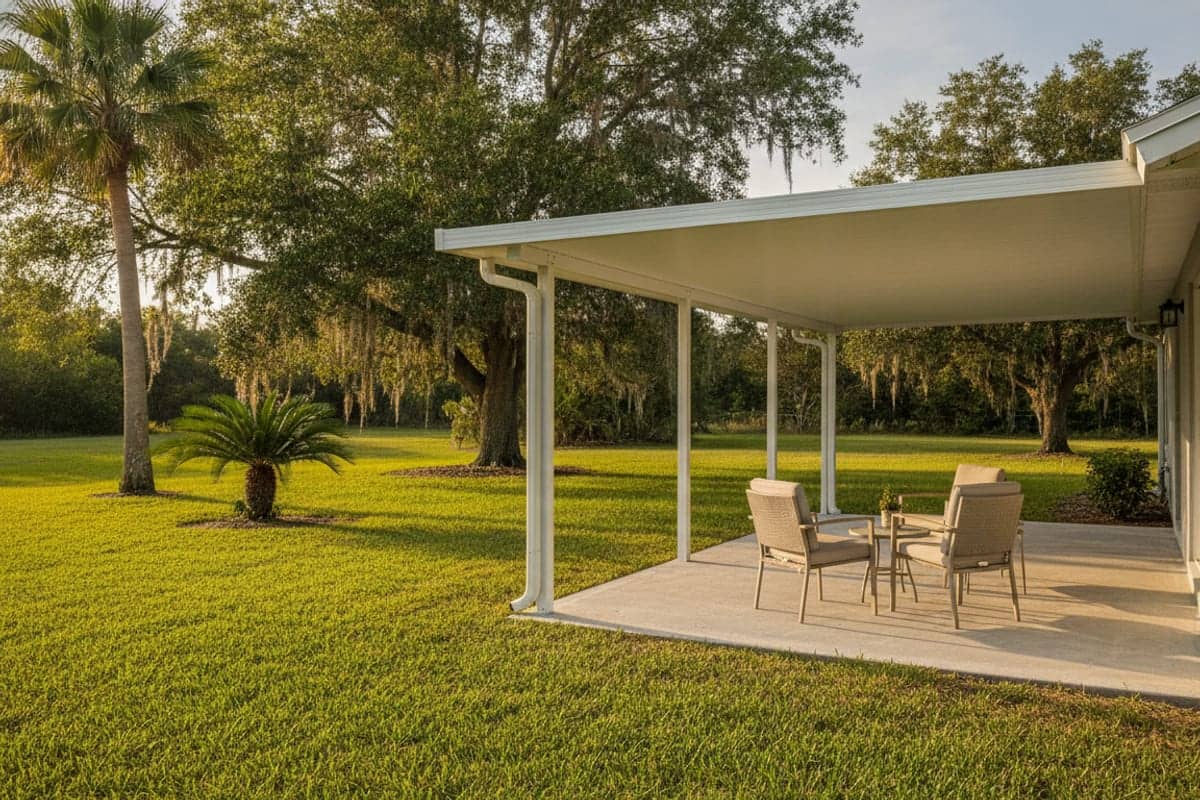
An aluminum patio cover runs $3,500 to $9,000 installed and permitted in Polk County. Pan roof sits at the low end, insulated panel at the high end, and the depth you ask for drives most of what is left. It is the least expensive structure an aluminum crew builds.
There is one catch worth knowing before you call anyone, and it has nothing to do with price. The building code will not let you park a car under it.
What an aluminum patio cover costs in Polk County
Most covers land between $3,500 and $9,000, installed with the permit pulled.
Two things move that number. The roof panel you pick, and how far the cover reaches out from the house. Depth costs more than width, because depth is what forces heavier beams. Doubling how far a cover projects is a bigger jump than doubling how wide it runs.
An aluminum patio cover is also the cheapest thing on this menu by a wide margin. The same footprint as a screen room costs more, and as a glass sunroom it costs several times more. With a cover you are buying a roof and posts, and nothing else.
The roof panel decision, and why it changes over a seating area
Insulated panel beats pan roof anywhere you plan to sit for more than a few minutes.
A pan roof is a single skin of aluminum. It stops rain and direct sun, and it passes radiant heat straight through to the space underneath. An insulated panel is two aluminum skins bonded to a foam core, and the core is what keeps that heat from arriving.
The second difference shows up every afternoon in July. A pan roof in a Polk County downpour is loud enough to end a conversation. The foam core takes most of that out.
Under a carport, where you park and walk away, pan roof is usually the right call. Over a patio with chairs on it, the upgrade earns the difference. Sound and radiant heat only matter where people sit.
An aluminum patio cover is not a carport, and the code says so
Appendix H of the Florida Building Code, Residential, sets out what a patio cover is allowed to be. Section AH101.2 is short and specific: patio covers shall be used only for recreational, outdoor living purposes, and not as carports, garages, storage rooms or habitable rooms.
That sentence surprises people, because the two structures can look identical from the street. Same posts, same panels, often the same crew on the same afternoon. What differs is the use the structure was permitted and engineered for.
It lands in three practical places. A cover permitted for outdoor living and later parked under is not what the county approved. One walled in for storage has become a different structure. Closing one into heated and cooled space is a conversion, and that is its own permit.
So if there is any chance you want to park under it, say carport on day one. The engineering, the setbacks, and the inspection all go smoother when the structure matches its stated use from the start. Carport permits and setbacks in Polk County walks that path, and building on an easement in Polk County covers the recorded strip that can rule out the spot before either question comes up.
What Polk County wants before anything goes up
A patio cover needs a permit here. Not usually, always.
The county’s own permitting guidance is blunt about the threshold: a construction permit is required for construction of any building or structure regardless of size. A roofed structure fixed to your house clears that bar without argument.
Setbacks come with it, so a cover that reaches toward the rear property line may not be approvable at the depth you had in mind. Measure before you fall in love with a size. If you are in an HOA along the I-4 corridor, architectural review generally comes before the county rather than after.
Polk County’s plans examiners take questions at (863) 534-6080 from the Bartow office if you want to check your own lot first. The contractor should still be the one pulling the permit, and screen enclosure permits in Polk County explains why that matters more than it sounds.
Ask every bidder for the FL Product Approval number
Every roof panel and structural component on your cover should carry a Florida Product Approval number, and you can look it up yourself.
Florida runs a statewide approval system under Rule 61G20-3 of the Florida Administrative Code. Roofing and structural components are both categories that fall under it, which covers the panels overhead and the frame holding them. An approved product carries an FL number, and those numbers are searchable on the state’s own building code site.
This is the cheapest question a homeowner gets to ask. A crew that builds these every week will have the number ready without looking. Ask which panel is being quoted and what its FL approval is, and the vague answers separate themselves quickly.
The same thinking runs through the structure. Wind load and engineered drawings covers what a sealed drawing actually buys you in Polk County.
Aluminum, wood, or fabric over a Polk County patio
| Cover type | How it does here |
|---|---|
| Insulated aluminum panel | Permitted structure, engineered to a design wind speed, no repainting cycle. Highest cost. |
| Pan roof aluminum | Same structure and permit, less heat and noise control. Cheapest permanent option. |
| Wood pergola or frame | Needs sealing and repainting in this humidity, and an open top is shade, not rain cover. |
| Fabric or retractable awning | Retracts, so it is not a permanent roof, and it generally has to be closed in wind. |
An aluminum awning and an aluminum patio cover come from the same family, and people search for both interchangeably. The working difference is scale and attachment. An awning usually shades a door or a window. A cover spans a patio and carries a real roof load, which is why one needs engineering and the other often does not.
Out on the Ridge around Lake Wales, open citrus land means full sun and more wind on anything you put up, and the case for a permitted aluminum structure over a fabric one stops being close. Along the US-98 corridor through South Lakeland, west-facing patio covers are most of what crews build, for the reason you would guess.
Where the posts land is the part nobody asks about
Posts belong on footers, not shot into the edge of an existing slab.
A patio slab is often four inches thick and thinner at the edge, poured for foot traffic rather than to carry a roof and resist uplift. Anchoring a post into that edge is the shortcut people find out about during the first real storm.
That detail carries extra weight in the phosphate country around Mulberry and Bartow, where reclaimed ground settles and cracked slab edges turn up often enough that any decent crew evaluates the slab before drawing anything.
Ask two questions and you will learn most of what you need. Where are the posts going, and what is under them. How does the ledger attach to the house, and how is it flashed. A badly flashed attachment is the most common leak on a cheap patio cover, and sealant alone is not an answer. Where runoff would land in a walkway, the cover should tie into seamless gutters rather than dumping on the path.
Build it now so it can be screened later
Tell the contractor at the start if a screen room might follow. It costs nothing to say and it changes the design.
The roof is the expensive half of a screen room. When a crew knows screen is coming, they set post spacing, header height, and beam sizing so a screen frame drops in later without new posts. Retrofitting a cover that was never planned for it usually means starting over on the posts, which erases the savings you were after.
There is a permit consequence to the two-stage plan too. Polk County treats converting non-habitable space to habitable space as its own permit, and names replacing screening or vinyl windows with glass or solid walls as exactly that. Screening a covered space is one job. Glazing it later is a second one with its own review.
Screening in a builder covered lanai covers the first step, and screen room, three season room, or sunroom lays out where each stage lands on price.
Frequently asked questions
How much does an aluminum patio cover cost in Polk County?
Most run $3,500 to $9,000 installed and permitted. Pan roof sits at the low end and insulated panel at the high end, and how far the cover projects from the house drives more of the price than its width does.
Do I need a permit for a patio cover in Polk County?
Yes. The county requires a construction permit for any building or structure regardless of size, and a roofed cover attached to a house qualifies. Setbacks apply, and HOA architectural review usually comes first.
Can I park a car under an aluminum patio cover?
No. Florida Building Code Appendix H limits patio covers to recreational outdoor living use, and names carports, garages, storage rooms and habitable rooms as uses it does not cover. Permit it as a carport instead.
Is an insulated patio cover worth the extra money?
Over a seating area, yes. The foam core blocks the radiant heat a single skin pan roof passes straight through, and it takes most of the noise out of a summer downpour. Over parking, a pan roof is usually enough.
What is a Florida Product Approval number?
It is the statewide approval an exterior product carries under Rule 61G20-3, in categories that include roofing and structural components. Ask which panel a bidder is quoting, then look its FL number up on the state site.
Can I screen in a patio cover later?
Yes, if it was designed for it. Say so up front so post spacing and beam sizing leave room for a screen frame. Adding glass or solid walls later counts as a conversion in Polk County and needs its own permit.
Getting a number for your patio
A real quote starts with someone standing on your patio at the hour you actually stopped using it, looking at where the sun lands and what the slab is doing at the edge.
At Lakeland Outdoor Pro we connect Polk County homeowners with insured local aluminum crews who build patio covers and awnings, across the whole county rather than one town. If you have a patio that goes unused from two in the afternoon until sunset, call (863) 777-5379 and we will get someone out to measure it and tell you honestly whether a cover or a screen room is the better buy.