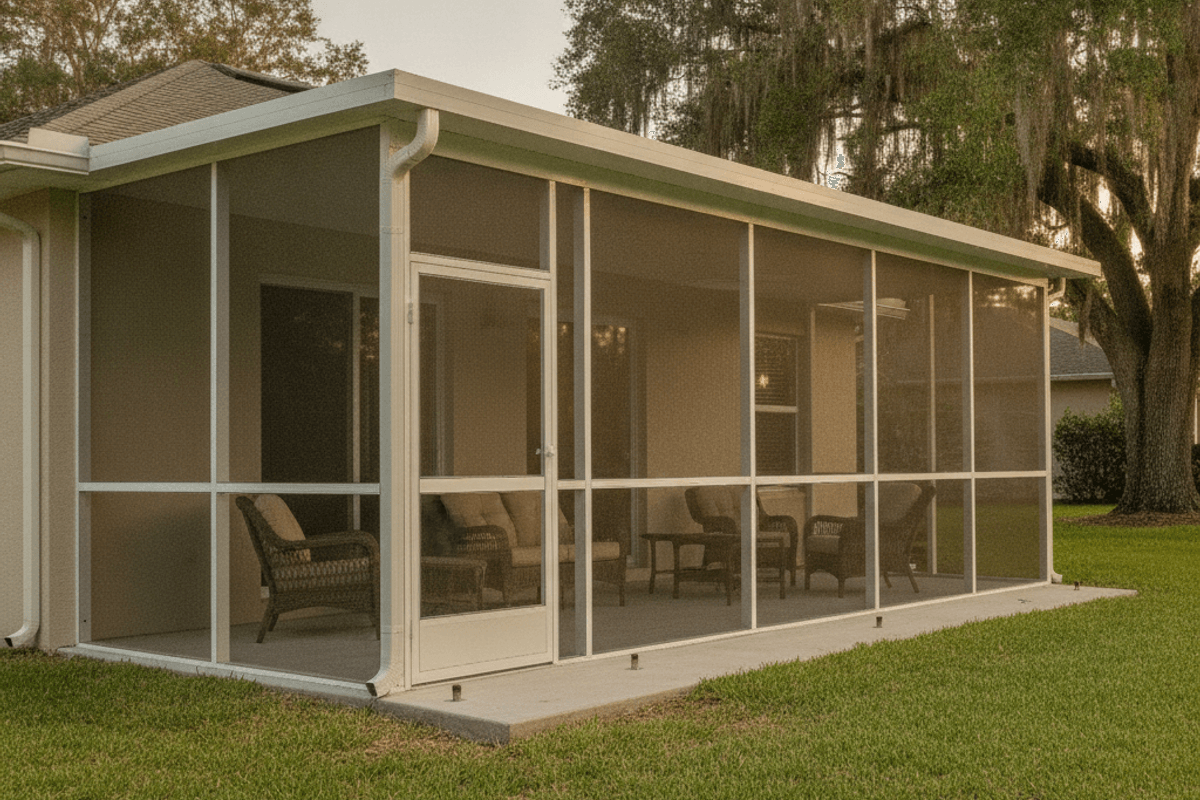
A permit tech asks for your product approval numbers, you go looking for one that covers the whole cage, and there isn’t one. That is normal. Florida’s statewide approval system approves products by category, and an aluminum screen enclosure frame is not one of the categories. The frame gets approved a different way, through an engineer’s signature and seal, while a handful of parts bolted to it do carry their own numbers.
Knowing which is which turns a confusing plan-review comment into a two-minute conversation.
What a Florida product approval number actually is
It’s a state file number attached to evidence that one manufactured product meets the Florida Building Code. The Florida Building Commission runs the system, keeps the list, and makes it public. F.S. 553.842(13) directs the commission to “maintain a list of the state-approved products, product evaluation entities, testing laboratories, quality assurance agencies, certification agencies, and validation entities and make such lists available in the most cost-effective manner.”
The number is the shorthand for that file. The Commission’s own search form labels the field “FL (Application: ##### or Product: #####.#)”, which is why you’ll see a bare five-digit number on one submittal and a number with a decimal on another. The decimal points at a specific product inside a larger application.
Approval is a prerequisite, not paperwork you chase afterward. The statute says products requiring approval “must be approved by one of the methods established in subsection (5) before their use in construction in this state.”
The payoff for a manufacturer who goes statewide is that a local building department can’t reopen the question. Under 553.842(4), “statewide approval shall preclude local jurisdictions from requiring further testing, evaluation, or submission of other evidence as a condition of using the product so long as the product is being used consistent with the conditions of its approval.” That last clause does real work. An approval covers an installation method, a substrate, a fastener pattern and a pressure range. Use the product outside those limits and you are no longer standing on the approval.
The eight categories, and why a screen cage is not one of them
The statute names them. F.S. 553.842(5) says one of the approval methods “must be used by the commission to approve the following categories of products: panel walls, exterior doors, roofing, skylights, windows, shutters, impact protective systems, and structural components as established by the commission by rule.”
The Commission’s public search page offers exactly that set in its Category picker: “Panel Walls Roofing Shutters Sky Lights Structural Components Windows Exterior Doors Impact Protective Systems”. There is no screen enclosure category, no pool cage, no lanai, no carport.
That absence is the single most useful thing on this page. A homeowner who hears there is no product approval for their enclosure often assumes the contractor cut a corner. Usually it means the opposite. The frame is a custom assembly of extrusions, sized to your slab and your lot, and the code handles that case on purpose.
F.S. 553.842(10) is explicit: “Products, other than manufactured buildings, which are custom fabricated or assembled shall not require separate approval under this section provided the component parts have been approved for the fabricated or assembled product’s use and the components meet the standards and requirements of the Florida Building Code which applies to the product’s intended use.”
Read that twice. The exemption is conditional. The pieces still have to be right.
How the aluminum frame gets approved instead
Through an engineer. F.S. 553.8425 covers local product approval and opens by requiring that products “shall demonstrate compliance with the structural windload requirements of the Florida Building Code through one of the following methods”. One of them, 553.8425(1)(d), is this: “A product-evaluation report or certification based upon testing or comparative or rational analysis, or a combination thereof, developed and signed and sealed by a Florida professional engineer or Florida registered architect, which indicates that the product complies with the code”.
That is the sealed drawing set in your permit package. It carries the member sizes, the anchor type and spacing, the beam spans, the uplift numbers and the design pressures your specific structure was engineered to. The building official reviews it. Under 553.8425(6), once the documentation checks out, “the authority having jurisdiction or a local building official shall deem the product approved for use in accordance with its approval and limitation of use.”
So your cage does get approved. It just gets approved as a one-off engineered structure rather than as a catalog item, and the approval lives in the drawings instead of in a state database. Ask for a copy of that set when the job closes out. It’s the document that answers nearly every future question about the structure, from a buyer’s inspector to an insurance underwriter to the crew that comes back in fifteen years to rescreen it.
The engineer also has to be at arm’s length from whoever makes the parts. 553.8425(2) requires that “the testing laboratory or the evaluating architect or engineer must certify independence from the product manufacturer.”
Which parts of your enclosure do carry an FL number
Look at the category list again and match it against what’s actually on a Polk County job. Several pieces land squarely inside it:
- A screen door or a French door into the cage is an exterior door, and an exterior door is one of the eight statewide categories, so the door unit itself will usually have its own FL number even though the frame around it does not.
- Acrylic or glass panels that turn a screen room into a three season room are windows, and windows are on the list, which is why an acrylic conversion tends to generate more product paperwork than the original screen enclosure ever did.
- A solid roof panel over a patio cover or an insulated carport roof falls under roofing or panel walls depending on how it’s built and detailed.
- Screws, anchors and structural connectors can show up under structural components when a manufacturer has chosen to approve them that way.
Screen mesh itself is the usual surprise. It is not one of the eight categories, and nobody should promise you otherwise. There is a hard line in the statute about how any of this gets marketed: a product “may not be advertised, sold, offered, provided, distributed, or marketed as hurricane, windstorm, or impact protection from wind-borne debris from a hurricane or windstorm unless it is approved pursuant to this section or s. 553.8425.” If someone is selling you screen as storm protection, that sentence is the one to read back to them. Where a structure sits relative to the wind-borne debris region changes what the code asks of the openings, and that determination belongs to the building official, not to a brochure.
Miami-Dade NOA versus a statewide FL number
You’ll see both on submittals in Polk County, and neither one outranks the other here. A Notice of Acceptance is Miami-Dade County’s own product control approval, and the state specifically recognizes the office that issues it. F.S. 553.842(8)(a) reads: “The commission shall specifically approve the National Evaluation Service, the International Association of Plumbing and Mechanical Officials Evaluation Service, the International Code Council Evaluation Services, Underwriters Laboratories, LLC, Intertek Testing Services NA, Inc., and the Miami-Dade County Building Code Compliance Office Product Control Division.”
Miami-Dade is one approved evaluation entity on a list of six, plus licensed Florida engineers and architects. A manufacturer that tested through Miami-Dade often carries both an NOA and an FL number, because the NOA is the evaluation report that the state approval was built on.
| Statewide approval, F.S. 553.842 | Local approval, F.S. 553.8425 | |
|---|---|---|
| Who issues it | The Florida Building Commission, listed publicly by FL number | The building official reviewing your permit |
| What it covers | A manufactured product in one of the eight named categories | Any product or system showing it meets the windload requirements, including a one-off engineered assembly |
| What the local department may ask for | Nothing further, as long as the product is used inside the conditions of its approval | The compliance documentation itself, which for an enclosure frame means the sealed drawings |
| Where the paperwork lives | In the Commission’s public database | In your permit file and your copy of the drawing set |
| Typical enclosure parts | Doors, windows, acrylic panels, roof panels, some fasteners | The aluminum frame, its anchors into your specific slab, the whole assembly |
One useful detail for anybody comparing two bids: a product approval is tied to how the product gets installed, not just to what it is. 553.8425(3) lets building officials “accept modifications to approved products or their installations if sufficient evidence is submitted to the local building official to demonstrate compliance with the code or the intent of the code, including such evidence as certifications from a Florida registered architect or Florida professional engineer.” Field conditions change. The path back to approval runs through the engineer, not through a judgment call on the slab.
How to look up an FL number yourself
The Commission’s Product Approval search is public and free, and it works in both directions. Its own instructions say: “You can search for products by FL number or by any search criteria.” Then: “If you have the FL#, enter the FL# and the appropriate code version of the application and click search. If you are seeking the FL#(State Product Approval Number), select the product manufacturer and the code version and click search.”
Code version matters more than people expect, because an approval is pinned to the edition it was evaluated against. As of this writing the Commission’s search page states that “the code version is the 2023 Florida Building Code which became effective December 31, 2023.” Pick the wrong edition in the dropdown and a perfectly valid approval returns nothing, which sends a lot of homeowners into a panic over a filter setting.
Check the status field once you land on a record. The search offers Pending FBC Approval, Revoked, Suspended, Validated, Approved, Denied, Applied For and Re-Apply, and you want to see a product that reads Approved or Validated rather than one sitting in limbo. The form also filters on approval for use inside and outside the High Velocity Hurricane Zone, on impact resistance, and on design pressure, which is how you confirm a part is rated for the conditions your drawings call for rather than for Miami’s.
What the database cannot tell you is whether the contractor holding the drawings is licensed. That’s a separate lookup, and it belongs on the DBPR licensee search, not here. We wrote up which license classes may legally build an aluminum enclosure and how to verify one yourself.
Inside Lakeland city limits versus unincorporated Polk
The documents are the same, the desk is not. The City of Lakeland runs its own Building Inspection division with its own published permit requirements, while a job in Winter Haven’s county pockets, out toward Bartow, or in a Davenport subdivision off US-27 goes through the Polk County Building Division. Two reviewers can land on different questions about the same drawing set, and a crew that works mostly in unincorporated Polk can hit friction the first time it files inside the city. We mapped the difference between the two departments in its own piece.
The statute leaves the local official real authority even over a state-approved product. 553.842(9) says: “A building official may deny the local application of a product or method or system of construction which has received statewide approval, based upon a written report signed by the official that concludes the product application is inconsistent with the statewide approval and that states the reasons the application is inconsistent.” Note the conditions attached: a written report, signed, stating reasons. That’s a reviewable document, not a verbal no.
Product approval is also only one lane of a plan review. Setbacks, lot coverage, wind load and the inspection sequence all get looked at independently, and a clean set of FL numbers does nothing for a cage that sits three feet into a rear easement.
When approval expires, and the cage you already have
Approvals don’t run on a calendar. They end when something changes. F.S. 553.8425(7) sets it out: “Approval shall be valid until such time as the product changes and decreases in performance; the standards of the code change, requiring increased performance; or the approval is otherwise suspended or revoked.” The statewide section says much the same in 553.842(1)(f), where state and local approvals stay valid “until the requirements of the code on which the approval is based change, the product changes in a manner affecting its performance as required by the code, or the approval is revoked.”
Here is the sentence that settles the question every owner of a 1990s Cypress Gardens cage eventually asks. The same subsection continues: “Changes to the code do not void the approval of products previously installed in existing buildings if such products met building code requirements at the time the product was installed.”
A newer code edition does not retroactively condemn your existing enclosure. What it governs is new work. Replace a screen panel and you’re inside maintenance. Rebuild a corner, add a roof, extend the footprint, and you’re pulling a permit against today’s requirements with today’s engineering. That’s also the fork where an older structure with no permit history turns into an after-the-fact permit conversation, which is a different and considerably slower animal.
Frequently asked questions
Does a screen enclosure need a Florida product approval number?
Not as a whole structure. The eight statewide approval categories in F.S. 553.842(5) are panel walls, exterior doors, roofing, skylights, windows, shutters, impact protective systems and structural components, and a screen enclosure frame is none of them. The frame is approved through drawings signed and sealed by a Florida professional engineer or registered architect under F.S. 553.8425(1)(d). Individual components bolted to it, like the screen door or an acrylic window panel, often do carry their own FL numbers.
What does an FL number look like, and where do I find it?
The Commission’s search form describes the format as “FL (Application: ##### or Product: #####.#)”, so you’ll see either a five-digit application number or that number followed by a decimal identifying one product inside the application. On a job, the numbers appear on the submittal sheets your contractor files with the permit application and on the manufacturer’s installation instructions. You can also search for them yourself on the Florida Building Commission’s public Product Approval site.
Is a Miami-Dade NOA better than a statewide approval in Polk County?
No. F.S. 553.842(8)(a) names the Miami-Dade County Building Code Compliance Office Product Control Division as one of six specifically approved evaluation entities, alongside the National Evaluation Service, IAPMO Evaluation Service, ICC Evaluation Services, Underwriters Laboratories and Intertek. Licensed Florida engineers and architects can also evaluate products. An NOA is one valid route to approval, not a higher grade of it, and a Polk County reviewer is looking for evidence that fits the code and your drawings.
Why did my product approval search come back empty?
Usually the code version dropdown. An approval is evaluated against a specific edition of the Florida Building Code, and the search filters on that edition, so the right product under the wrong edition returns nothing. The Commission’s page states that “the code version is the 2023 Florida Building Code which became effective December 31, 2023.” Try the manufacturer search rather than the FL number if you’re still coming up dry, since manufacturers get listed under several slightly different company names.
Can the building official reject a product that already has statewide approval?
Yes, in a narrow way. F.S. 553.842(9) lets a building official deny the local application of a state-approved product, but only “based upon a written report signed by the official that concludes the product application is inconsistent with the statewide approval and that states the reasons the application is inconsistent.” The usual trigger is an installation outside the conditions of the approval, such as a fastener pattern or a substrate the approval never covered. Ask for that written report, because the statute requires one.
My cage was built years ago. Does a new code edition make it illegal?
No. F.S. 553.8425(7) says changes to the code “do not void the approval of products previously installed in existing buildings if such products met building code requirements at the time the product was installed.” Your existing structure is judged against the code in effect when it went up. New work is judged against the current one, so an addition, a reroof over the enclosure or a structural rebuild gets engineered to today’s requirements even though the rest of the cage does not.
Does screen mesh have a product approval?
Screen mesh is not one of the eight statewide categories, so a roll of mesh generally has no FL number of its own. Be careful with anyone who markets it as storm protection: F.S. 553.842(5) prohibits advertising, selling or marketing a product “as hurricane, windstorm, or impact protection from wind-borne debris from a hurricane or windstorm” unless it is approved under 553.842 or 553.8425. What your enclosure is rated to withstand is written in the engineered drawings, not on the mesh.
Who keeps the approval paperwork after the job is done?
Keep a copy yourself. The sealed engineered drawings and the product submittals end up in the permit file at the city or county, and the contractor keeps a set, but the homeowner’s copy is the one that matters when you sell the house, change insurance carriers or hire a different crew for a repair fifteen years later. Ask for the drawing set and the submittals at close-out, while everyone still has the file open.
When to call us
Erecting or modifying an aluminum enclosure frame, setting anchors into a slab, and filing the engineered drawings that go with them are licensed contractor work in Polk County, and the engineering behind those drawings is why. If you’re trying to read a plan-review comment about product approval, or you want a quote from a crew that files this paperwork every week in both Lakeland and the county, we’ll match you with a licensed local crew and get someone out to look at your slab and your lot.
Call us at (863) 777-5379.