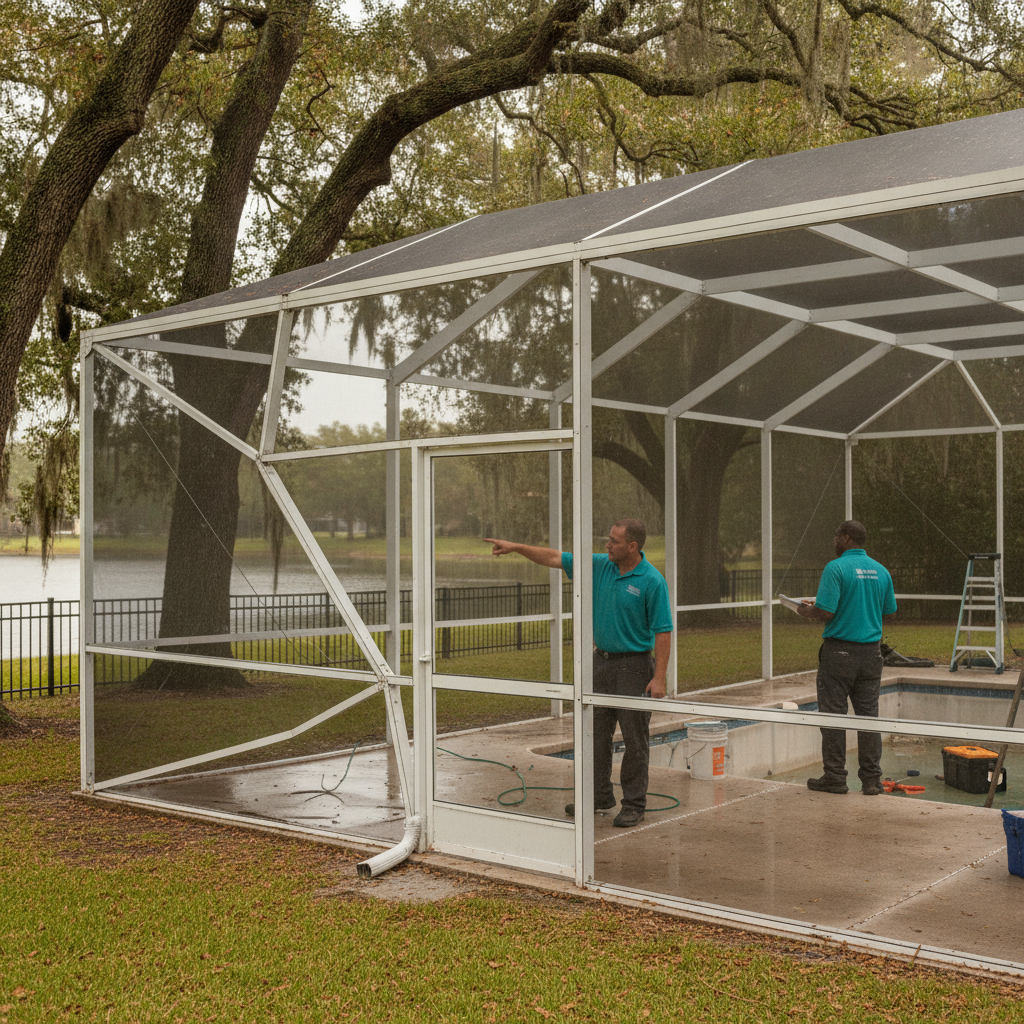
The spline on a south-facing bay can pop on a Tuesday and make the whole cage look finished. It isn’t. A kicked corner after a summer storm, a beam you can sight a kink down, or an anchor walking in a thin Dixieland slab is a different problem, and stretching new mesh over a racked opening just gives you a taut parallelogram.
A torn panel versus a racked aluminum frame
A torn panel is mesh. A racked cage is geometry. They fail on different clocks, and they take different tools.
Screen lives in a channel around each bay, pinched there by a rubber spline. Pull the spline, swap the cloth, roll the spline back. On a ground-level panel that is honest homeowner work. When a crew does the same swap, individual screen panels in this market run $35 to $90 each. That is aluminum screen repair in Lakeland in the narrow sense: cloth and spline, frame still square.
The aluminum is the skeleton those bays hang on. Uprights have to land on concrete thick enough to hold an anchor. Beams carry the roof between those posts. Corners are screwed, not fused into one piece. Daily thunderstorms work those fasteners. A live-oak limb off Lake Morton doesn’t have to snap a beam to ruin a bay. It can kick a corner, oval the screw holes, and leave the opening out of square. From then on every panel you stretch is fighting the frame.
You read it from the deck. Walk the corners with the door closed. A sound bay has even gaps at the spline channel. A racked bay looks like a picture frame someone sat on: one corner high, the opposite corner pinched, the door that used to latch now dragging its kick plate. Sight down a roof beam. A straight line is still a frame. A kink is not.
Screws backing out of the extrusion are the early version of the same story. The cage flexes, the fastener loses bite, the hole wallows. Surface rust on those fasteners is usually the steel screw, not the aluminum, and it is a warning that the joint is working. None of that is a mesh problem.
A kicked post on a pre-1960 patio in Dixieland or around Lake Morton is often a slab problem wearing an aluminum costume. Those rear slabs were poured thin, and many of them never got a perimeter footer. An upright has to land on concrete that can actually hold the anchor. When it can’t, the post rocks. Each storm opens the hole a little more. Resetting that anchor, sistering a post, or squaring a bay is screen enclosure repair work. That is aluminum frame repair in Lakeland: posts, beams, corners, and the deck they stand on. It isn’t a Saturday spline job, and it isn’t work to DIY. Cutting, standing, or re-anchoring an enclosure frame, and any change to a pool door’s closer or latch, belongs with a licensed contractor.
The same read applies to lanai repair in Lakeland when a screened room shares a kicked corner with the house wall. If the opening isn’t a rectangle anymore, the cloth is the last thing to argue about.
What fails on older Lakeland and south-US-98 cages
On older Lakeland cages the frame usually lets go at the fasteners, the corners, and the slab. The mesh on the south and west walls dies years before the shaded north side looks tired.
Downtown, Lake Morton, and the bungalows toward Kathleen sit under live oak. Catkins mat on anything with a coarse opening in April. Acorns and small limbs tap the roof all fall. South along US-98 the lots open up and the work turns into full cages and west-facing patio covers, so the same elevations that already fail first take more sun. Screen in Central Florida lasts roughly seven to twelve years, and it fails unevenly for that reason.
A 1990s cage in south Lakeland, or one of that vintage around Winter Haven and the Chain of Lakes, is often in its second or third mesh cycle on the original posts. The cloth can be replaced. The question is whether the posts still stand plumb and whether the slab still holds them. If the south wall’s mesh is brittle and the north wall still looks new, that is UV, not a reason by itself to scrap the frame.
Paint tells a similar story. Chalking is a fine white powder on the film from weathering, and it can look like the color faded. A properly stripped and primed repaint on a sound cage is a real path, and finish life after that work is generally eight to fifteen years here. That is restoration of a frame that still has its shape. Folded members and walking anchors don’t get better under new paint.
The Atlantic hurricane season runs from June 1 to November 30. October is still inside that window. After a storm, look at the posts before you look at the tears. Mesh blows out because it is supposed to. A beam that took a fold, or a corner that kicked, is the part that decides whether a repair stays honest. Some of that damage rides on an insurance endorsement that covers screened enclosures and aluminum-framed carports when a hurricane hits, with pool cages sometimes bundled by some carriers. The answer is on your own declarations page, which is the same ground we walk in pool cage storm damage and insurance.
Inside city limits, the City of Lakeland Building Inspection division lists screening of any space that requires structural or infill framing among the work that needs a permit. Unincorporated Polk goes through the county Building Division, which uses the same kind of language for screening that adds framing. A crew that mostly works the county can hit friction inside Lakeland city limits because the city publishes its own requirements through its own Building Inspection division. Replacing a post is not a spline swap at either counter.
When a repair is honest and when the cage is done
A repair is honest when the bays can be squared, the posts still land on sound concrete, and the aluminum itself isn’t folded. The cage is done when the geometry is gone, the slab will not hold a new anchor, or so many members are bent that you are rebuilding it in place and calling it a patch.
Cost follows that line. Individual panels stay in the $35 to $90 range. A full-cage rescreen, if the frame is still true, runs $1,400 to $3,200. Pool cage painting and frame restoration sits at $2,800 to $6,500 when the aluminum can take it. A new residential pool cage in the Lakeland area is $9,000 to $18,000, and a cage with a large deck, a two-story mansard tied into the house wall, or a high clear span runs $20,000 to $35,000. Replacement, as the comparison against painting, starts at $9,000 or more. A longer clear span means heavier beams carrying the same roof, and heavier beams cost more per foot. A thin Dixieland slab that can’t take a perimeter anchor pushes the job toward new concrete before any aluminum goes back up.
| What you see | What it usually means | Honest path |
|---|---|---|
| Torn cloth, square bays, door still latches | Mesh and spline | Panel swap or rescreen |
| One kicked post, oval screw holes, slab still sound | Local aluminum frame repair | Repair the member and re-anchor |
| Corners out of square, doors drag, anchors walking in thin concrete | The cage has lost its shape | Replace the enclosure |
Door hardware is a separate question from whether the frame is worth saving. Florida’s Residential Swimming Pool Safety Act never names a screen enclosure as a barrier category. Section 515.29 asks a barrier to be at least 4 feet high on the outside, to have no gap a child could squeeze through or climb, and to carry a self-closing, self-latching gate with the release on the pool side. Whether a given cage does all of that is what the building official signs off on. A repaired door on a racked opening is still a racked opening.
Florida law is plain on who may do the structural work. A person must be certified or registered in order to engage in the business of contracting in this state. Several license classes lawfully build and repair aluminum structures. Ask which class the contractor holds, and verify it yourself. The crews we send are licensed and insured. We match you. We don’t stand the posts.
If the honest path is a new enclosure, that is pool cage installation, not another round of patches on a parallelogram.
How much does it cost to restore a pool cage in Lakeland?
Pool cage painting and frame restoration on this market runs $2,800 to $6,500. That range is for restoring an existing cage whose aluminum can still take a strip, a prime, and new finish, not for folding in new bays as if they were paint.
How much does it cost to replace a pool cage in the Lakeland area?
A new residential pool cage in the Lakeland area is $9,000 to $18,000. Add a large deck, a two-story mansard tied into the house wall, or a high clear span, and the published range is $20,000 to $35,000. Replacement compared with painting starts at $9,000 or more.
How long does screen last on a Central Florida cage?
Screen life here is roughly seven to twelve years, and it fails unevenly because sun exposure kills mesh on the south and west elevations years before the shaded north side. The frame is on its own clock: fasteners, corners, and the slab decide that, not the cloth.
When to call us
When a post is out of plumb, an anchor is walking, or a storm folded a beam, that work needs a licensed contractor, not a spline roller. We cover Lakeland, Winter Haven, Bartow, and the rest of Polk County, and we match you with licensed local crews for the frame job in front of you. Call us at (863) 777-5379.