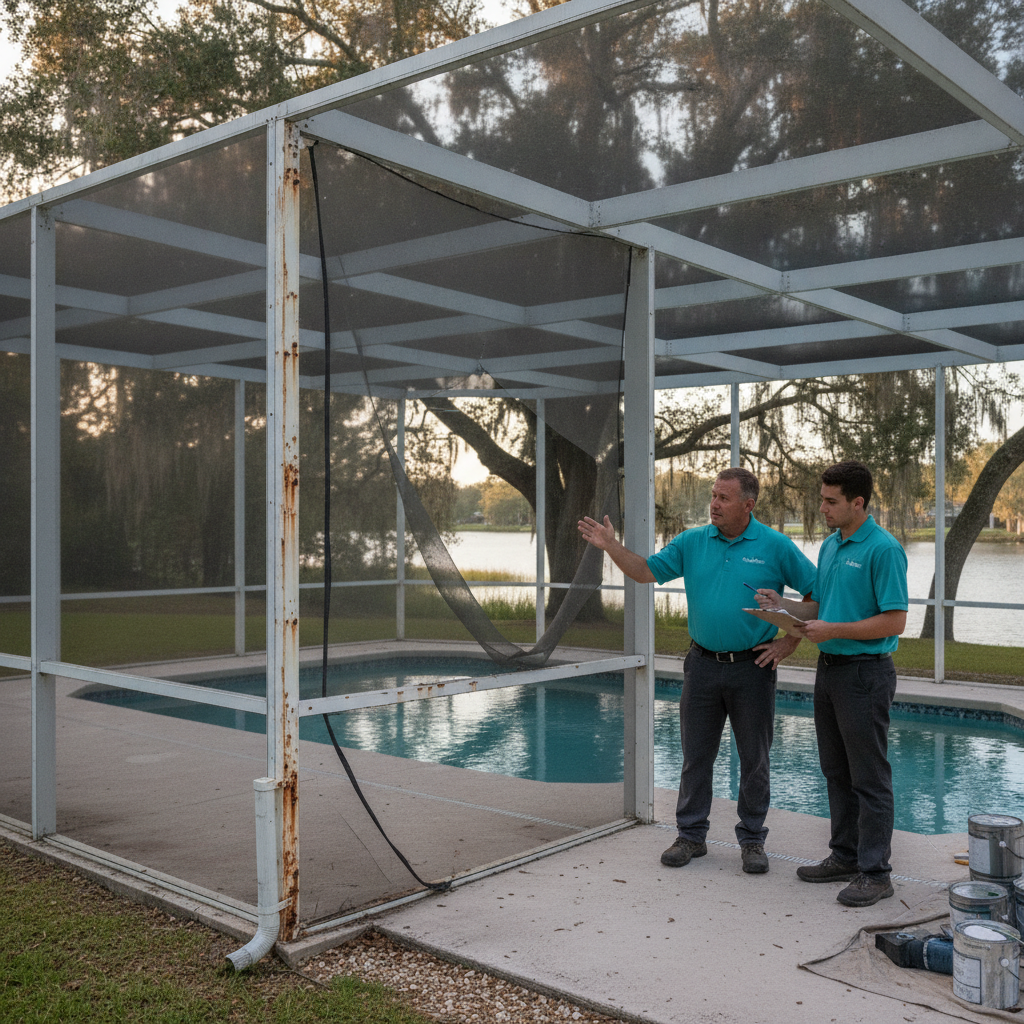
The brown streaks on a Winter Haven cage after a summer storm almost always start at a screw head. Iron in the fastener oxidizes, rain carries the stain down the white aluminum, and the mesh below looks like the whole frame is rotting. The beams are still aluminum. What you need to know is whether that color is runoff from hardware, or whether the metal around those holes has already lost its grip.
Surface rust vs a failing frame
The brown stain on a Lakeland pool cage is iron oxide from steel hardware. Aluminum has no iron in it, so the beams do not make that color. They oxidize a different way: a pale, tight film that shields the metal underneath. That is why a bare aluminum member can sit in Polk County weather for decades while a fifty-cent screw turns the cage the color of tea.
You read the two by where the color sits. Brown streaks that begin at a screw, a bracket, or a tek fastener and wash downward are hardware. A chalky white powder clustered in one cratered spot on a beam is the aluminum’s own film breaking down, usually where pool splash, fertilizer, or a joint that never dries keeps attacking the same inch of metal. Paint chalking is a third look. Sherwin-Williams describes it as a fine white powder on the paint film from weathering, which can look like the color is fading. The fix for that powder is washing, scrubbing, rinsing with clear water, and a full dry. Another coat on top of the dust lets go.
A failing frame looks like movement, not like a stain. An upright has play at the deck. A beam has taken a kink. A screen panel rides loose because the channel has opened. Fastener holes have gone oval, and a new screw spins instead of biting. On a 1990s cage in Cypress Gardens, the south and west elevations take the sun first, so the mesh on those faces goes brittle while the shaded north side still looks new. Screen in Central Florida lasts roughly seven to twelve years and fails in that uneven pattern. That is a rescreen conversation. It becomes a frame conversation when the aluminum around the fasteners has pitted or the members have shifted.
Walk the base. Rain sheets down the cage and sits where the bottom rail meets the deck. In Dixieland and around Lake Morton, live oak catkins mat in that joint every spring and hold water against the metal. A base that stays wet is where galvanic corrosion eats the aluminum around a steel screw. That joint is what has to hold when a thunderstorm works the cage.
If the cage door no longer self-closes, or the latch has rusted and the leaf stands open, that is past cosmetics. Florida’s barrier statute asks a barrier to stand at least 4 feet high on the outside, to have no gap a child could squeeze through or climb, and to carry a self-closing, self-latching gate with the release on the pool side. Whether a given enclosure does all of that is what the building official signs off on. Hardware that leaves a gap, or a door that will not latch, is exactly the defect that review is looking at.
Screws, fasteners, and Polk County water
Rain, irrigation, and pool splash are the water that drives fastener rust here. Polk County is inland. The attack is humidity that hangs on after a June storm, a sprinkler that soaks the bottom rail every morning on a Davenport lot, and splash from the pool itself. A steel screw in an aluminum hole, with that moisture as the connector, sets up galvanic corrosion. The aluminum around the fastener gives up material. The screw rusts. The joint loosens. The next storm works the hole a little wider.
That is the same pattern behind screws popping on a pool cage. The screw was not randomly ejecting. The hole had already been eaten, or the fastener had lost its bite, and wind finished the job.
Older cages around Winter Haven, Auburndale, and the Chain of Lakes were often assembled with plated steel hardware that was cheap and easy to get. It looks fine for years. Then the plating scratches during a rescreen or a ladder bump, and rust starts at that scratch. Newer work more often uses stainless or coated fasteners, which still need the aluminum around them to be sound. Driving a stainless screw into a hole that has already gone soft does not rebuild the wall of the hole.
Deck-level fasteners take the worst of it. Splash sits on the bottom rail. Lawn irrigation soaks the same line. The top of a mansard stays drier. Look low first, then at every joint you can see from the deck, then at the door closer and the latch. The door is where a homeowner feels the failure first: a leaf that no longer pulls itself shut after you walk through with a towel in your hands.
Rinsing the frame with a garden hose after a heavy week of storms, and after the lawn service has been through, does more than any bottle on a shelf. Keep the spray off the screen enough that you are not blowing spline out of the channel. Soft pressure on the aluminum, a rinse from the top down, and let it dry. That is homeowner work. Pulling structural fasteners, drilling new holes, or resetting anchors in the slab is not. Florida law says a person must be certified or registered to engage in the business of contracting in this state. Ask which class the contractor holds and verify the license yourself. Several classes lawfully build aluminum structures. There is not one magic class name for a pool cage.
If the crew is doing more than swapping hardware, permitting enters the picture. Unincorporated Polk lists screening that requires structural or infill framing as work that needs a permit. Inside city limits, Lakeland’s Building Inspection division publishes its own list, and screening of any space that requires structural or infill framing sits on it. A crew that mostly works the county can hit different paperwork inside Lakeland. Painting a sound frame is a different conversation from taking a cage down and putting a new one up.
The Atlantic hurricane season runs from June 1 to November 30. A cage with loose fasteners is a structure the wind can work. The Florida Building Code assigns an ultimate design wind speed to a specific address, and the engineered drawing in a permit package states the value that cage was designed to. Inland Polk carries a lower number than a Gulf-front county, which is why the same cage prices differently here.
Paint vs replace
Paint restores a sound frame. It stalls a failing one.
Pool cage painting and frame restoration in the ranges this site already publishes runs $2,800 to $6,500. A properly stripped and primed repaint generally lasts eight to fifteen years here. That is what crews see on this work, not a warranty. The prep is the job: wash the aluminum, scrub the chalk, rinse with clear water, and let it dry fully before primer goes on. Coat over powder and the new film lets go in the first wet season.
Replacement, as the comparison against painting, starts at $9,000 or more. A new residential pool cage in the Lakeland area typically lands between $9,000 and $18,000. A large deck, a two-story mansard tied into the house wall, or a high clear span pushes $20,000 to $35,000. Those ranges move with span, height, and how much of the old structure has to come down. On a thin 1950s patio slab in Dixieland, the crew also has to decide whether the concrete will even hold a perimeter anchor. That is a real cost driver, not a footnote.
Paint when the members are straight, the anchors are tight, and the stain is hardware runoff plus a chalked finish. Replace when uprights have play, holes have gone oval, fasteners have opened, or a beam has taken a set. A stall looks like this: the south elevation of a Cypress Gardens cage gets a coat, the brown streaks return at every screw after the first big rain, and the door still does not latch. The painting versus replacing decision is the same one, just with rust as the reason the finish failed.
If the mesh is the only tired part, rescreening is the middle path. A full-cage rescreen runs $1,400 to $3,200. Individual panels run $35 to $90 each. Standard fiberglass is about $2.50 to $4.00 installed per square foot of screen. Rescreen does not fix a rusted frame. It also does not fix a door that will not close. Pair it with hardware when the frame is still true.
A covered lanai that was never a cage is a different structure. Screening in an existing covered lanai, or a basic screen room over an existing slab, is its own job. Builder-covered lanais in Davenport and Four Corners often sit bare because screening was a separate line item. Rust on those smaller frames still starts at the fasteners. The same read applies: stain versus movement.
| What you see | Painting and hardware | New cage |
|---|---|---|
| Brown streaks from screw heads, members straight | Swap fasteners, wash, prime, paint | More structure than the stain needs |
| Chalked finish, tight anchors | Strip, prime, repaint | The frame can stay |
| Oval holes, play at the deck, bent members | Paint hides it for a season | The frame has to come down |
| Door will not self-close, gaps at the latch | Hardware and alignment first | Only if the opening itself is out of square |
Is the white powder on the frame the same as rust?
White powder on a painted cage is usually chalking: weathering of the paint film. White powder in a small crater on bare aluminum is the oxide layer breaking down in that spot. Rust is the brown iron stain from steel fasteners. Three different materials, three different next steps. Wash and inspect before anyone opens a can of paint.
How much does it cost to replace a pool cage screw?
A single fastener is a small part. The real cost is access, matching hardware that will not restart galvanic corrosion, and the condition of the hole in the aluminum. If the wall of the hole is gone, you are buying a repair or a replacement, not a screw. There is no honest flat price for “one screw” on a two-story mansard versus a deck-level kick plate.
How do you clean rust streaks off a pool cage?
Rinse from the top down with a garden hose. Soft brush on the aluminum. Leave the screen alone enough that the spline stays in the channel. For a chalked painted finish, wash, scrub, rinse, and dry, then decide on paint. A tight-tip pressure washer on a 1990s Winter Haven cage will blow panels free and chew the finish you were trying to save.
Can you swim if the cage is staining the deck?
The brown marks on the deck and the waterline after a storm are usually iron washing off steel fasteners. That is a hardware problem on the enclosure, and a separate water-chemistry problem in the pool. A pool tech handles the water. A licensed aluminum crew handles the screws that keep marking the deck.
When to call us
Call when fasteners are backing out, a door will not latch, a member has play at the deck, or you are choosing between a repaint and a new cage. The crews we send are licensed and insured, and they will tell you if paint is restoration or a stall. Call us at (863) 777-5379.