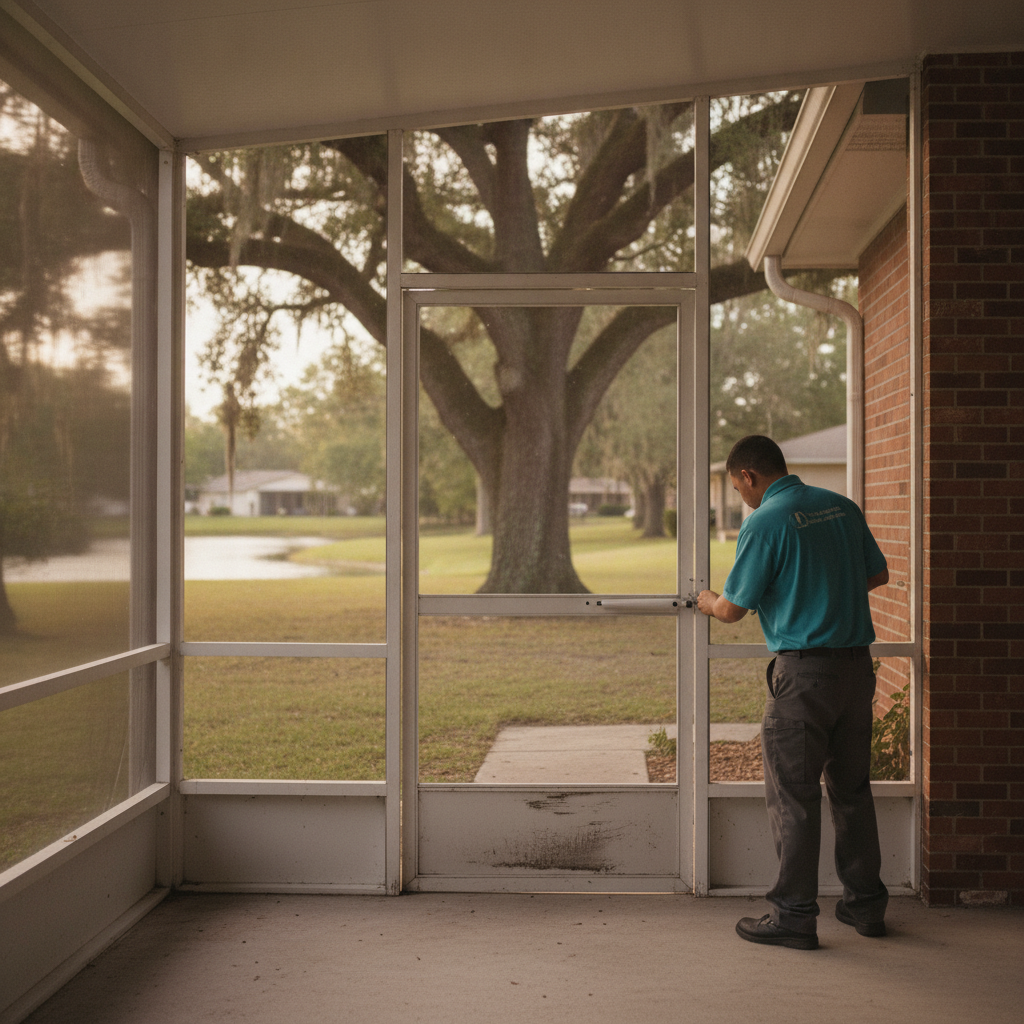
The closer on a Dixieland screened porch that will not pull the leaf to the strike is a hardware job. The same aluminum door on a Cypress Gardens pool cage is the opening a toddler walks through, and Florida’s pool-safety statute talks about that opening in detail. Start with which situation you have, because both look like a tired lanai screen door from the kitchen.
A sticky lanai door versus a door that is the pool opening
A sticky door on a screened porch is usually a closer, a latch, or a hinge that has walked. A door that is the gate into a pool enclosure is a different piece of work, even when the frame color matches the rest of the cage.
Most Lakeland calls for a lanai screen door sit on a screened porch or a screen room that never had a pool. The leaf hangs in an aluminum opening. Mesh sits in a channel, held by a rubber spline, the same way a wall panel does. People go in and out with groceries, a dog, a mop bucket. The closer tires. The latch starts to miss. Oak catkins from the Lake Morton canopy mat on the threshold in April and the door drags. That is a porch door. The job is to get it closing and staying closed.
The other call is the door on a cage. Winter Haven, Auburndale, and the rest of the Chain of Lakes have a lot of 1990s pool cages, and the door on those cages is the opening between the yard and the water. Florida’s Residential Swimming Pool Safety Act lists ways a residential pool may be made safe. One option, in section 515.27, is an enclosure that meets the barrier requirements of section 515.29. The statute never names “screen enclosure” as a category. A screened structure only satisfies that option when it independently meets the specifications, and whether a particular cage does is a determination for the building official reviewing the permit.
Section 515.29 is the specification list. The barrier must be at least 4 feet high on the outside. It may not have gaps, openings, indentations, protrusions, or structural components a young child could crawl under, squeeze through, or climb over. Gates that provide access to swimming pools must open outward away from the pool, be self-closing, and carry a self-latching locking device. The release has to sit on the pool side of the gate, placed so a young child cannot reach it over the top or through an opening. The barrier also has to sit far enough from the water that a child who got through would not fall straight in, and it may not sit where a permanent object becomes a climbing aid.
That is the mechanism. It is why a closer that no longer shuts on a pool cage is not a nuisance, and why swapping a porch-style latch onto a pool opening is the wrong repair. The crews we send treat a pool-side leaf as pool cage door replacement work: outward swing, self-closing, self-latching, release on the pool side and out of a child’s reach. The building official is who signs off. This page will not tell you your door already qualifies.
A builder-covered lanai in a Davenport or Four Corners subdivision sits in between. The roof is there. The screening was a separate line item. The opening the builder left is often a standard hinged door or a slider, and HOA architectural review may care about color and grid before anyone talks about hardware. Inside Lakeland city limits, the City of Lakeland Building Inspection division publishes its own permit requirements, including screening of any space that requires structural or infill framing. Unincorporated Polk goes through the county Building Division, which names the same kind of screening on its FAQ. A crew that only swaps a door leaf in an existing opening is in a different conversation with the building official than a crew adding framing. Ask which one you are in before anyone cuts aluminum.
Closer, latch, kick plate, and a racked frame
A closer that no longer seats the latch is the usual sticky-door call. The hydraulic arm at the top of the leaf is what pulls the door home after someone walks through. Afternoon thunderstorms slam it. Kids hold it open with a brick. The arm loses tension, the leaf stops short of the strike, and mosquitoes use the gap. On a porch, that is annoying. On a pool opening, that is the self-closing function the statute describes.
The latch is the second wear point. Humidity and grit from the patio slab chew the strike. A leaf that has dropped a fraction on tired hinges will hit high or low, and people start slamming it to make it catch. Slamming bends the stile. Once the stile is bent, new hardware in the old holes will still miss.
The kick plate is the solid lower panel dogs and vacuum heads actually hit. On a Lake Parker or Lake Hollingsworth porch, that plate takes claws every time the dog wants in. Standard fiberglass mesh above the plate will balloon and tear; the spline pops out of the channel and the panel looks like a sail. Phifer PetScreen is the manufacturer’s pet-resistant screening, built to resist tearing and puncture from most dogs and cats, and it is the usual ask for that lower run. The manufacturer does not publish a mesh count for it. Standard Phifer Fiberglass 18x14 stays a common choice for the rest of the leaf, the mesh that keeps out most insects and still lets breeze through. Near the lakes, Phifer No-See-Ums is the 20x20 mesh for smaller flying insects. It cuts airflow. Say that out loud before you put 20x20 on a west-facing door that already cooks in August.
A racked frame is the line between a hardware visit and a replacement. Push the top corners of the opening. If the rectangle has become a parallelogram, the latch will never meet the strike, and a new leaf in that opening will scrape the same way the old one did. Settlement on an older Lakeland bungalow does this. So does a lawn mower kissing the corner, or a branch off a live oak during a summer storm. The crews we send square the opening or they are installing a door that will fail the first humid week.
Screen itself fails unevenly here. In Central Florida, mesh often lasts roughly seven to twelve years, and the south and west elevations go brittle years before the shaded north side. A door that faces west on a South Lakeland patio takes that sun every afternoon. The spline still looks seated. The mesh dusts off on your hand. That door needs new mesh at minimum. If the stiles are chalked, twisted, or full of stripped screw holes, you are in replacement territory, the same fork a pool cage screen door repair in Lakeland runs into when the leaf itself is the worn part.
A sliding lanai screen door fails on different parts. Rollers flatten. The track fills with oak litter and grit. The leaf jumps the rail and then people lift it by the mesh, which blows the spline. Hinged doors fail on closers, hinges, and latches. Name which one you have when you call, because the parts are not interchangeable.
What a replacement door job includes
A replacement job is a new door leaf, new hardware, and a square opening. It is not a new enclosure.
The crew we send measures the existing opening, not a catalog size. Box stores sell standard lanai screen doors, and those work when the opening is still a true rectangle in a common width. A lot of Lakeland openings are not. Pre-1960 bungalows around Lake Morton and Dixieland have enclosures that were fitted to a thin patio slab and a slightly wandering house wall. A 1990s Winter Haven cage door was often built in place. Forcing a standard door into an out-of-square jamb is how you get a leaf that closes in January and binds in August.
Once the opening is measured, the old leaf comes off, along with the closer, the latch, the hinges, and any kick plate that is staying with the scrap. The crew checks plumb and square. Shims behind the jamb can pick up a small twist. A jamb that is folded, cracked at a corner, or pulled off the beam is frame work, and that is a bigger conversation than a door leaf.
The new door is powder-coated aluminum to match the enclosure, with a kick plate at the height the household actually uses. Mesh goes into the channel with new spline, tensioned so it does not oil-can in the first west wind. Hinges get corrosion-resistant screws into the frame, not into trim that will pull out. The closer gets adjusted until the leaf seats and latches without slamming. On a pool opening, that closer and latch are doing the self-closing and self-latching work the statute describes, with the release on the pool side. On a porch, they are keeping palmetto bugs out of the Florida room.
Rehang, rebuild with new hardware, or full replacement are the three jobs that exist on a tired leaf. Rehang is the same door, reset on its hinges, closer tuned. Rebuild keeps the stiles and swaps the worn parts: closer, latch, kick plate, mesh. Full replacement is a new leaf in a sound opening. The right one depends on whether the rectangle is still a rectangle and whether the stiles will hold a screw.
Florida law requires a person to be certified or registered to engage in the business of contracting in this state. Several license classes lawfully build and repair aluminum structures. Ask which class the contractor holds, and verify it yourself at myfloridalicense.com. The crews we send are licensed and insured. Lakeland Outdoor Pro matches you with those crews. We do not hold the license, and we do not hang the door.
A door replacement is also a moment to look at the rest of the run. If the two wall panels beside the door dust off when you push them, the west elevation is in the same sun that killed the door mesh. Doing the door alone and calling back for those panels a season later is two setups. If the enclosure itself is what you are still building, that is screen door and panel work inside a larger screen-room or cage job, not a lone leaf on an afternoon.
Common questions about lanai screen doors
Can you buy a replacement screen door at a hardware store?
You can buy a standard-size hinged or sliding screen door at a hardware store, and it will fit a true, common opening. Many Lakeland lanai openings were built in place around an older slab or a cage beam, so the width and the square are custom. A store door in a racked jamb will scrape, miss the latch, and leave a gap at the head. Measure the opening at the top, middle, and bottom, and on both diagonals, before you assume a boxed size will drop in.
Is a torn door panel a new door or just new mesh?
A clean tear with a straight stile and a spline that still locks is a mesh job, the same channel-and-spline work as a wall panel, and a ground-level door panel is a job a homeowner can do. A stile that is bent, a kick plate punched through, stripped hinge holes, or a closer that cannot pull the latch to the strike is a leaf. Pet damage that blew the spline out of three sides of the channel usually wants new mesh and a kick plate together, because the next shoulder check will open the same corner.
What does Florida require if that door opens to a pool?
The statute asks a barrier to be at least 4 feet high on the outside, to have no gap a child could squeeze through or climb, and to carry a self-closing, self-latching gate that opens outward, with the release on the pool side and out of a child’s reach. Whether a given cage and its door do all of that is what the building official signs off on. Changing that hardware is licensed contractor work, not a weekend latch swap.
When to call us
Call when the closer no longer seats the latch, when the frame is racked, or when the door is the opening to a pool and the hardware is tired. That is licensed contractor work, and the crews we send will tell you whether the leaf can be rebuilt or the opening needs a new door. Call us at (863) 777-5379.