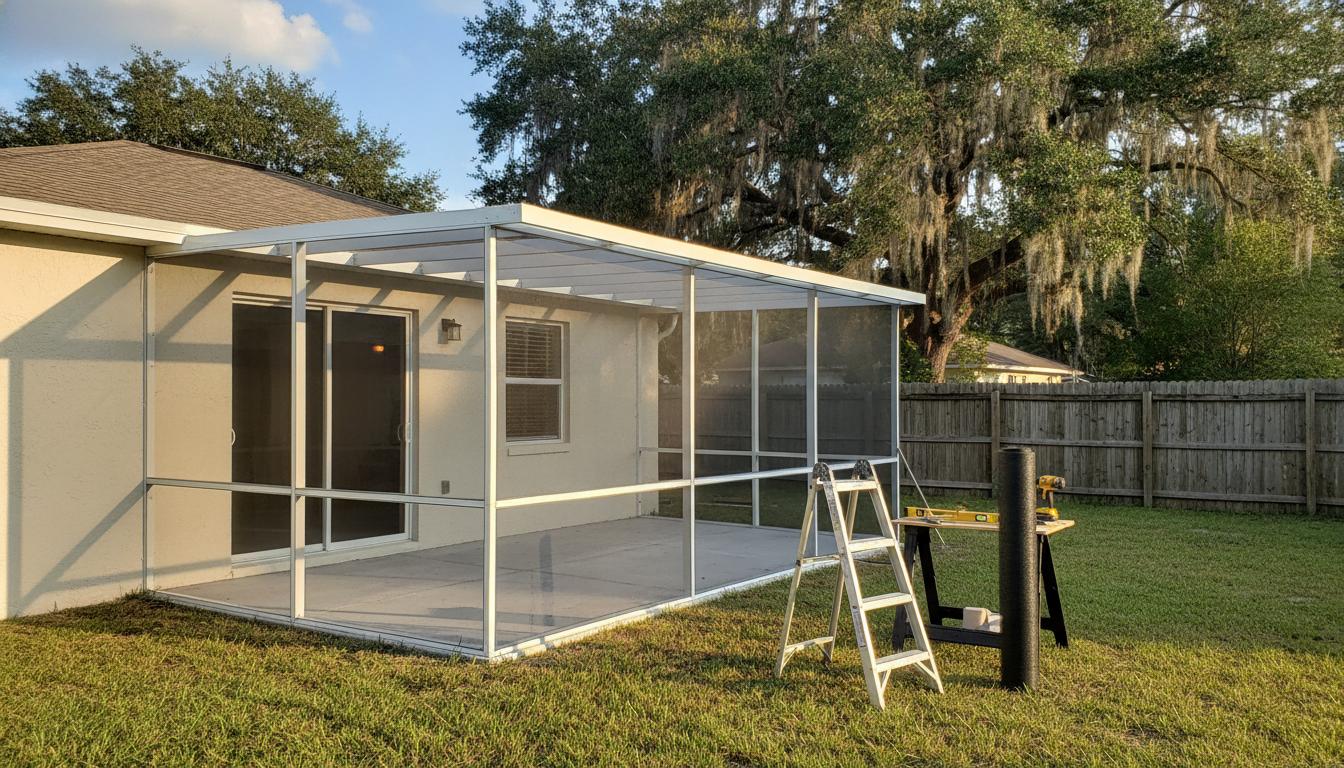
Yes, a qualifying Polk County homeowner can pull an owner-builder permit on their own house. That is a limited legal pathway, not automatically illegal. Signing one makes you the responsible party of record, with direct, onsite supervision of all work not performed by licensed contractors. Read what you’re agreeing to before you sign.
What an owner-builder permit actually is
Florida Statutes 489.103(7) creates a narrow exemption from the state’s contractor licensing law. It covers “Owners of property when acting as their own contractor and providing direct, onsite supervision themselves of all work not performed by licensed contractors.”
The residential scenario that matters for an outdoor project applies “When building or improving farm outbuildings or one-family or two-family residences on such property for the occupancy or use of such owners and not offered for sale or lease.” A commercial building can qualify too, but only at a cost of $75,000 or less.
This is not a contractor’s license. It is a carve-out for qualifying owners building or improving a house, farm outbuilding, or two-family property for their own occupancy or use. A screen room, pool cage, carport, or patio cover built this way still has to meet the same code requirements as the normal permit path.
The exemption trades the license for your own supervision. You’re standing in for a licensed contractor, responsibilities included.
What the disclosure statement makes you agree to
The local permitting agency has to give you a disclosure statement in substantially the form written into 489.103(7). Here’s what that statutory form actually says.
“I understand that, as an owner-builder, I am the responsible party of record on a permit.” That one line changes your legal position: you become the party the agency holds accountable for the whole project.
The form also spells out the other option: “I understand that I may protect myself from potential financial risk by hiring a licensed contractor and having the permit filed in his or her name instead of my own name.” Hiring a licensed contractor does not make every sale, permit, or disclosure issue disappear. It does move the owner-builder exemption risk off your name.
If you proceed, you’re committing to hands-on supervision: “I understand that, as the owner-builder, I must provide direct, onsite supervision of the construction.” The statute itself draws the line harder. The exemption “does not exempt any person who is employed by or has a contract with such owner and who acts in the capacity of a contractor,” and an owner “may not delegate the owner’s responsibility to directly supervise all work to any other person unless that person is registered or certified under this part and the work being performed is within the scope of that person’s license.”
There’s a payroll consequence in the same disclosure. Any unlicensed helper on the project must work as your employee. That makes you an employer, required to withhold federal income tax and Social Security contributions under FICA and to provide workers’ compensation for that person. None of this applies to a licensed contractor’s own crew, only to unlicensed labor you hire directly.
Then there’s the injury clause. If an unlicensed worker gets hurt on your project, the disclosure warns: “My homeowner’s insurance may not provide coverage for those injuries.”
The disclosure also commits you to keeping it current. You agree to notify the issuer immediately of any additions, deletions, or changes to the information you provided.
The one-year sale or lease presumption
Florida law includes a presumption if the property is flipped too quickly. The statute says: “In an action brought under this part, proof of the sale or lease, or offering for sale or lease, of any such structure by the owner-builder within 1 year after completion of same creates a presumption that the construction was undertaken for purposes of sale or lease.”
If the state ever pursues the question, selling or listing within a year of finishing the work counts as evidence you built it to sell. The statutory disclosure puts it the same way: sell or lease within a year and “the law will presume” the work was done for sale or lease, which violates the ordinary exemption. The pathway is built for owners using the property themselves.
That presumption is not the whole statute. There is a separate takeover exception, below.
When pulling your own permit is legitimate
An owner-builder permit fits a homeowner doing genuine hands-on work on their own house, with the time and knowledge to provide direct, onsite supervision themselves. It is not a way to hire unlicensed help while keeping your name off the risk.
There is a second path. Under 489.103(7)(a)4, an owner can complete a permit “where the contractor listed on the permit substantially completed the project as determined by the local permitting agency,” including for “an accessory structure of a one-family or two-family residence.” That covers a screen room or carport a contractor mostly finished, where the agency agrees the work was substantially complete.
The owner needs the local permitting agency’s approval first. The agency must determine that the listed contractor substantially completed the project. An owner who qualifies this way is not required to occupy the home for at least a year after completion. Do not erase that exception when the ordinary one-year occupancy rule is the topic.
For the purposes of this subsection, the term “owners of property” includes the owner of a mobile home situated on a leased lot. That is the statute’s definition. Other local landowner-consent or park rules can still apply; this page does not certify a county form for every rented lot.
The screen enclosure permits guide can help organize the file. It does not decide whether you qualify.
What the disclosure says about unlicensed contracting
The statutory disclosure names a pattern directly: “I understand that it is a frequent practice of unlicensed persons to have the property owner obtain an owner-builder permit that erroneously implies that the property owner is providing his or her own labor and materials.” The described warning applies when an unlicensed person has the owner obtain the permit while that person acts as the contractor, falsely implying that the owner supplies or directly supervises the work.
An unlicensed person cannot legally pull a permit and perform licensed work under your name, so they ask you to sign instead. You become the responsible party of record for work you didn’t do.
The disclosure is blunt about what happens if it goes wrong: “Your only remedy against an unlicensed contractor may be in civil court.”
Check a contractor’s license before they touch anything on your property. The Florida Department of Business and Professional Regulation keeps records at myfloridalicense.com. A returned record still has to be read for current status and scope. For screen enclosures specifically, our breakdown of which license class covers this work explains what to ask for.
What the statute requires at application
State law requires you to handle the signing personally: “an owner must personally appear and sign the building permit application.” At issuance, “A copy of the property owner’s driver license, the notarized signature of the property owner, or other type of verification acceptable to the local permitting agency is required when the permit is issued.”
If the rules get broken, state law directs the local permitting agency to “withhold final approval, revoke the permit, or pursue any action or remedy for unlicensed activity against the owner and any person performing work that requires licensure under the permit issued.”
The City of Lakeland publishes additional city qualifications for owner-builder permits, including homestead and exclusive full-time use language. That is city guidance. It does not rewrite 489.103(7), and it does not apply to unincorporated Polk County or every municipality. Do not use an abbreviated city FAQ to erase the substantial-completion takeover exception.
After the permit is issued, a recorded Notice of Commencement may still be a separate question. Our Notice of Commencement guide walks through that step. If you already have a permit open and aren’t sure of its status, searching a Polk County permit covers that too.
The under-$7,500 exemption is not a loophole until the scope is resolved
Homeowners ask whether F.S. 553.79(1)(g) lets them skip a permit for a screen room or carport. The 2026 statute is in force. It does not answer that question by dollar figure alone.
It reads: “A local government that issues building permits shall exempt an owner of a single-family dwelling or the owner’s contractor from the requirement to obtain a building permit to perform any work valued at less than $7,500 on the owner’s property.”
The exemption does not apply to “Work on a property that is partially or entirely located in a flood hazard area as defined by the Florida Building Code.” And it does not apply to “Any electrical, plumbing, structural, mechanical, or gas work performed on property containing a single-family dwelling. A construction project may not be divided into more than one project for the purpose of evading the requirements of this paragraph.”
Even where the dollar figure might otherwise fit, it is not automatic. “The owner or the owner’s contractor must submit a written request for exemption to the local enforcement agency with a copy of the contract or other documentation demonstrating the nature and the value of the work to be performed.” And “A local government has no legal duty to the owner, contractor, or successors or assigns thereof for exempted work performed under this paragraph.”
Do not label enclosure work exempt without resolving that exact scope and those carve-outs. Like-material mesh replacement, added framing, and a new enclosure can be different permit questions in different jurisdictions. Have the issuing agency classify the actual work.
Frequently asked questions
Can I pull my own permit for a screen enclosure in Polk County?
Yes, if you qualify under Florida Statutes 489.103(7): the project is on your own one-family or two-family residence, for your occupancy or use, not offered for sale or lease, and you personally provide direct, onsite supervision of work not performed by licensed contractors. You’ll sign the owner-builder disclosure, which makes you the responsible party of record. A licensed aluminum contractor can pull the permit instead if you’d rather not take on that role.
Can a contractor ask me to pull an owner-builder permit?
Not every request is improper. A qualifying owner-builder can hire licensed contractors for work within their licenses while remaining the owner-builder and providing direct, onsite supervision of other work. The danger is an unlicensed person using the owner’s permit to act as the contractor, or any arrangement that falsely represents who is supervising and responsible. The statutory disclosure names that unlicensed-contracting pattern as a frequent practice and warns that your only remedy against an unlicensed contractor may be in civil court. If a licensed contractor is actually acting as the prime contractor, the permit should be listed under that contractor’s own license. Read any license’s current status at myfloridalicense.com before signing.
Does the $7,500 exemption mean my project needs no permit?
Not until the scope is resolved. F.S. 553.79(1)(g) requires a written request and value/scope documentation. It excludes flood-hazard property and electrical, plumbing, structural, mechanical, or gas work. Projects cannot be split to evade it. Do not treat a screen enclosure, pool cage, carport, or patio cover as exempt just because the ticket is under $7,500.
Can I sell my house right after owner-builder work?
Selling or listing within a year of completion creates a legal presumption that you built the project to sell rather than to live in, unless you qualify for the substantial-completion takeover exception in 489.103(7)(a)4. That exception requires agency approval and a listed contractor who substantially completed the project. A licensed contractor’s permit avoids the owner-builder exemption risk. It does not erase every other sale, permit, or disclosure issue.
What does the statute require when the permit is issued?
A copy of your driver’s license, a notarized signature, or another form of verification the local permitting agency accepts. State law also requires that you personally appear and sign the building permit application. After issuance, a recorded Notice of Commencement may still be required before inspections can begin.
Can a mobile home owner get an owner-builder permit?
State law defines “owners of property” to include the owner of a mobile home on a leased lot. Local landowner, park, or agency rules can still apply on a rented lot. This page does not certify those extra local forms.
Call a licensed, insured crew instead
An owner-builder permit is real legal and financial responsibility, not a paperwork shortcut. You become the responsible party of record, the onsite supervisor, and in some cases an employer with tax and workers’ compensation duties, all before the first post goes into the ground.
If you’d rather not carry that risk yourself, call Lakeland Outdoor Pro at (863) 777-5379. We connect Polk County homeowners with licensed and insured local aluminum crews for screen rooms, pool cages, carports, patio covers, and more. Ask whether the matched crew will pull any needed permit under its own license.