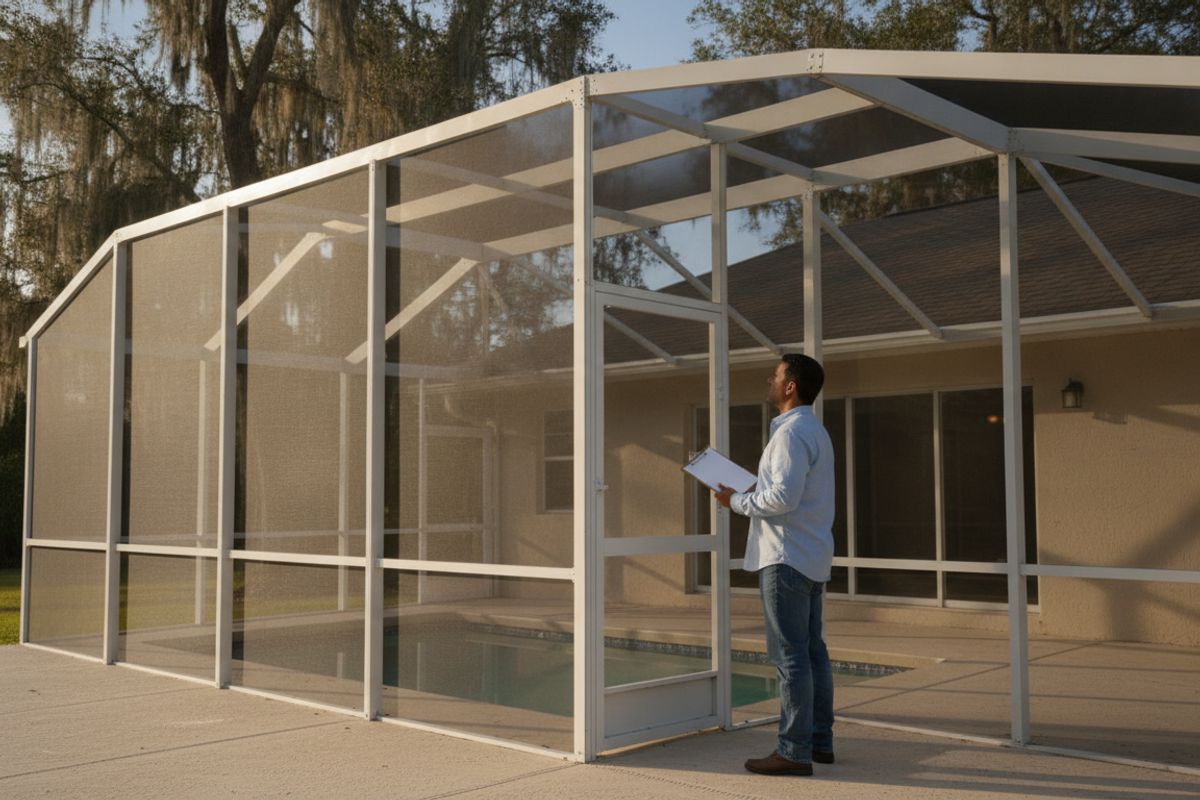
Florida has a license class written specifically for screen enclosures, and most homeowners have never heard its name. It is the structural aluminum or screen enclosures specialty contractor, defined in Florida Administrative Code rule 61G4-15.100(1)(a). If your bidder holds that license, they are licensed for exactly this work. The trouble is that the advice floating around, including advice we used to give on this site, tells people to look for a building or residential contractor instead. Both are legal. Only one of them was written for the job.
Which contractor license covers a screen enclosure in Polk County
The state rule is unusually specific about what this license covers. A structural aluminum or screen enclosures specialty contractor is certified to perform work involving “aluminum screened porches, screened enclosures, pool enclosures, pre-formed panel-post and beam roofs, mobile home panel roof-overs, residential glass and window door enclosures, vinyl panel window enclosures and single-story self-contained aluminum utility storage structures not exceeding seven hundred twenty (720) square feet.”
Read that list against a quote for a pool cage, a screen room, or an aluminum patio cover and the overlap is almost exact. The rule goes further and folds in the trim work that rides along with these jobs, naming the “installation of siding, soffit, fascia, gutters, and preformed panel-post and beam roofs, and screen enclosures.” That is why one crew can hang seamless gutters on the same visit without a second license.
Concrete is included, but narrowly. The rule limits masonry work to “foundations, slabs and block knee walls incidental to the aluminum and allied materials construction work.” A slab poured to carry your enclosure is inside the license. A driveway is not.
One date matters here. This certified category is recent, created by rule on 5-5-24 and amended 8-28-24. Guides written before that describe an older licensing picture, which is part of why so much of what you will read on this topic is out of step with what Florida actually does now.
What an aluminum specialty contractor is not allowed to do
The same rule draws the line, and the line is the useful part for a homeowner. The aluminum contractor “shall not perform any work that alters the structural integrity of the building including but not limited to roof trusses, lintels, load bearing walls and foundations.”
That single sentence answers questions people ask us all the time. Tying a new enclosure into your house wall is routine and inside the scope. Cutting into a truss to make headroom is not. If a bid quietly includes work that changes how your house carries load, the specialty license does not cover it, and someone else has to be involved.
The rule handles that case too. The aluminum contractor “shall subcontract, with a licensed qualified contractor in the field concerned, all work incidental to that which is defined herein but which is the work of a trade other than that of an aluminum contractor.” So a bid that mixes trades is not a problem by itself. A bid that mixes trades under one specialty license, with nobody named for the other half, is.
Certified or registered, and why that decides who can work here
This is the distinction almost nobody explains, and in a county with as many separate permitting jurisdictions as Polk, it decides whether your contractor can legally take the job at all.
A certified contractor, under Florida Statutes 489.105(8), “possesses a certificate of competency issued by the department and who shall be allowed to contract in any jurisdiction in the state without being required to fulfill the competency requirements of that jurisdiction.” Statewide. Nothing else to check.
A registered contractor is different. Under 489.105(10), a registered contractor “has registered with the department pursuant to fulfilling the competency requirements in the jurisdiction for which the registration is issued.” Then comes the sentence that matters: “Registered contractors may contract only in such jurisdictions.”
So a registered aluminum contractor who qualified in a neighboring county cannot contract for your job in Polk unless their registration reaches here. The license can be genuine, current, and clean, and still be the wrong license for your address. Since which jurisdiction you fall under already changes your permit path, it is worth asking the same question about the license.
A building or residential contractor is also legal, and the rule says so
We want to be precise about this, because the older advice on this site was too narrow. A building or residential contractor can hold the scope for your enclosure.
Florida Statutes 489.105(3)(b) defines a building contractor as one whose services cover commercial and residential buildings up to three stories “and accessory use structures in connection therewith.” Subsection (3)(c) gives a residential contractor the same accessory-structure language for one, two, and three-family homes. A screen enclosure on a house is an accessory use structure in connection with that house.
Rule 61G4-15.100 closes the question itself at subsection (3): “Nothing in this rule shall be deemed to restrict or limit in any manner the scope of work authorized by law of other contractor classifications.”
So the honest version of the advice is not “look for a building or residential license.” It is that three different license classes can legally build your enclosure, and the specialty class is the one written for it. Told to check for only the first two, a homeowner would turn away a perfectly licensed aluminum contractor. That is the mistake this post exists to correct.
Florida contractor license classes, in plain terms
Florida splits construction licensure into broad classes and specialty classes. The broad ones, general and building and residential, are defined directly in Florida Statutes 489.105(3) and are scoped by building type and height. The specialty classes come from board rule instead. Statute 489.105(3)(q) defines a specialty contractor as one “whose scope of work and responsibility is limited to a particular phase of construction established in a category adopted by board rule and whose scope is limited to a subset of the activities described in one of the paragraphs of this subsection.”
That is the mechanism behind the aluminum category. The legislature authorized the class; the board wrote the scope. It is also why the scope language is so much more detailed than anything in the statute, and why it is worth reading before you sign.
Polk County’s own permit system reflects the same split. As we covered in running a Polk County permit search, the county tracks license types including Alum Specialty Structure, Aluminum, and Aluminum Concrete as their own categories rather than folding them into a general building bucket.
How to check the license in about two minutes
Three checks, in this order, and none of them cost anything.
Start at myfloridalicense.com and search the contractor by name or license number. That confirms the license exists, is active, and tells you the class and whether it is certified or registered. Match the class against the work in front of you.
Then search the same license number in the Polk County Access Portal under the licensed professional search. That shows what the license has actually pulled on real addresses in this county, which is a different and better signal than existence alone.
Third, ask who is pulling the permit and confirm it is them, under their own license. A contractor who pulls the permit has already demonstrated to the building department that the license exists, is current, and is in a class that covers the work. If someone asks you to pull an owner-builder permit for work their crew is doing, that shifts responsibility for the structure onto you, and it is a reason to stop rather than a paperwork detail. The state’s own disclosure form names that exact ask as a common unlicensed tactic, which the owner-builder permit in Polk County covers in full.
Where a complaint goes in Polk County, and what the board can do
Polk County has its own Contractor Licensing Board, and its powers depend on which kind of license you are complaining about. In the county’s words, the board “reviews complaints against, and exercises disciplinary authority over licensed contractors. This authority includes license suspension or revocation for locally licensed contractors, but is limited to suspension of permit pulling privileges in Polk County for state-certified contractors.”
That is worth understanding before you need it. Against a locally licensed contractor, the county can suspend or revoke the license outright. Against a state-certified contractor, the county can stop them pulling permits in Polk County, and the license itself is the state’s to act on. The board’s contact number is (863) 534-6530, and it meets the second Wednesday of each month at 5:30 p.m. in the County Commission Boardroom in Bartow.
What happens if you sign with an unlicensed contractor
Florida law puts the loss on the unlicensed side, which surprises people who assume a cheap unlicensed job is merely risky. Florida Statutes 489.128(1) states that contracts entered into on or after October 1, 1990, “by an unlicensed contractor shall be unenforceable in law or in equity by the unlicensed contractor.”
The statute treats someone as unlicensed if they do not hold “a license required by this part concerning the scope of the work to be performed under the contract,” and a business is unlicensed without a qualifying agent for that scope. Note what that turns on. It is not whether they hold some license. It is whether the license covers this scope.
The practical read for a Lakeland homeowner is that an unlicensed contractor cannot sue you to enforce the contract, and that is genuinely in your favor. It cuts the other way too: the money rules in Florida Statute 489.126 reach a person promising this work “without regard to the licensure of the person”, so holding no license is not a way out of them. It is also cold comfort when a cage fails in a storm, an insurer asks for the permit, and there is no permit, because nobody eligible to pull one was ever on the job.
Frequently asked questions
What license does a screen enclosure contractor need in Florida?
The category written for this work is the structural aluminum or screen enclosures specialty contractor under Florida Administrative Code 61G4-15.100(1)(a), which covers screened porches, pool enclosures, and pre-formed panel-post and beam roofs. A building or residential contractor can also hold the scope, since their statutory definitions include accessory use structures.
Is a certified contractor better than a registered contractor?
Neither is better, but they are not interchangeable. Florida Statutes 489.105(8) lets a certified contractor work in any jurisdiction in the state. Under 489.105(10), registered contractors “may contract only in such jurisdictions” where their registration was issued, so a registered contractor from another county may not be able to take your Polk County job.
Can an aluminum contractor cut into my roof or a load-bearing wall?
No. Rule 61G4-15.100(1)(a) says the aluminum contractor “shall not perform any work that alters the structural integrity of the building including but not limited to roof trusses, lintels, load bearing walls and foundations.” Work of another trade has to be subcontracted to a licensed contractor in that field.
How do I check a contractor’s license in Polk County?
Search the license at myfloridalicense.com to confirm it is active and see the class, then search the same license number in the Polk County Access Portal to see what it has actually pulled locally. Both searches are free and neither requires an account.
Does the license cover the concrete slab under my enclosure?
Only the parts tied to the enclosure. The rule limits this contractor’s masonry work to “foundations, slabs and block knee walls incidental to the aluminum and allied materials construction work,” so a slab poured to carry the structure is inside the scope while unrelated flatwork is not.
Who do I complain to about a contractor in Polk County?
The Polk County Contractor Licensing Board at (863) 534-6530. It can suspend or revoke a locally licensed contractor’s license, but for a state-certified contractor its authority is “limited to suspension of permit pulling privileges in Polk County,” with the license itself handled at the state level.
Checking the license before you sign
Confirming a license takes less time than reading a bid, and it answers a question the price never does. If you want a second read on a quote for a carport, an enclosure, or a cover, we can point you to crews whose licenses match the work and who pull their own permits. Call (863) 777-5379 and we will get you a straight answer on what your job actually needs.