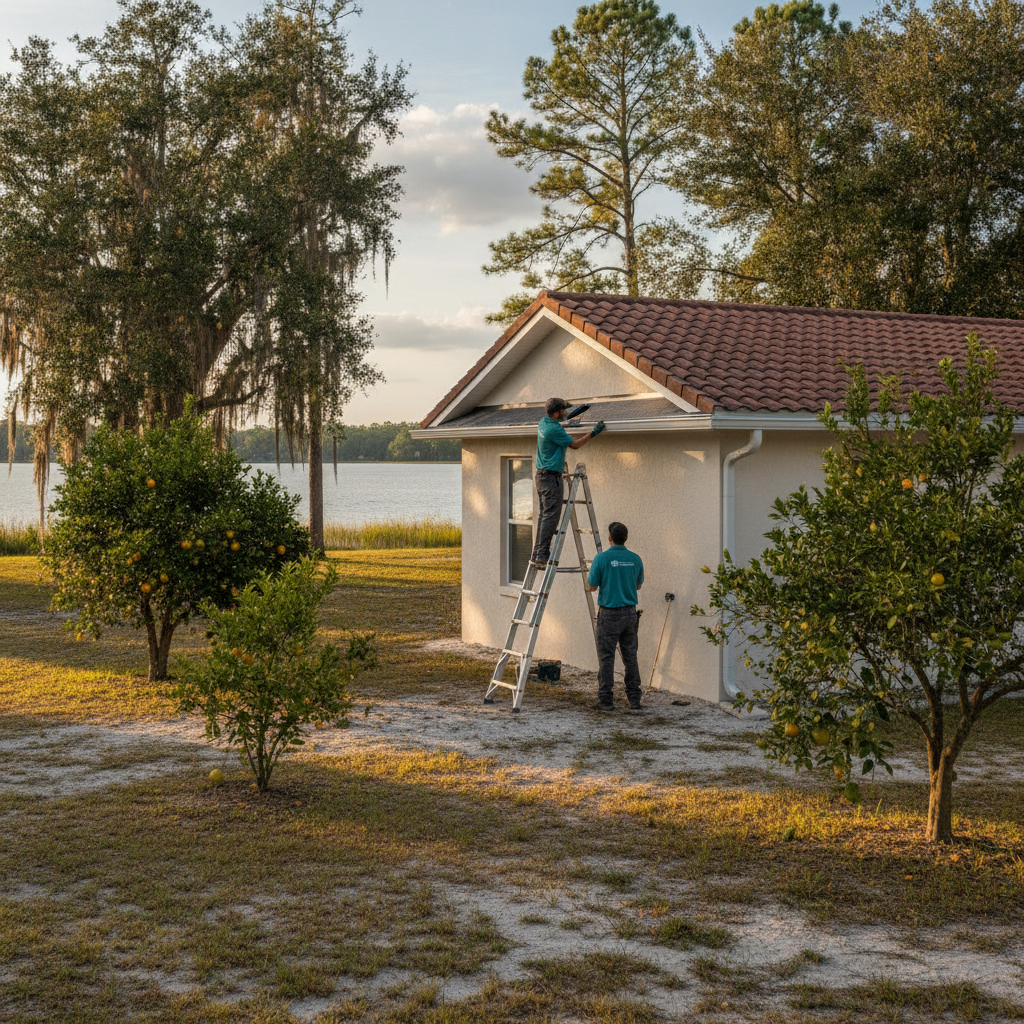
The stuff that clogs a Lake Wales gutter is not the same stuff that clogs one under the live oaks off Lake Morton. On the ridge, citrus bloom, dry leaf, and blown sand ride the wind onto the roof and into the trough. A cover that sheds catkins in Dixieland can still overflow here if the openings are wide enough for that finer trash to sift through.
Citrus trash and sand versus Lakeland oak catkins
Lake Wales Ridge debris is fine, dry, and mixed with sand. That is the local problem, and it is not an oak problem with the city name swapped.
Under the canopy around Lake Morton, oak catkins drop in a thick spring pulse and mat on top of a coarse gutter screen. The mat sits on the mesh. Water either finds a path around it or it sheets over the front edge, and you see the overflow on the fascia. On a ridge lot in Lake Wales, Babson Park, or Frostproof, the grove next door sheds small petals, leaf fragments, and dust. Wind across open citrus and pasture lifts sand onto the shingles. That mix does not mat on a wide screen. It falls through the openings, packs into the trough, and turns into a slurry the first time a summer thunderstorm hits.
A wide-opening gutter screen is built to stop large leaf. Citrus trash is not large leaf. Petals and sand grains are smaller than the holes that let water in on a cheap screen. So the screen looks empty from the ladder. The downspout still coughs brown water. The fascia stays wet. That is why a Lakeland oak story fails a Lake Wales homeowner.
The ridge sits higher than the Lakeland core. Lots open up. Fascia on older ranch houses is often original, sun-baked, and a long walk from the next house. Overflow here does not just stain a tight downtown lot. It sheets down rural siding, soaks the board the gutter is hanging from, and dumps water next to a slab on sand. Sand does not hold water the way a heavier soil might. It also migrates. Once it is in the trough, it does not rinse out as cleanly as a wet oak leaf.
After bloom, the petals are pale and almost weightless. They stick when they are damp and powder when they are dry. A week of dry weather, then the afternoon storm, is the pattern that loads a Lake Wales run. The Atlantic hurricane season runs from June 1 to November 30, and those months just add volume on top of a trough that is already packed with grit.
If you already have a lanai or a cage on the same lot, the same grove trash loads the mesh. That is a separate job from the gutter, and screen repair in Lake Wales is how those panels get sorted. The gutter cover still has to be chosen for the fines, not for the oak story.
Cover, screen, and micro-mesh on a ridge roof
On a Lake Wales roof, a tight micro-mesh or a solid cover beats a wide-opening screen, because the debris here is small enough to pass a coarse grid.
People type gutter cover, gutter guard, and gutter screen as if they were one product. They are three different ways of keeping trash out of a gutter guard run, and the ridge cares which one you pick.
A gutter screen is a coarse grid that sits in or over the trough. Water falls through. Large leaf stays on top. That is the product that mats with oak catkins in Lakeland and still lets citrus fines and sand into a Lake Wales trough. It is light, it goes on fast, and it is the wrong filter for grove trash.
Micro-mesh is a much tighter weave. Water still has to find the openings, so the panel has to sit at a pitch that sheds standing water. Fine petals and grit stay on top and rinse off in a heavy rain if the surface is smooth enough. Sand can still sit on a dry mesh until the next storm. The win is that the trough itself stays closer to empty, which is what keeps the downspout honest.
A solid cover, the hood style people mean when they search gutter cover Lake Wales FL, sheds most water over a curved or angled lid and lets it enter through a narrow slot. Large debris never sees the trough. Fine sand can still migrate into the slot on a windy ridge day, so the crew still has to leave a way to flush the system. The cover is only as good as the gutter under it. A sagging, out-of-pitch trough with a pretty lid still ponds.
None of these products is a substitute for a gutter that is the right size for the roof. Building America notes that gutter channels are typically available in 4-, 5-, and 6-inch sizes. Neither 5-inch nor 6-inch is a default for Polk County roofs. The choice follows catchment per run, pitch, valleys, outlet spacing, and downspout cross-section. A cover on an undersized trough just hides the overflow until the first long storm.
| Product | What it stops | What still gets in on the ridge | When it fits a Lake Wales roof |
|---|---|---|---|
| Screen | Large leaf and twigs | Citrus petals, grit, and sand | Shaded lots with almost no grove trash |
| Micro-mesh | Fine leaf and most bloom | Surface sand until rain rinses it | Grove-adjacent ranches, the common ridge case |
| Solid cover | Almost all debris at the lid | Fine grit at the intake slot | Long, simple fascia runs with a sound trough |
Cost follows linear feet, stories, and whether the trough itself has to come off. Gutter guards install in the $5 to $14 per linear foot range. A new aluminum seamless gutter installs at roughly $8 to $14 per linear foot, which puts most Polk County homes between $1,300 and $2,800 for the gutter itself. Those ranges move up with two-story access, rotten fascia, extra outlets, and long rural runs. They are not a quote from this brand.
A Lakeland gutter-guard install is often an oak-canopy problem. Treat that page as the sister story, not the same job with the city name swapped.
What a Lake Wales install has to include
A cover that lasts on the ridge starts with the fascia, the pitch of the trough, and a downspout that can actually spit sand.
The crews we send walk the board first. Rural fascia on a Lake Wales ranch takes sun and overflow for years before anyone looks up. If the board is soft, hanging a new cover on it just pulls fasteners through wet wood. The hangers have to bite sound material. Replacing a rotten stretch of fascia is not extra theater. It is the only way the next cover stays in plane.
Then the trough. If the existing gutter is out of pitch, rusted at the joints, or pulling away, the honest sequence is a new seamless gutter, then the cover. Clipping a lid onto a trough that already ponds is how you buy the same overflow with a cleaner silhouette. Outlets and downspouts matter as much as the lid. Sand settles at the drop. A skinny downspout on a long ridge run will clog at the elbow even when the cover is doing its job.
Building America program guidance, not a local code we verified, is to discharge surface water at least 5 feet from the foundation, and to keep underground catchment at least 10 feet out. On sandy ridge soil that distance is doing real work. Water dumped at the corner of a ranch slab finds a path under the edge faster than it does on a heavier lot in town.
Pitch and hangers have to survive wind. Polk County is inland. There is no coastline and no salt air here. The building official assigns the design wind speed to the specific address, and the practical version for a gutter cover is simple: the lid has to stay clipped in a summer storm, and the hangers have to hold when the trough is full. A loose cover leaves the trough in a storm.
On Lake Wales outdoor living work, the same licensed crews who hang gutters also see the lanai, the patio cover, and the cage. A grove lot rarely has only one water problem. Match the cover to the debris, then let the rest of the envelope get its own look.
Florida requires the person in the business of contracting to be certified or registered. That is Florida Statutes 489.113, in those words. Several license classes can lawfully hang this kind of work. Ask which class the contractor holds and verify it yourself at myfloridalicense.com. The crews we send are licensed and insured. This brand matches you with them. It does not hang the metal.
Much of the acreage around Lake Wales is unincorporated Polk, which goes through the Polk County Building Division. The City of Lakeland runs its own Building Inspection division, which is a different desk if you are comparing a job in town to a ridge parcel. Do not assume a crew that mostly works one jurisdiction has the same paper path in the other. For the gutter itself, ask the building official on the specific design rather than guessing from a neighbor’s job.
Do gutter covers work with citrus trees in Lake Wales?
They work when the openings are small enough that bloom and grit stay out of the trough. A wide gutter screen is the product that fails first next to a grove, because petals and sand fall through the same holes that let water in. Micro-mesh and a solid cover are the two shapes that match ridge debris. You still rinse the surface. You still keep the downspout clear at the elbow. The cover is a filter, not a spell.
What do gutter guards cost around Lake Wales?
Installed gutter guards in this market run $5 to $14 per linear foot. A new aluminum seamless gutter, if the trough has to be replaced first, is roughly $8 to $14 per linear foot, which puts most Polk County homes between $1,300 and $2,800 for that gutter work. Length, stories, fascia repair, and extra downspouts are what move a given house inside those ranges. Every ridge ranch prices from its own run, not from a county average.
Do I need a new gutter before a cover goes on?
You do when the existing trough is out of pitch, pulling off the fascia, or rusted at the seams. A cover cannot fix a sag. On a sound, correctly pitched seamless gutter, the cover is the add-on. On a Lake Wales ranch with original metal and stained fascia, plan for the trough and the board, then the lid.
When to call us
Call when the trough overflows in a regular afternoon storm, when you can see sand at the downspout elbow, or when the fascia under the gutter is staining or going soft. That is licensed contractor work: ladders, fascia fasteners, and a cover that has to stay put in wind. Call us at (863) 777-5379.