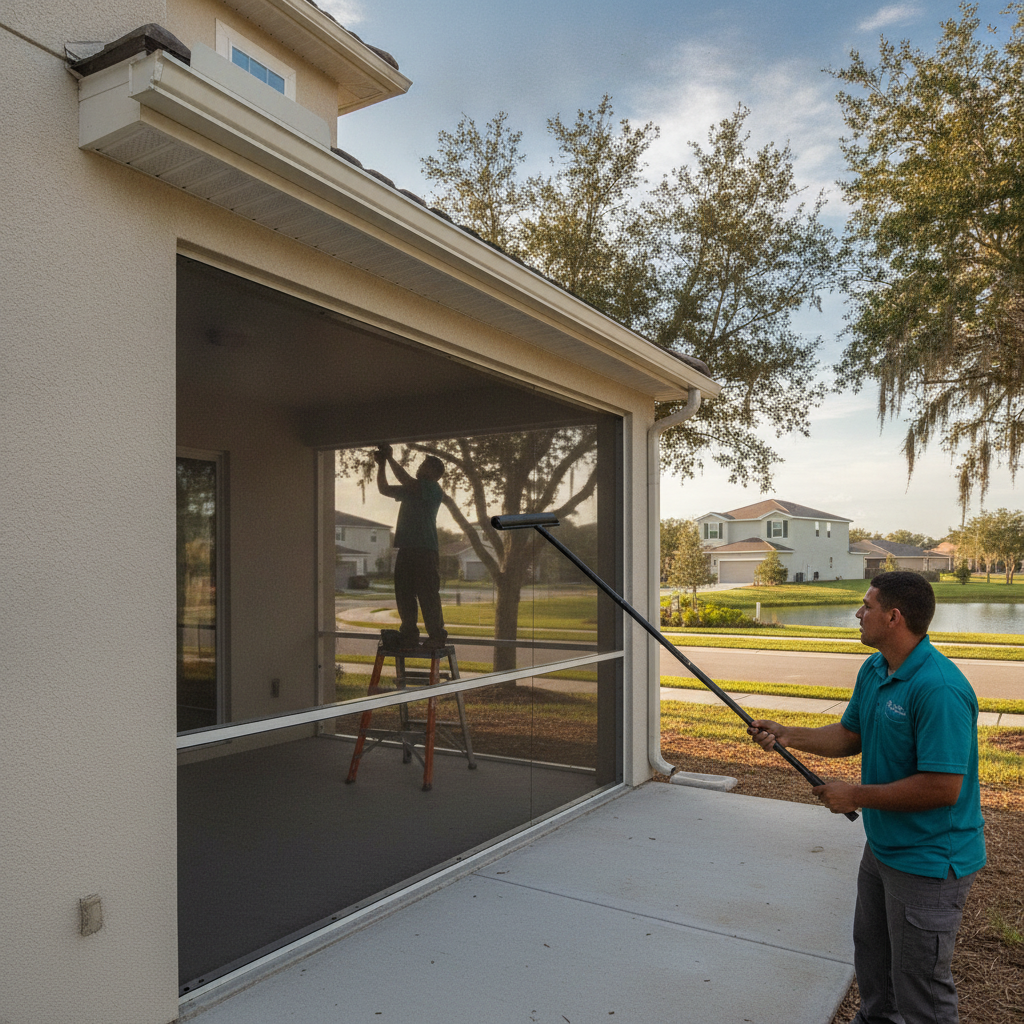
The closing packet on a new Haines City house often shows a roof over the back slab and open air on three sides. Builders along US-27, Posner Park, and Grenelefe pour the pad, set the posts, and leave the screen as a separate line. Haines City screen rooms on these lots are almost always that infill job: aluminum, mesh, a door, and a permit through Polk County once the HOA packet clears.
Builder-covered lanais along the I-4 corridor
Haines City sits on the growth strip with Davenport, Four Corners, Loughman, and the newer streets around Posner Park. The houses are two-story stucco. The lots are wider than a Dixieland bungalow. The back porch arrived as a covered lanai with nothing in the openings.
That is a different starting point from the rest of Polk. A 1950s patio slab near Lake Morton was often poured thin, with no perimeter footer, and an upright has nowhere honest to land. A 1990s cage in Cypress Gardens is already a full structure, usually in its rescreen window, with the south and west mesh going brittle first. A new Haines City pad is a roof and a slab the builder poured with the house. The missing piece is the screen.
Screening in a builder-covered lanai is the product. The crews we send hang kick plates and panels in the openings the builder left, set a door, and tie the new aluminum into posts that are already there. It is not a pool cage spanning water and a deck. It is not a glass sunroom. It is a screen room on a pad that already has a roof.
Short-term-rental pool homes on this corridor fork the other way. If there is water in the backyard, guests will sit around a pool, and the job is a cage, not a lanai infill. The Davenport version of that conversation is already written at Davenport pool cages. Patio screen enclosures in Davenport on a covered slab with no water under it are the same class of work as Haines City. Keep this page for the dry pad.
We cover the city on the Haines City outdoor living hub, along with the rest of Polk County. The line is answered from that same number whether you are in Grenelefe, Posner Park, or a US-27 lot that closed last month.
Summer on these streets is the usual Central Florida pattern. Afternoon storms, then mosquitoes in the openings the builder left. A coarse 18x14 fiberglass mesh, the kind Phifer describes as built to keep out most insects while still letting breezes through, is what most of these rooms get. Tighter 20x20 no-see-um mesh is the other common ask when gnats show up at dusk. The roof is already doing the rain work. The screen is doing the bug work.
HOA architectural review before anyone orders screen
Most new Haines City subdivisions will not let a crew hang a panel until architectural review says yes. The association cares about what the street sees: frame color, door swing, kick-plate height, and whether the infill matches the house. It does not care which spline the installer uses.
The packet is drawings and finish notes, not a sales flyer. A licensed contractor puts the elevation on paper so the board can see bronze or white extrusion against the stucco, the roof that is already there, and the screen in the openings. Neighbors who screened last year are the live sample. Walk the block before you pick a color.
HOA approval for a screen enclosure in Polk County is the longer walkthrough of that packet. What changes on a new Haines City lot is the starting structure. You are not proposing a new roof. You are proposing infill in a builder cover the association already accepted when the house was built. That usually simplifies the drawing. It does not skip the review.
Some associations want the packet stamped before anyone talks to the county. Some will look at it in parallel. Do not guess which one you have. Call the management company and ask for the architectural form, the color list if they keep one, and whether they want the county permit number in the file. There is no published county-wide HOA fee or turnaround to quote, because each community writes its own.
A short-term rental does not get a pass. If the house is in an association, the association still reviews the enclosure even when the occupants will be guests. The board is looking at the building, not the listing.
Florida still requires the person in the business of contracting to be certified or registered. Florida Statutes 489.113 states that plainly. Several license classes lawfully build aluminum structures. Ask which class the contractor holds, then verify it yourself at myfloridalicense.com. The crews we send are licensed and insured. The brand matches you with them. It does not hold the license.
If the initial payment is more than 10 percent of the contract price, Florida Statutes 489.126 requires that contractor to apply for the permits necessary to do the work within 30 days after the date payment is made. On a new lot, that clock is the one worth watching. The HOA letter is not a substitute for the permit.
What the job includes on a new Haines City pad
The work on a builder-covered lanai is infill, a door, and the fasteners that hold the new aluminum to posts and slab that already exist. Polk County’s Building Division says a permit is required for screening of any space which requires structural or infill framing to be added. That line is on the county Building Division FAQ. Haines City is not inside Lakeland’s Building Inspection division, so this job goes through Polk County.
The crew measures the openings, confirms the posts will take the extra aluminum, and checks that the slab will hold the anchors at the base. New subdivision pads poured with the house are a better starting point than those thin Dixieland slabs. The upright still has to land on concrete thick enough to keep the anchor. If a post is out of plumb or a beam was left light for a future screen load, the drawing has to show how that gets fixed. That is when a “screen the openings” job starts to look like a longer span, a heavier beam, or, on a rare lot, a new slab.
Local companies advertise entry-level screen rooms near $1,499 plus permit, and that number is real for a small standard-size room. Screening in an existing covered lanai more often lands in the $1,500 to $3,500 range. Add an insulated roof panel, a longer clear span, or a new slab, and the same kind of room runs $6,000 to $14,000. Those figures are the ranges this site already publishes. They are not a quote for your lot. What moves the number is opening count, door hardware, mesh grade, and whether the builder’s frame can carry the infill without extra structure.
A basic screen enclosure over an existing slab with an aluminum mansard roof sits in that same $1,500 to $3,500 band when the roof is part of the new work. On a Haines City builder pad the roof is usually already there, so you are not buying a mansard. You are buying the walls.
The Florida Building Code assigns an ultimate design wind speed to a specific address. The engineered drawing in the permit package states the value the structure was designed to. Inland Polk carries a lower number than a Gulf-front county, which is why the same cage prices differently here. No page on this site will invent a miles-per-hour figure for your street. The drawing is the document that has it.
If the backyard has a pool, stop treating this as a lanai infill. A pool cage is the structure that covers water. Florida’s Residential Swimming Pool Safety Act lists ways a pool may be made safe. Section 515.29 asks a barrier to be at least 4 feet high on the outside, to have no gap a child could squeeze through or climb, and to carry a self-closing, self-latching gate with the release on the pool side. The statute never names “screen enclosure” as a category. Whether a given cage does all of that is what the building official signs off on. A dry screen room on a covered lanai does not answer that question.
Mesh on a new room still ages the Central Florida way. Fiberglass in this climate often lasts roughly seven to twelve years, and it fails unevenly because sun kills the south and west elevations years before the shaded north side. On a brand-new Haines City cage or room that clock starts the day the spline goes in. Spec the mesh for bugs and glare now. Plan on a rescreen later. Replacing one spline-set panel at ground level is a homeowner job. Erecting or modifying the aluminum frame is not.
Hurricane season runs from June 1 to November 30. Storm-season repair work is scheduled. A new-room install on a quiet lot can still go in during those months. The crew will not promise a calendar you can set a closing date by. The line is answered, and the permit still has to land.
Questions on Haines City screen rooms
Does a Haines City screen room need a county permit
Yes, when the work adds structural or infill framing to screen a space. Polk County publishes that requirement on its Building Division FAQ, and Haines City jobs go through that division rather than Lakeland’s. The HOA letter is a separate approval. Both can sit in the same folder. Neither replaces the other.
What do these rooms cost on a builder-covered pad
Screening in an existing covered lanai is published here at $1,500 to $3,500. Advertised entry-level rooms near $1,499 plus permit are real for a small standard-size room. An insulated roof panel, a longer clear span, or a new slab pushes the same kind of room to $6,000 to $14,000. Your openings, door, and whether the builder’s frame can carry the infill are what move the number.
If the rental has a pool, is a screen room enough
A screen room on a dry covered lanai and a cage over water are different structures. Guests around a pool are a cage conversation, which is why the Davenport cage page exists next door on this corridor. The statute’s barrier rules are height, climbable-gap, and a self-closing, self-latching gate with the release on the pool side. The building official decides whether a given cage does that. No page here will tell you a room or a cage already counts.
When to call us
Call when the builder left the lanai open, the HOA packet is in front of you, or a short-term rental with a pool needs a cage instead of a dry-room infill. The crews we send are licensed contractors, and this kind of framing is their work, not a weekend project. Call us at (863) 777-5379.