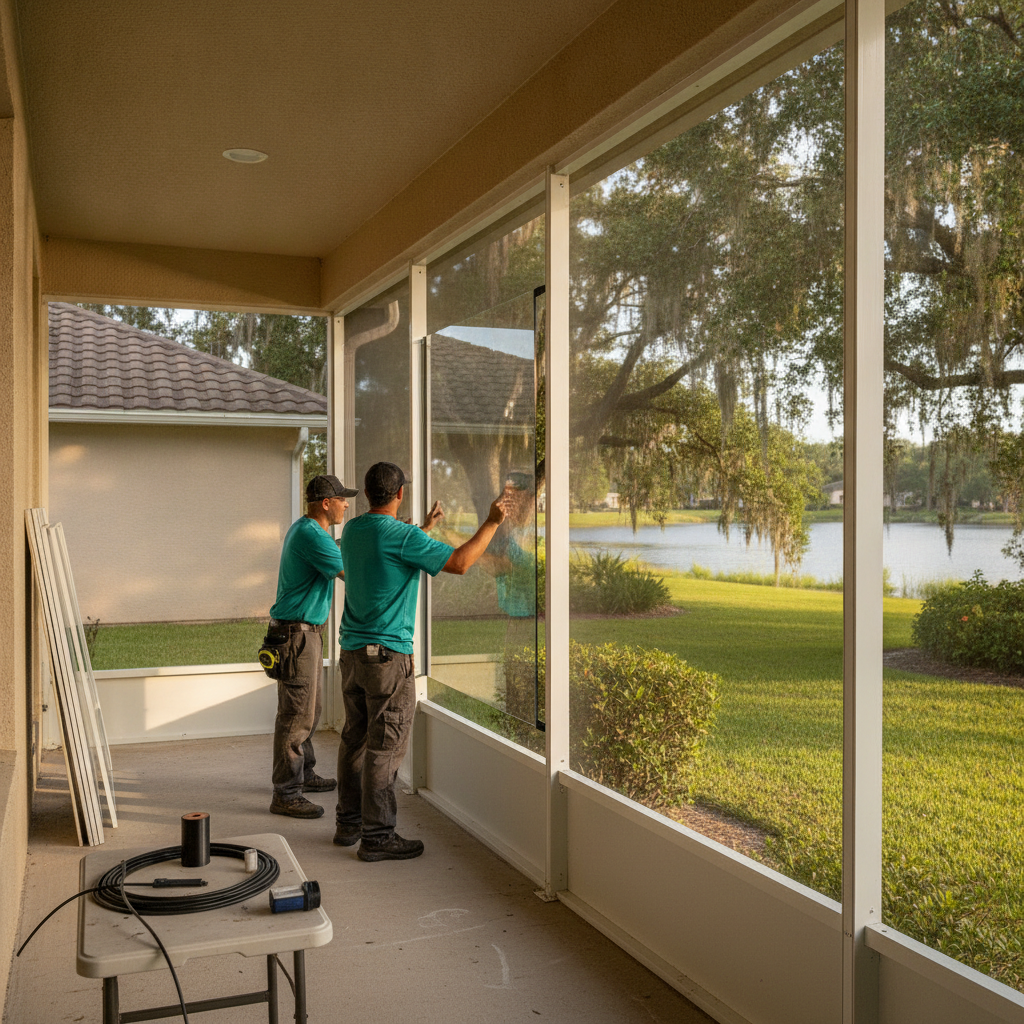
Clear acrylic lanai windows cost less than a glass sunroom because they are weather panels in an existing screen frame, not a new room. In Lakeland you are paying for how many bays get a solid sheet, whether that aluminum was built to hold anything heavier than mesh, and how much of a west wall you want closed against a summer thunderstorm. A couple of lift-out panels on a Davenport builder lanai is a different job than boxing in the whole space.
Acrylic, glass, and what each does in Polk County heat
Acrylic is a clear plastic sheet that slides or clips into the openings that currently hold screen. It stops wind-driven rain and knocks down the afternoon breeze. It does not turn the lanai into air-conditioned living space, and it is not laminated impact glass on the house.
Glass is a different product. A glass sunroom is a finished envelope: heavier infill, a real wall system, and a room people mean to live in. That is why a glass sunroom in Polk County runs $22,000 to $45,000. Acrylic sits on the cheaper side of that split because the crews we send are closing an outdoor room, not adding a house.
Polk County heat is what the product brochure leaves out. A west-facing lanai in South Lakeland or along US-98 takes the long afternoon sun. Mesh lets that heat move through. A solid acrylic bay traps it, the same way a parked car does. On a July afternoon the room can feel hotter with the panels in than it did as a screen room. People who live with this usually leave the north and east bays in screen and close the weather side.
The same sun that kills mesh on the south and west elevations, in roughly seven to twelve years in Central Florida, is the sun that hazes acrylic. The north side of a Cypress Gardens lanai can still look new while the west sheets have gone milky. That haze is UV, not dirt you can hose off. Oak pollen off Lake Morton in April wipes off a sheet. It mats in mesh and stays.
Acrylic also moves with heat. The sheet grows on a hot Bartow slab and shrinks after a night rain. Tracks have to leave room for that or the panel binds, then it chatters when an afternoon storm cell builds over Polk. Glass is heavier and stiffer. It asks more of the posts and the anchors. On a thin 1950s patio slab in Dixieland, that extra load is the whole conversation. Those slabs were often poured without a perimeter footer, and a solid wall wants something thick enough to hold an anchor.
How the panel actually sits in the frame matters to the price. Screen is a flexible mesh held in a channel by a rubber spline. A rigid sheet will not roll into that groove. The crew adds a deeper track, a clip system, or a new infill bar. That track is labor. If the original extrusion has no panel groove, you are not buying “windows.” You are buying a small framing job so the sheet has a place to live.
One more distinction, because the search mixes them. Acrylic lanai windows are weather panels. They are not hurricane protection for the sliding door behind the lanai. Inland Polk has no coast, but it still takes hurricane wind. Screen mesh is meant to fail and let pressure through. A solid sheet catches that pressure and sends it into the posts. The Florida Building Code assigns an ultimate design wind speed to the address, and the engineered drawing in the permit package states the value the structure was designed to. Inland Polk carries a lower number than a Gulf-front county, which is why the same cage prices differently here. None of that makes a plastic sheet into impact glass.
If the structure is a pool cage rather than a dry lanai, solid panels also do not settle the pool-barrier question. Florida’s Residential Swimming Pool Safety Act asks a barrier to be at least 4 feet high on the outside, to have no gap a child could squeeze through or climb, and to carry a self-closing, self-latching gate with the release on the pool side. Whether a given cage does all of that is what the building official signs off on. Closing a bay with acrylic does not change that review.
A few panels versus enclosing the whole lanai
Most Lakeland quotes split here: close the weather walls, or enclose every opening.
A few panels is the cheaper shape. You keep the breeze on the shaded sides, you stop the rain that blows in from the west, and you still have a lanai. Cost follows the count of bays, the height of the opening, whether the crew can use the existing bar or has to add track, and whether the panels are lift-out sheets or sliding sashes. Lift-out is what people want before hurricane season, which runs from June 1 to November 30. Sliding sashes stay in the frame and you live with them year round.
Knee walls change the math. Many Lakeland lanais have a half-wall of aluminum or block with screen above it. You are only buying the upper openings. Floor-to-beam sheets on a 1990s Winter Haven cage cost more because the sheet is taller and the wind sail is bigger. Same material. Different opening.
Enclosing the whole lanai is the three season room version of the same idea: every screen bay gets a solid infill, and the space starts to behave like a Florida room. That is closer to a conversion than to a window buy. Conversion of an existing lanai in the Lakeland area runs $8,000 to $20,000. Screening in an existing covered lanai, with mesh only, runs $1,500 to $3,500. Those two published ranges are the ladder. Acrylic windows live between them because you are adding sheet and track to a frame that was often built for mesh.
What moves the number, in which direction:
- More solid bays load the same posts with more wind, so the crew may have to add uprights, a header, or a better anchor into the slab.
- A long clear span or an insulated roof already pushes a screen room into the $6,000 to $14,000 band, and solid infill on that span is not a cheap add-on.
- Builder-covered lanais in Davenport, Four Corners, and along I-4 were often left as a separate screening line item. The roof and slab are there. Closing those openings with acrylic is still infill, but the frame has to be sized for solid panels, not leftover builder screen.
A pool cage rescreening is the wrong job if what you actually want is clear panels. Full-cage rescreen work in this market runs $1,400 to $3,200, and that is mesh going back into channels. Acrylic is a different material in a different track. Mixing them on one Chain of Lakes cage is common: mesh on the roof and the shaded sides, solid panels on the wall that takes the rain. Do not stretch a rescreen price onto a panel job.
| | Screen only | Acrylic panels | Glass sunroom | | What you get | Bugs out, breeze in | Rain and wind stopped, still an outdoor room | A finished room with a glass envelope | | Heat on a Polk afternoon | Hottest air, best airflow | Traps sun on west and south walls | Can be insulated, still needs shade on the west | | What the frame feels | Mesh lets pressure through | Solid sheet loads every post | Designed as part of the house | | Typical starting point | Existing covered lanai | Screen bays you want to close | A conversion you mean to live in |
If you are choosing glass, the sister cost picture is on our glass lanai enclosure cost page. If you are still deciding whether the space should stay a screen room, read screen room versus three season versus sunroom. Acrylic is the middle child: clearer than mesh, lighter than glass, and still an outdoor room.
Polk buyers pay for a place they can sit during an afternoon thunderstorm, especially around Winter Haven and the lakes. A milky acrylic box that bakes in August is not that place. There is no single value number that fits a Dixieland bungalow and a new short-term rental in Haines City. Finish, shade, and whether the work was permitted matter more than the word lanai on a listing.
Permits when you turn a screen room into a Florida room
Closing screen bays with solid panels is infill, and infill is permit work in this county.
In unincorporated Polk, the Building Division FAQ lists “Screening of any space, which requires structural or infill framing to be added.” Acrylic windows are infill in those openings. If the crew adds framing or track to hold the sheets, you are in that sentence.
Inside the City of Lakeland, Building Inspection publishes its own permit requirements. That list includes porches and “Screening of any space that requires structural or infill framing.” A crew that mostly works unincorporated Polk can hit friction inside city limits because the city runs that division on its own page. Ask which office has the lot before anyone cuts a channel.
A Florida room is what people call the lanai once it stops being a screened porch and starts being a closed room. That change is why the permit exists. The building official is looking at wind on a solid wall, how the structure ties to the house, and how the space will be used. They are not rubber-stamping a window order. The vocabulary for that shift is in what is a Florida room.
No page here publishes a permit fee, and a fee you heard from a neighbor in Winter Haven may not be the fee on a Lakeland city lot. The City of Lakeland collects non-utility impact fees for Polk County at the time of permit. Those categories are transportation, fire protection, law enforcement, and parks. That is a county fee collected at the city counter, not two separate piles. Whether an acrylic job trips an impact fee is a question for the permit office on the actual scope.
HOAs along the I-4 corridor in Haines City, Davenport, and Loughman often want a picture of the panel before the city does. Architectural review is not a substitute for a permit, and a permit is not a substitute for the HOA.
Florida law is plain on who may contract the work. A person must be certified or registered in order to engage in the business of contracting in this state. Several license classes lawfully build aluminum structures. Ask which class the contractor holds, and verify it yourself at myfloridalicense.com. If you put down more than 10 percent of the contract price as an initial payment, that contractor must apply for the permits necessary to do the work within 30 days after the date payment is made. The consumer-protection version of that rule is in our note on Florida statute 489.126.
Panels that are already in without a permit are a Building Division problem, not a weekend fix. Bartow and south Polk see a lot of owner-builder and unpermitted work on older stock. State law still expects construction to be done by a licensed contractor unless you are acting under the owner-builder exemption with its restrictions. The county and the city will tell you what the package has to include. Guessing from a listing photo will not.
How much do acrylic windows cost?
Acrylic lanai windows are priced by the opening, not by a countywide sticker. Screening an existing covered lanai runs $1,500 to $3,500. Converting an existing lanai in the Lakeland area runs $8,000 to $20,000. A glass sunroom in Polk County runs $22,000 to $45,000. A few removable sheets on the weather wall sit toward the low end of that conversion band. Closing every bay, adding track, and stiffening a frame that was built for mesh sits toward the high end.
What is the average cost to enclose a lanai?
There is no single average that covers a Kathleen patio and a two-story cage in Winter Haven. Mesh on an existing covered lanai is the $1,500 to $3,500 job. A full conversion in the Lakeland area is the $8,000 to $20,000 job. Glass is the $22,000 to $45,000 job. Size, roof, slab, and how many openings go solid are what move you up that ladder.
Do you need a permit to enclose a lanai in Florida?
In unincorporated Polk County and inside the City of Lakeland, screening that needs structural or infill framing is on the published permit list. Acrylic panels in those openings are infill. The building official for your address is the one who says what the package must include.
When to call us
When you want acrylic panels in a screen frame, or you are choosing that against a glass room, the work belongs to a licensed contractor. The crews we send look at the existing aluminum, the slab, and which walls actually need to close. Call us at (863) 777-5379.