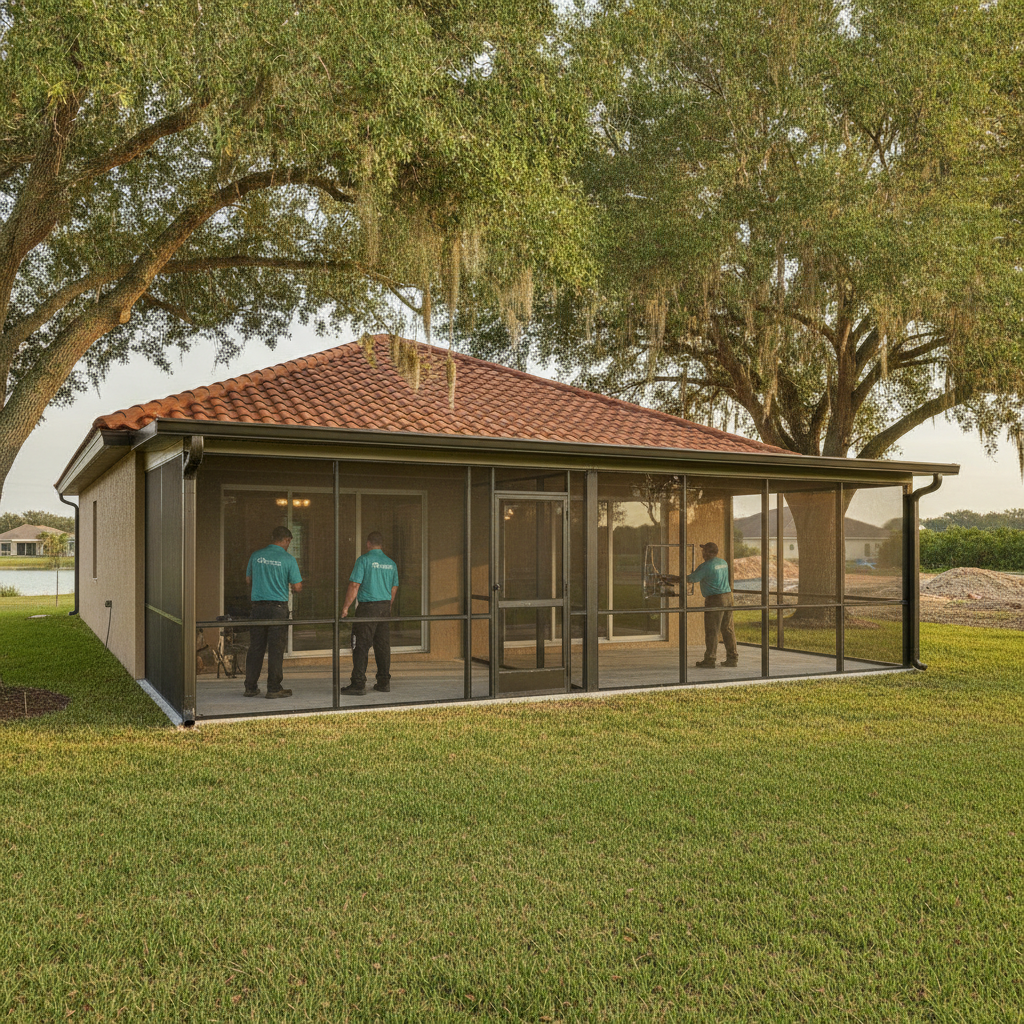
A Dixieland neighbor will point at the screened porch off the kitchen and call it a Florida room. A Davenport listing will print the same words on a glass box that stays shut through July. In Polk County the names get used loosely, and the building department cares about how the room is enclosed and conditioned, not the nickname on the quote.
What people in Polk actually mean by each name
Most people here use Florida room for a screened living porch. Screen sits in a channel, held by a rubber spline, and air moves through. Bugs stay out. Rain still comes in on a hard angle. Heat dumps back out through the mesh. That is the room a 1990s Winter Haven listing is talking about. It is also the room a Lake Morton bungalow already has if someone screened the rear slab.
Sunroom, in this county, usually means glass. Walls you cannot feel a breeze through. An insulated roof more often than a glass roof. Sometimes a cooling tie-in from the house. It is a room you sit in in July without sharing the afternoon with the mosquitoes off Lake Howard.
A three season room sits in the middle. Acrylic or vinyl panels drop into the same kind of aluminum frame a screen room uses. Open them and it behaves like a Florida room. Close them against an August downpour and it behaves more like a sunroom, minus the insulation of real glass.
None of those nicknames is a building category. A realtor, a neighbor, and a crew can mean three different rooms with the same two words. National blogs treat Florida room and sunroom as synonyms. That habit is why this search exists. If you want the product-by-product split, we already wrote the screen room versus three-season versus sunroom comparison. This page is the naming problem: what you call it, and what the inspector is actually looking at.
Lanai is the other word that walks into the conversation. In Polk it usually means the covered patio the builder left, screened or not. A Davenport subdivision lanai with a roof and no screen is not a Florida room yet. Screen it and people start calling it one. Glaze it and they start calling it a sunroom. The slab did not change. The enclosure did.
What a Florida room is gets its own page, because the history of the name is a different question from the permit question. On this page, hold one local rule in your head: Florida room most often means screen, sunroom most often means glass, and the paperwork follows the walls.
| Name people use | What is usually standing there | What the job actually is |
|---|---|---|
| Florida room | Screen in aluminum channels, air moving through | A screened enclosure |
| Sunroom | Glass walls, often an insulated roof | An enclosed room |
| Three-season room | Acrylic or vinyl panels that open and close | An enclosure with operable panels |
On a Cypress Gardens lot the south wall of a 1990s cage goes brittle years before the shaded north side. People still call the whole thing a Florida room. The mesh is doing the work, not the nickname.
How the permit category changes the job
The permit follows the construction, not the sales flyer.
In unincorporated Polk County, the Building Division’s published FAQ says a permit is required for “Screening of any space, which requires structural or infill framing to be added.” That sentence catches most Florida-room jobs. Adding screen to a space that already has a roof still needs framing in the openings. Framing is the trigger.
Inside the City of Lakeland, Building Inspection publishes its own permit requirements. Permits are required for “Screening of any space that requires structural or infill framing,” and the same page names porches. A crew that mostly works unincorporated lots can hit friction once the address is inside city limits, because the city runs that list through its own division.
A glass sunroom is a different animal on paper. You are enclosing space with walls and a roof, often tying into the house, often adding openings that have to latch, sometimes adding conditioning. That is why the paperwork and the inspections feel heavier than screening an existing lanai. The longer walkthrough of that path is in sunroom permits in Polk County.
Solarium does not create an exemption. It is another nickname. If the work adds structural or infill framing, or it builds an enclosed room, the inspector is classifying the work, not the word.
A Florida room over a pool does not get a free pass on child safety because someone used a friendly name. Florida’s Residential Swimming Pool Safety Act never names “screen enclosure” or “Florida room” as a barrier category. The statute asks a barrier to be at least 4 feet high on the outside, to have no gap a child could squeeze through or climb, and to carry a self-closing, self-latching gate with the release on the pool side. Whether a given cage does all of that is what the building official signs off on.
Florida law is plain on who may contract the work. A person must be certified or registered in order to engage in the business of contracting in this state. Several license classes lawfully build aluminum structures. Ask which class the contractor holds, and verify it yourself through Florida DBPR’s Verify a License tool.
Cost moves with the category, not with the nickname. Local companies advertise entry-level screen rooms near $1,499 plus permit, and that number is real for a small standard-size room. Screening in an existing covered lanai often lands in the $1,500 to $3,500 band. Add an insulated roof panel, a longer clear span, or a new slab and the screen-room job climbs to $6,000 to $14,000. Conversion of an existing lanai in the Lakeland area is published at $8,000 to $20,000. A glass sunroom in Polk County is published at $22,000 to $45,000.
Those ranges move with span, roof, glass versus acrylic, and whether the slab can take the load. A longer clear span means heavier beams carrying the same roof, and heavier beams cost more per foot. A thin 1950s patio slab in Dixieland, poured without a perimeter footer, is an anchoring problem. Calling that slab a Florida room does not make the concrete thicker.
HOA architectural review in the I-4 corridor can care about the look of glass versus screen. That is a design review. It is not a substitute for the building permit.
Heat, glass, and acrylic on an inland lot
Inland Polk cooks. There is no sea breeze to steal the story. A west-facing glass wall on a Haines City lot takes the afternoon sun and holds it. Screen lets that heat leave. Glass does not, unless you condition the room.
That is the real Florida room versus sunroom decision in this climate. A screened Florida room stays in the outdoor temperature. Ceiling fans move the air you already have. After the daily thunderstorm, the floor is wet at the edges and the chairs are fine if they were made for it. A glass sunroom is an interior-ish room. It will run hotter than the house in July if you leave it closed and unconditioned. It will be the nicest room on a January morning when the oaks are bare.
Acrylic sits between them. It is lighter than glass. Heat makes it move. UV yellows it over years, faster on the south and west elevations, slower under a live oak canopy off Lake Morton. It scratches if you wipe grit across it. Glass is heavier, clearer for longer, and better at holding conditioned air. That is why the published glass-sunroom range sits well above a screen job.
Screen itself fails unevenly here. In Central Florida, mesh lasts roughly seven to twelve years, and the south and west elevations go first. A Winter Haven Florida room that still looks new on the shaded north side can already be brittle where the sun hits it. The spline popping out of the channel the first time wind gets under a loose panel is how that job announces itself.
New subdivisions along I-4 through Davenport and Four Corners often hand you a builder-covered lanai with no screen and a west exposure. Screening it is one job. Glazing it is another. The west wall is the same wall in both cases. What you put in the openings decides whether the room dumps heat or stores it.
Bartow and south Polk bring older stock and more owner-builder questions. The construction test does not change. Lake Wales Ridge lots have more room and more setback conversation, and the same naming mess. Under the oaks downtown, catkins mat on coarse screens every April. Glass does not catch catkins. It catches glare instead.
When the sky goes dark over Winter Haven, acrylic panels close and you step inside, or you live with wind-driven rain through screen. The Atlantic hurricane season runs from June 1 to November 30, and summer thunderstorms do not wait for June. Enclosure type is a weather decision as much as a furniture decision.
What are sunrooms called in Florida?
Florida room, lanai, sun porch, solarium, and three-season room all get used for the same search. In Polk County those words overlap on purpose. A screened porch, a glass room, and an acrylic enclosure can all show up in a listing as a Florida room. Ask what the walls are made of, whether the roof is insulated, and whether the space is conditioned. The nickname will not tell you.
Does a sunroom count as living space?
The nickname does not decide it. A screened Florida room is outdoor living. Glass and conditioning make a space behave more like the rest of the house. Listing agents and appraisers make their own call on square footage, and the tax roll uses its own rules. The building department is looking at the enclosure, not the MLS label.
Do I need a permit for a solarium?
A solarium is a nickname for an enclosed glass room. In unincorporated Polk County, screening that needs structural or infill framing needs a permit. A glass enclosure is still construction. Inside the City of Lakeland, the published list names screening that needs framing, and it names porches. Call it a solarium, a Florida room, or a sunroom. The inspector is classifying the walls.
When to call us
When the job adds framing, glass, acrylic, or a tie into the house, it needs a licensed contractor. We match Polk County homeowners with licensed local crews for that work, from a screened Florida room to a glass sunroom. Call us at (863) 777-5379.