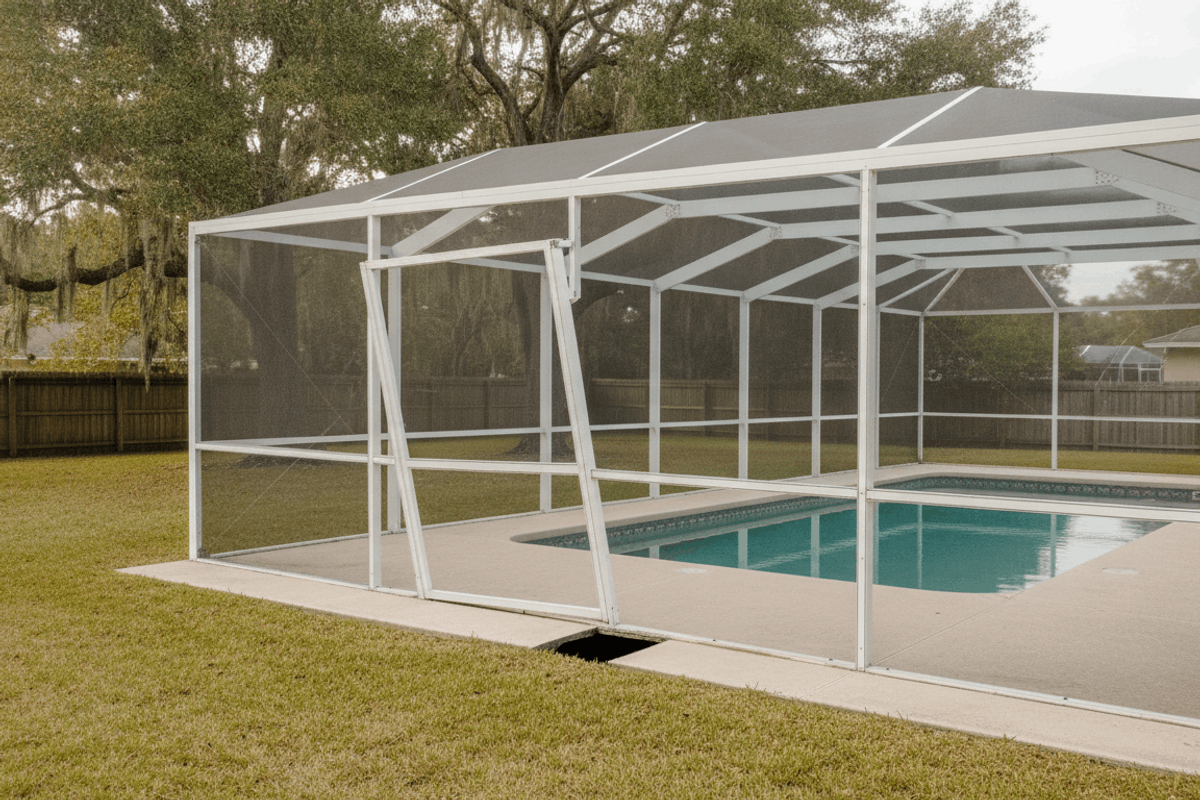
Before a Florida homeowner can sue over defective construction work, the state makes them send a letter. Chapter 558 of the Florida Statutes requires a written notice of claim, served on the contractor at least 60 days before filing, that describes each defect and gives the other side a formal chance to inspect it and offer to fix it, pay for it, or dispute it. Skip the letter and the courthouse door closes temporarily: F.S. 558.003 says “A claimant may not file an action subject to this chapter without first complying with the requirements of this chapter”, and on a timely motion “the court shall stay the action, without prejudice, and the action may not proceed until the claimant has complied with such requirements”.
This page is a map of the statute, written for a Polk County homeowner staring at a cage or a sunroom that was not built right. It is not legal advice, it does not evaluate anyone’s particular job, and it will tell you more than once where its usefulness ends.
What chapter 558 is for
The Legislature wrote its reason into the first section. F.S. 558.001 finds that “it is beneficial to have an alternative method to resolve construction disputes that would reduce the need for litigation as well as protect the rights of property owners”.
In practice the chapter is a mandatory cooling-off lap. You tell the builder exactly what is wrong. The builder gets to come look at it. The builder then has to put something in writing: an offer to repair, an offer to pay, a mix of both, a referral to their insurer, or a flat dispute. Only after that exchange runs its course, or the deadlines pass with silence, does a lawsuit proceed.
A lot of disputes die right there, which is the point. A contractor who knows the panel pulled loose because an upright was anchored into a slab edge would usually rather send a crew back than a lawyer forward.
What counts as a construction defect
The definition is wider than most homeowners expect. F.S. 558.002(5) defines a construction defect as “a deficiency in, or a deficiency arising out of, the design, specifications, surveying, planning, supervision, observation of construction, or construction, repair, alteration, or remodeling of real property”, when it results from one of four causes. Two of them do most of the work on residential jobs: “Defective material, products, or components used in the construction or remodeling”, and “A failure to construct or remodel real property in accordance with accepted trade standards for good and workmanlike construction at the time of construction”.
Read that against the kind of work this site covers. A pool cage whose fasteners were run into the thin edge of a deck pour and are now lifting. A screen room attached to fascia that was already soft, so the whole beam line sags a year later. A sunroom where the roof panels pond because the pitch was built flatter than the drawing. Re-screening and repair jobs count too: the definition expressly includes repair, alteration and remodeling, not just new construction.
Who can send the notice is equally broad. A claimant under 558.002(3) is “a property owner, including a subsequent purchaser or association, who asserts a claim for damages against a contractor, subcontractor, supplier, or design professional concerning a construction defect”. The subsequent purchaser language matters in Polk County’s growth corridor: if you bought a Davenport house whose builder-covered lanai was enclosed badly by the prior owner’s contractor, the chapter still describes you.
When the chapter applies, and when it does not
Three boundaries decide whether the 558 process applies to your situation at all.
First, the work has to be finished. 558.003 is explicit that “The notice is not required for a project that has not reached the stage of completion of the building or improvement”. Completion under 558.002(4) means “issuance of a certificate of occupancy, whether temporary or otherwise, that allows for occupancy or use of the entire building or improvement, or an equivalent authorization issued by the governmental body having jurisdiction”. On a Polk County enclosure that authorization comes out of the final inspection, which is its own process with its own traps; our walkthrough of what the inspector actually checks covers that end of the job. If the contractor abandoned a half-built cage, you are in a payment-and-abandonment fight, not a 558 fight, and the deposit rules in Florida Statute 489.126 are usually the sharper tool.
Second, the contract date. Under F.S. 558.005(1), the chapter applies to claims where “the agreement to make the improvement was made after October 1, 2009”, for “a construction defect that has arisen after completion of a building or improvement”. Nearly every enclosure standing in Polk County that is young enough to sue over clears that date easily.
Third, the opt-out. The same subsection opens with “Unless a claimant and a potential defendant have agreed in writing to opt out”, so a contract can take the parties out of the chapter. Your contract was probably supposed to mention the chapter either way: 558.005(6) says a post-2009 written contract between an owner and a contractor “must contain substantially the following notice”, and then supplies it: “ANY CLAIMS FOR CONSTRUCTION DEFECTS ARE SUBJECT TO THE NOTICE AND CURE PROVISIONS OF CHAPTER 558, FLORIDA STATUTES.” The statute then defuses itself: “The failure to include in the contract the notice provided in this subsection does not subject the contracting owner, contractor, or design professional to any penalty.” So a missing clause does not excuse anyone from the process, and it does not penalize the contractor who left it out.
The notice itself
F.S. 558.004(1) sets the timing: “the claimant shall, at least 60 days before filing any action, or at least 120 days before filing an action involving an association representing more than 20 parcels, serve written notice of claim on the contractor, subcontractor, supplier, or design professional, as applicable, which notice shall refer to this chapter”. If the work was done under a contract, “the written notice of claim must be served on the person with whom the claimant contracted”. For a single-family homeowner the practical reading is short: write to the company named on your contract, cite chapter 558 in the letter, and do it at least 60 days before any suit.
The content standard is reasonable detail, not an engineering report. Under 558.004(1)(b), “The notice of claim must describe in reasonable detail the nature of each alleged construction defect and, if known, the damage or loss resulting from the defect”, and based on at least a visual inspection it “must identify the location of each alleged construction defect sufficiently to enable the responding parties to locate the alleged defect without undue burden”. The statute then removes a worry outright: “The claimant has no obligation to perform destructive or other testing for purposes of this notice.” Walk the cage, photograph the pulled spline lines and the lifted base plates, note which elevation and which panel, and write that down. Southwest corner, both uprights, anchors lifting out of the deck is reasonable detail. The enclosure is bad is not.
There is a soft deadline buried here that rewards moving quickly. 558.004(1)(c) says “The claimant shall endeavor to serve the notice of claim within 15 days after discovery of an alleged defect, but the failure to serve notice of claim within 15 days does not bar the filing of an action”. Endeavor means try; missing it costs you nothing by itself. The hard clocks live elsewhere, and they are the subject of a section below.
Service is defined, and informal delivery does not qualify. Under 558.002(9), service means “delivery by certified mail with a United States Postal Service record of evidence of delivery or attempted delivery to the last known address of the addressee, by hand delivery, or by delivery by any courier with written evidence of delivery”. A text message to the crew lead is not service. Certified mail with the receipt stapled to your copy of the letter is.
One more feature worth knowing: under 558.004(11), “a claimant may include multiple defects in one notice of claim”, and the list “may be amended by the claimant to identify additional or new construction defects as they become known to the claimant”. One letter can carry the sagging beam line, the ponding roof panels and the gate that will not latch, and you can add what you find later.
What happens during the 60 days
The waiting period is not idle time. The statute runs a schedule through it, and each step has its own deadline for a single-family claim.
Within 30 days of being served, the contractor “is entitled to perform a reasonable inspection of the property” under 558.004(2). You have to give reasonable access during normal working hours. Destructive testing, cutting into the structure to find the cause, happens only “by mutual agreement” under conditions the statute spells out, and refusing a reasonable request has a cost: a claimant who refuses loses damages that the testing and a prompt feasible remedy would have avoided.
Within 10 days, the contractor may forward your notice down the chain under 558.004(3), to any subcontractor, supplier or design professional it “reasonably believes is responsible for each defect specified in the notice of claim”. The aluminum crew, the concrete sub who poured the deck, the supplier whose fasteners failed. Each of them can inspect too.
Within 45 days, the written answer is due. Under 558.004(5) the contractor “must serve a written response to the claimant”, and it must provide one of five things: an offer to repair at no cost with “a detailed description of the proposed repairs necessary to remedy the defect, and a timetable for the completion of such repairs”; an offer to settle with money; a combined repair-and-money offer; “A written statement that the person disputes the claim and will not remedy the defect or compromise and settle the claim”; or a statement routing the claim to the contractor’s insurer, which then has 30 days of its own to respond, and if the insurer stays silent “the claimant shall be deemed to have met all conditions precedent to commencing an action”.
Silence has the same consequence as a dispute. Under 558.004(6), if the contractor disputes the claim or “does not respond to the claimant’s notice of claim within the time provided in subsection (5), the claimant may, without further notice, proceed with an action against that person for the claim described in the notice of claim”.
Your move when the response lands
An offer starts a 45-day clock on your side. Under 558.004(7) you “must accept or reject the offer by serving written notice of such acceptance or rejection on the person making the offer within 45 days after receiving the settlement offer”. File a lawsuit without doing that and the court stays it on timely motion until you comply.
Accepting a repair offer means letting the crew back in. Under 558.004(8) you provide reasonable access during normal working hours so the repair happens on the offered timetable. If the contractor completes the repair or payment in the agreed time and manner, “the claimant is barred from proceeding with an action for the claim described in the notice of claim or as otherwise provided in the accepted settlement offer”. A completed accepted offer closes that claim. If the contractor blows the agreed timetable for reasons within their control, you may proceed to court without further notice.
Nothing in the chapter forces you to accept anything. Rejecting every offer and proceeding after the 60 days is a lawful path. The chapter also protects both sides on the way through: under 558.004(9), an offer or a failure to offer “does not constitute an admission of liability with respect to the defect and is not admissible in an action brought under this chapter”. The same subsection protects you in an emergency: “This section does not prohibit or limit the claimant from making any necessary emergency repairs to the property as are required to protect the health, safety, and welfare of the claimant.” If a storm-loosened beam is hanging over the pool deck, you do not have to leave it dangling for 60 days to preserve your claim. Document it thoroughly, then make it safe. For work like that, the crews we send handle enclosure repair across Polk County, and an invoice from a repair visit is itself evidence of what the fix cost.
The clocks running underneath the process
Chapter 558’s own deadlines sit on top of chapter 95’s, and confusing the two layers is the most expensive mistake a homeowner can make here.
The limitations period for construction claims is four years. F.S. 95.11(3)(b) covers an action “founded on the design, planning, or construction of an improvement to real property”, running “from the date the authority having jurisdiction issues a temporary certificate of occupancy, a certificate of occupancy, or a certificate of completion, or the date of abandonment of construction if not completed, whichever date is earliest”. For a hidden problem the start moves: “when the action involves a latent defect, the time runs from the time the defect is discovered or should have been discovered with the exercise of due diligence”.
Behind the limitations period stands the statute of repose, and it is absolute: “In any event, the action must be commenced within 7 years after the date the authority having jurisdiction issues a temporary certificate of occupancy, a certificate of occupancy, or a certificate of completion, or the date of abandonment of construction if not completed, whichever date is earliest.” Seven years from completion, the right to sue ends, discovered or not.
Serving a 558 notice freezes one clock and not the other. Under 558.004(10), service “tolls the applicable statute of limitations relating to any person covered by this chapter and any bond surety” until the later of 90 days after service or 30 days after an accepted offer’s repair period ends. But 558.004(1)(d) is blunt about the other layer: “A notice of claim served pursuant to this chapter shall not toll any statute of repose period under chapter 95.” A homeowner whose cage went up six and a half years ago and who just found the latent anchor problem is inside the limitations window and nearly out of the repose window, and the 60-day letter does not stretch it. That combination is exactly when a construction attorney stops being optional.
Where this fits among your other remedies
The 558 notice is the on-ramp to a lawsuit, and a lawsuit is only one of the tracks a Polk County homeowner can run, sometimes in parallel.
A licensing complaint to DBPR costs nothing and does not require the 60-day letter, because a 558 action is “any civil action or arbitration proceeding” under 558.002(1) and an administrative complaint is expressly excluded from that definition. Our explainer on contractor licensing for screen enclosures covers who holds which license and how to look one up.
The lawsuit the 558 process leads to is also the gateway to being paid when the contractor cannot pay. The Florida Homeowners’ Construction Recovery Fund pays only after a final judgment, arbitration award or board restitution order, which means a homeowner heading for the fund usually has to walk through chapter 558 on the way. The one-year claim deadline in that statute starts at the end of the underlying case, so the two timelines chain together.
And if the dispute is about money flowing the other direction, a sub or supplier threatening your title rather than you chasing the builder, that is lien territory, mapped in our piece on contractor liens in Polk County. The 558 notice does not answer a lien and a lien does not answer a defect.
One Polk-specific note for the paperwork file: the authority whose certificate starts the chapter 95 clocks depends on where the house sits. Inside Lakeland city limits the City of Lakeland’s Building Inspection division issues it; everywhere else in the county it is the Polk County Building Division. When you assemble a defect file, the certificate date from the right office is the first document in the stack, and it is retrievable through the county’s permit search tools.
What this looks like on a real enclosure
Take a 1990s cage on the Chain of Lakes in Cypress Gardens that got a full rescreen and new fastener package three years ago. This spring the homeowner notices the southwest uprights lifting off the deck, and a level on the beam line shows the whole wall leaning. The rescreen contract names a Winter Haven company, so the homeowner photographs every lifted base plate, writes a letter citing chapter 558 that locates each one by elevation and panel, and sends it certified mail. Thirty days later the company’s estimator walks the deck. At day 40 a written offer arrives: re-anchor both walls into fresh concrete at no cost, four weeks to complete. The homeowner accepts in writing inside the 45-day window, the crew performs on schedule, and the claim ends there, two letters and zero filing fees after it began.
Now move the same defect to a Davenport subdivision where the builder’s lanai contractor is three corporate names gone and nobody answers the certified letter. Day 46 arrives with silence. Under 558.004(6) the homeowner may proceed to court without further notice, the limitations clock having been frozen by 558.004(10) while the letter sat unanswered. Whether to actually file is a dollars-and-judgment question for an attorney, not a website. But the homeowner who sent the letter lost nothing by it, and the one who filed first would have watched the case get stayed while they did it anyway.
Frequently asked questions
Do I have to send a 558 notice before suing my contractor in Florida?
Yes, if your claim is a construction defect claim covered by the chapter. F.S. 558.003 says a claimant “may not file an action subject to this chapter without first complying”, and a suit filed early gets stayed on timely motion until you comply. The requirement applies to completed projects; it does not apply to a project that has not reached completion.
How long before filing do I have to serve the notice?
At least 60 days for most homeowners. F.S. 558.004(1)(a) requires service “at least 60 days before filing any action”, and at least 120 days for an action involving an association representing more than 20 parcels.
What has to be in the notice of claim?
Reasonable detail, defect by defect. Under 558.004(1)(b) it must describe “the nature of each alleged construction defect and, if known, the damage or loss resulting from the defect”, locate each defect well enough to find without undue burden, and refer to chapter 558. A visual inspection is enough; you have no obligation to perform destructive testing.
How must the notice be delivered?
By a method that leaves a record. F.S. 558.002(9) defines service as certified mail with a USPS delivery record, hand delivery, or courier delivery with written evidence. An email or a phone call is not service under the chapter.
What happens if the contractor ignores the notice?
You may sue. Under 558.004(6), if the person served disputes the claim or does not respond within the 45-day response window, “the claimant may, without further notice, proceed with an action against that person”.
Does the notice pause the deadline to sue?
It pauses the statute of limitations, not the statute of repose. Service tolls the limitations period under 558.004(10) until at least 90 days after service, but 558.004(1)(d) says the notice “shall not toll any statute of repose period under chapter 95”, and 95.11(3)(b) ends construction actions 7 years after the completion certificate regardless of discovery.
Can I fix the defect myself before the 60 days run?
Emergency work, yes. F.S. 558.004(9) preserves “any necessary emergency repairs to the property as are required to protect the health, safety, and welfare of the claimant”. Non-emergency repairs made before the contractor can inspect are riskier, because the chapter is built around giving the responding party a chance to see the defect as it stands.
Does chapter 558 apply to a rescreen or repair job, or only new construction?
The defect definition in 558.002(5) covers deficiencies in “construction, repair, alteration, or remodeling of real property”, so a botched rescreen, a bad cage repair or a remodel gone wrong sits inside the chapter the same way a new build does, once the work is complete.
When to call us
Chapter 558 is for the job that already went wrong. If what you actually need is the next job done right, a re-anchor, a full rescreen, or a cage whose storm damage needs honest assessment before anyone argues about it, the licensed crews we send work every corner of Polk County, from Lakeland to the Chain of Lakes, and a pool cage that is built and anchored correctly the first time never meets this statute. Call us at (863) 777-5379.