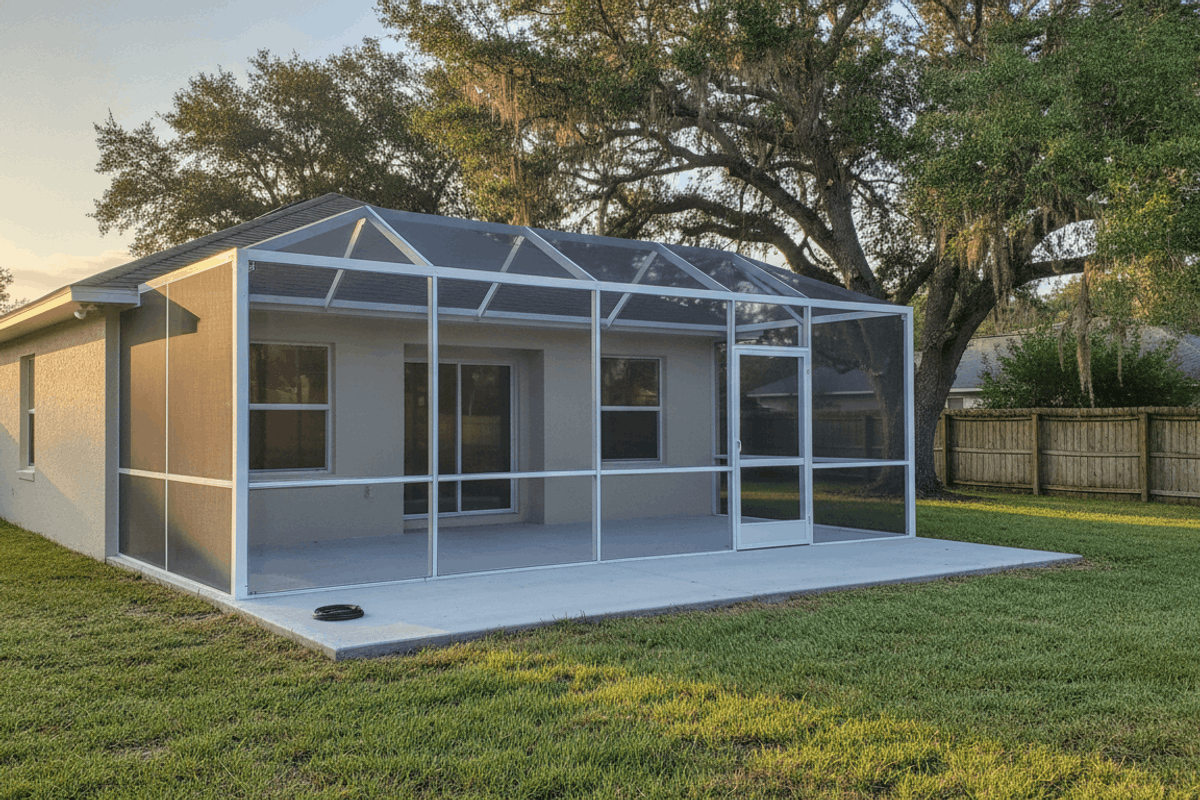
Florida does not make you wait for the county inspector. Under F.S. 553.791, a homeowner can hire a licensed private provider to run the plan review and the required inspections on their own permit, pay that provider directly, and have the building department accept the result. The statute says it plainly: “the fee owner of a building or structure, or the fee owner’s contractor upon explicit written authorization from the fee owner, may choose at any time to use a private provider to provide plans review or building code inspection services with regard to such building or structure and may make payment directly to the private provider for the provision of such services”.
That is the law. Whether it is worth doing on a Polk County screen enclosure is a different question, and the honest answer for most homeowners here is no. This page explains both halves: what the statute actually gives you, and why the local numbers usually argue against using it on a cage or a sunroom.
What a private provider is
A private provider is a licensed engineer, architect, or certified building code inspector or plans examiner who does the same code review the building department would do, on contract to you instead of on salary to the county. The statute defines their work as “building code inspection services”: plan review and the inspections “conducted either in person or virtually, of each phase of construction for which permitting by a local enforcement agency is required to determine compliance with applicable codes”.
The scope word doing the heavy lifting there is “applicable codes”. The statute defines that term narrowly. It “means the Florida Building Code and any local technical amendments to the Florida Building Code but does not include the applicable minimum fire prevention and firesafety codes adopted pursuant to chapter 633”.
So a private provider checks code compliance. Nothing else. Hold onto that, because it is the whole reason this route rarely helps on an enclosure.
There is also a conflict rule with no exceptions. Under 553.791(3), “A private provider may not provide building code inspection services pursuant to this section upon any building designed or constructed by the private provider or the private provider’s firm.” Your aluminum contractor cannot inspect their own cage, and neither can the engineer whose firm sealed the drawings for it.
What you can hire one to do, and what you cannot
You pick the scope. The statute says “The fee owner may elect to use a private provider to provide plans review or required building inspections, or both.” There is a catch attached: if you use one for plan review, “the local building official, in his or her discretion and pursuant to duly adopted policies of the local enforcement agency, may require the fee owner or the fee owner’s contractor to use a private provider to also provide required building inspections”. Review and inspections can be bundled on you, by local policy, once you start down this road.
You can also come in late. Under 553.791(6), “After construction has commenced, the fee owner or the fee owner’s contractor may elect to use a private provider to provide inspection services for a single-trade inspection for a single-family or two-family dwelling by notifying the local building official of the owner’s or contractor’s intention to do so before the next scheduled inspection”. That is the one-off door: a single trade, on a house, mid-job.
Now the limit that matters on a screen room. The City of Lakeland publishes it in one sentence on its own private provider page: “Private Providers may only review and inspect for compliance with the Florida Building Code.” And then the list of what stays with the city: “Planning & Zoning, Fire, Floodplain, Stormwater, Transportation, and any local municipal codes cannot be done by a Private Provider.”
Read that against a Polk County enclosure permit. The things that actually stall these jobs are almost never the building code. They are the setback from the rear and side lines, which is zoning. They are the flood zone review, which is floodplain management. They are drainage and lot coverage, which is site review. A private provider cannot touch any of it, and the statute agrees with the city: 553.791(8)(a) lets the local official keep reviewing “to the extent necessary to determine compliance with local ordinances, floodplain management regulations, site review requirements, and any other administrative or life safety review unrelated to building code compliance”.
What a private provider can review on your cage is the part the wind load calculation and the connection details live in. That is real work. It is just rarely the bottleneck.
What it costs, and what the county has to knock off
You pay the provider. Lakeland states it flatly: “Property owners that opt for Private Provider services must pay for those services independently.”
In exchange, the jurisdiction has to give back the part of the permit fee it is no longer earning. Under 553.791(2)(b), “the local jurisdiction must reduce the permit fee by the amount of cost savings realized by the local enforcement agency for not having to perform such services”. The same paragraph goes further: “The local jurisdiction may not charge fees for plans review or building inspections if the fee owner or the fee owner’s contractor hires a private provider to perform such services.” And it closes a loophole: “The local enforcement agency may not charge punitive administrative fees when a fee owner has chosen to work with a private provider.”
Note what that refund is and is not. It is the plan review and inspection slice of your permit fee, not the whole fee. The rest of a Polk County permit covers intake, recording, surcharges and the zoning and floodplain work nobody is taking off the county’s plate. If you want the baseline those fees come from, our breakdown of what a Polk County enclosure permit costs and who collects it sets it out.
There is a fixed percentage floor in the statute, but it does not apply to your house. Subsection (2)(d) requires a reduction of “at least 25 percent of the portion of the permit fee attributable to plans review or building inspection services” for a private provider on part of the work, and “at least 50 percent” when a provider does all of it. Those two numbers are written for “a commercial construction project”. A residential enclosure falls under the cost-savings language in (2)(b) instead, which has no published floor, so the arithmetic depends on how your jurisdiction prices its own labor.
Registration is free on the provider’s side. The statute requires every local agency to “create a registration system for private providers and private provider firms working in the local enforcement agency’s jurisdiction”, and says “The local enforcement agency may not charge an administrative fee for registration or updates to a registration.” Polk County’s own registration form confirms it in writing: “There is no registration fee assessed for private provider companies.”
The notice you have to file
This is a paperwork route, so it has paperwork.
The core requirement is in 553.791(5). The fee owner or their contractor “shall notify the local building official in writing at the time of permit application, or by 2 p.m. local time, 2 business days before the first scheduled inspection by the local building official or building code enforcement agency that a private provider has been contracted to perform the required inspections of construction under this section, including single-trade inspections, on a form adopted by the commission”. The state form is the state form: “The local enforcement agency may not alter the form.”
The notice has to name the provider, their firm, address, phone, email and license or certification number, and the owner has to sign an acknowledgment electing the private provider route.
Locally, Lakeland layers its own process on top of that. The city requires a completed Notice to Building Official form and a Fee Owner Authorization form uploaded with the permit, and it says “All Private Providers must be registered with the City of Lakeland before they can be added to a permit or commence any work.” It also sets a boundary on timing that the statute does not: “The Private Provider option can be chosen as long as the City of Lakeland has not commenced any plan review and/or inspection activity on the project.” And it bundles the two services: “If Plan Review will be done by a Private Provider, inspections must also be done by the same Private Provider.”
Worth knowing that the Legislature capped how far a city can go here. Under 553.791(19)(a), “A local enforcement agency, local building official, or local government may not adopt or enforce any laws, rules, procedures, policies, qualifications, or standards more stringent than those prescribed by this section.” The bundling rule has a clear statutory hook in (2)(a). Some of the rest is the kind of thing worth asking the building official to point to in the statute before you accept it as a bar to your permit.
In unincorporated Polk County, the Building Division asks for a conversation first. Its registration form says: “Please contact a Building official at (863) 534-6528 for a preliminary conversation regarding private providers working in unincorporated Polk County.” If you are not sure which of those two offices your lot answers to, our guide to Lakeland versus the Polk County building department sorts that out first, because the answer changes every form in this section.
What you get in return
Three things, and they are genuinely good if your constraint is scheduling.
Inspections outside business hours. This is the headline. 553.791(10) says “The local building official may not prohibit the private provider from performing any inspection outside the local building official’s normal operating hours, including after hours, weekends, or holidays.” A county inspector works county hours. A provider you hired does not have to.
Virtual inspections stay available. Under 553.791(19)(c), “A local enforcement agency may not prohibit or limit private providers from using virtual inspections if a virtual inspection is not prohibited by any applicable code.”
Hard deadlines with teeth. This is where the statute stops being polite. If an engineer or architect seals the plan review affidavit, the official has 10 business days to issue the permit or send a specific written denial, and “If the local building official does not provide specific written notice to the permit applicant within the prescribed 10-day period, the permit application is deemed approved as a matter of law, and the local building official must issue the permit on the next business day.” The same deemed-approved mechanism applies to incomplete-forms notices under (8)(b).
The closeout has its own clock, and it is short on a house. Under (16)(a), once you hand in the certificate of compliance and everything else is paid and approved, the official has “No more than 10 business days, or if the permit is related to single-family or two-family dwellings then no more than 2 business days” to issue the certificate of occupancy or completion or tell you what is missing. Miss it and (16)(b) grants the certificate automatically “as of the next business day”. That matters if you are selling, because an open permit is exactly the thing that surfaces at closing. Our walkthrough on selling a house with an unpermitted enclosure covers that side of it.
The paper trail the provider owes
The provider’s reports are the record, so the statute fixes their timing. Under (14), the provider “shall post each completed inspection record, indicating pass or fail, and provide the record to the local building official within 4 business days”. Lakeland shortens that locally, asking for results uploaded within two days of completion.
At the end, the provider firm issues a certificate of compliance: a sworn statement “summarizing the inspections performed and including a written representation, under oath, that the stated inspections have been performed and that, to the best of the private provider’s knowledge and belief, the building construction inspected complies with the approved plans and applicable codes”. That document is what unlocks the certificate of completion, the same milestone the county inspection process ends on.
Failed items work the way you would expect, with one fee protection attached. A deficiency notice gets posted, physically or electronically, and “After corrections are made, the item must be reinspected by the private provider or the representative of the private provider before being concealed.” The county cannot bill you for its own overhead on top: under the same subsection, “The local jurisdiction may not charge reinspection or reaudit fees as a result of the local jurisdiction’s audit inspection occurring before the performance of the private provider’s inspection or for any other administrative matter not involving the detection of a violation of the building code or a permit requirement.”
The provider carries real insurance behind all of this. Subsection (20) sets “minimum policy limits of $1 million per occurrence and $2 million in the aggregate for any project with a construction cost of $5 million or less”, written by an insurer with at least an A.M. Best rating of A.
Why it almost never pencils out on a Polk County cage
Here is the part most pages on this topic leave out.
Lakeland publishes its own turnaround times on the same page where it explains the private provider option. Plan review runs “Approximately 7 days” per cycle. Inspections “Can generally be scheduled as early as the next business day”. A private provider is being sold against a city that already inspects next day.
The city also publishes its utilization numbers, as F.S. 553.80(7)(b) requires. For the reporting period Lakeland shows, 10/1/2021 to 9/30/2022, the city conducted 44,228 building inspections and reinspections. Of those, 422 were conducted by a private provider, and the number of audits the city ran on private provider inspections was 0. That is under one percent of inspections going this route in a city of 10,468 permit applications. The option is legal, published and apparently almost unused here.
Set that next to the cost. You are paying a licensed engineer, architect or certified inspector at private rates across multiple trips to a job that typically needs a handful of inspections, in exchange for a permit fee reduction on only the review-and-inspect slice, against a department that already turns inspections around the next business day and still has to do your zoning and floodplain review itself.
Where it does make sense is narrow and real: a large commercial job with the statutory 25 and 50 percent fee floors in play, a schedule that genuinely needs a Saturday inspection, or a project where ten business days of certainty on the permit is worth paying for. A 24 by 30 pool cage in Winter Haven is none of those.
What this route does not change
Two things survive it intact.
Your contractor is still on the hook. The statute is explicit in (9): “The contractor’s contractual or legal obligations are not relieved by any action of the private provider.” A passed private inspection is not a warranty, and it does not touch your rights if the work turns out to be defective later. Those run on their own track through the chapter 558 defect notice process.
And the county steps back from responsibility along with the work. Under (11), “A local enforcement agency is not responsible for the regulatory administration or supervision of building code inspection services performed by a private provider hired by a fee owner or the fee owner’s contractor.” You are buying speed and control, and you are also buying the oversight gap that comes with them. The discipline route moves too: complaints about a private provider go to their professional licensing board under (21), not to the building department.
The one thing the statute will not let a city do is talk you out of it. Under (23), the local government, enforcement agency, building official and code enforcement personnel “may not prohibit or discourage the use of a private provider or a private provider firm.”
Frequently asked questions
Can a Polk County homeowner hire their own building inspector?
Yes, for building code work only. F.S. 553.791 lets the fee owner, or the contractor with the owner’s explicit written authorization, hire a registered private provider to do plan review, the required inspections, or both, and pay that provider directly. The provider has to be licensed as an engineer, an architect, or certified under part XII of chapter 468, and they cannot inspect a building their own firm designed or built.
Does using a private provider lower my permit fee?
It lowers part of it. The jurisdiction must reduce the permit fee by its cost savings for not doing the review and inspections, and it may not charge plan review or inspection fees at all when you hire a provider for that work. The 25 and 50 percent minimum reductions written into the statute apply to commercial construction projects, not to a house, so a residential reduction depends on how your jurisdiction prices its own labor.
Can a private provider approve my setback or flood zone review?
No. Private providers are limited to the Florida Building Code and local technical amendments to it. Lakeland lists zoning, fire, floodplain, stormwater, transportation and local municipal codes as city staff work only, and the statute preserves the local official’s review of local ordinances, floodplain management regulations and site review requirements. On a screen enclosure those are usually the slow parts, which is why this route rarely speeds up a cage permit.
How much notice does the building department need?
Written notice at the time of permit application, or by 2 p.m. local time two business days before the first scheduled inspection, on the state form the local agency is not allowed to alter. If you are adding a provider for a single-trade inspection after construction has started on a single-family or two-family dwelling, you notify before the next scheduled inspection.
Can a private provider inspect on a weekend?
Yes. The local building official may not prohibit a private provider from inspecting outside the department’s normal operating hours, including after hours, weekends and holidays. A local agency also may not prohibit or limit virtual inspections unless an applicable code prohibits them.
What happens if the building official sits on my permit?
The statute puts a clock on it. When an engineer or architect seals the plan review affidavit, the official has 10 business days to issue the permit or send specific written notice of what fails and which code sections are violated. If that notice does not arrive in time, the permit is deemed approved as a matter of law and must be issued the next business day. The same deemed-approved rule applies to incomplete-document notices, and a single-family certificate of occupancy or completion request has a two-business-day clock.
Does a private provider inspection get my contractor off the hook?
No. The statute states that the contractor’s contractual or legal obligations are not relieved by any action of the private provider. A passing inspection is a code finding on the day it was made, not a guarantee of the work. If a defect shows up later, the construction defect notice process under chapter 558 is the track that applies, and your contractor’s license and insurance still matter.
How common is this in Lakeland?
Rare. In the utilization report Lakeland publishes under F.S. 553.80(7)(b), covering 10/1/2021 to 9/30/2022, 422 of the city’s 44,228 building inspections and reinspections were conducted by a private provider, and the city ran zero audits of private provider inspections that year. The city also publishes next-business-day inspection scheduling, which is hard for a paid provider to improve on.
Getting an enclosure through the normal way
For almost every screen room, pool cage or sunroom in Polk County, the ordinary route is the fast one: a contractor who pulls the permit, draws it correctly against the wind load the first time, and schedules the county inspections themselves. The permit stops being a problem when the drawings are right.
We connect Polk County homeowners with experienced, insured local aluminum and screen crews who handle their own permitting, from screen rooms and lanai enclosures to pool cages across Lakeland and the rest of the county. Call (863) 777-5379 for a free on-site measure.