There is a state fund that pays Florida homeowners who lost money on a construction contract. Most people never hear about it until long after the job went wrong, which is a shame, because one of its conditions is a one-year clock.
It is called the Florida Homeowners’ Construction Recovery Fund. F.S. 489.140 is the whole section that creates it: “There is created the Florida Homeowners’ Construction Recovery Fund as a separate account in the Professional Regulation Trust Fund. The recovery fund shall be funded pursuant to s. 468.631.”
This page is a map of the statute. It is not legal advice, it is not a determination about anyone’s job, and it does not tell you what to do about yours.
What is the Florida Homeowners’ Construction Recovery Fund?
It is a last-resort pool of money, administered through the Construction Industry Licensing Board, for homeowners who already won and still have not been paid.
The Department of Business and Professional Regulation puts it this way on its own recovery fund page: “If you have suffered damages caused by the financial mismanagement of a licensed contractor or construction company with whom you have signed a construction contract, you may be eligible for the fund. The fund is a last resort after all civil remedies have been exhausted.”
Read both halves of that sentence. Licensed contractor, and last resort. Those two words do more work than anything else on this page, and the rest of the statute is mostly them spelled out.
Your contract was supposed to tell you about this
Every residential construction contract in Florida above a small threshold has to carry a written notice about the fund. F.S. 489.1425(1) says:
“Each agreement or contract for repair, restoration, improvement, or construction to residential real property must contain a written statement explaining the consumer’s rights under the recovery fund, except where the value of all labor and materials does not exceed $2,500.”
The statute then supplies the language. It has to be substantially in this form, in capitals, under the heading FLORIDA HOMEOWNERS’ CONSTRUCTION RECOVERY FUND:
“PAYMENT, UP TO A LIMITED AMOUNT, MAY BE AVAILABLE FROM THE FLORIDA HOMEOWNERS’ CONSTRUCTION RECOVERY FUND IF YOU LOSE MONEY ON A PROJECT PERFORMED UNDER CONTRACT, WHERE THE LOSS RESULTS FROM SPECIFIED VIOLATIONS OF FLORIDA LAW BY A LICENSED CONTRACTOR.”
That block has to be “immediately followed by the board’s address and telephone number as established by board rule.”
A pool cage, a screen room, a lanai rescreen, a carport, a patio cover: all of them are improvements to residential real property, and almost all of them clear $2,500 in labor and materials. So the notice belongs in the paperwork. Go look at your signed contract right now, before you need it. If it is not there, that is itself a violation, and the board “may fine the contractor up to $500” on a first finding and “shall fine the contractor $1,000 per violation” on a second or subsequent one. In both cases “the moneys must be deposited into the recovery fund.”
What has to go wrong before the fund is in play
Not every bad job qualifies. F.S. 489.141(1)(b) narrows it to a judgment, award or restitution order “based upon a violation of s. 489.129(1)(g), (j), or (k) or s. 713.35”. Three paragraphs, and a fourth statute about false lien statements. Here is what those three actually say.
F.S. 489.129(1)(g), financial mismanagement or misconduct “that causes financial harm to a customer”. The statute gives it three triggers. One is liens recorded against your property for supplies or services you already paid the contractor for, which the contractor has not cleared “within 75 days after the date of such liens”. The second is the one that fits a half-finished aluminum frame:
“The contractor has abandoned a customer’s job and the percentage of completion is less than the percentage of the total contract price paid to the contractor as of the time of abandonment, unless the contractor is entitled to retain such funds under the terms of the contract or refunds the excess funds within 30 days after the date the job is abandoned”
The third is a finished job that cost you more than the contract price as adjusted by change orders, with carve-outs for circumstances outside the contractor’s control, circumstances you caused, and whatever the contract itself permits.
F.S. 489.129(1)(j), abandonment on its own terms: “A project may be presumed abandoned after 90 days if the contractor terminates the project without just cause or without proper notification to the owner, including the reason for termination, or fails to perform work without just cause for 90 consecutive days.”
F.S. 489.129(1)(k), false statements about bonding, about having paid the subs and suppliers, or about carrying workers’ compensation and public liability insurance.
Notice what is not on that list. Ugly welds, a cage that drains the wrong way, a screen door that binds, a schedule that slipped by a month. Workmanship disputes are a different fight, and the recovery fund is not where they go.
The conditions you have to clear first
This is the part that surprises people, and it is why the one-year clock matters so much.
F.S. 489.141(1) opens: “A claimant is eligible to seek recovery from the recovery fund after making a claim and exhausting the limits of any available bond, cash bond, surety, guarantee, warranty, letter of credit, or policy of insurance if each of the following conditions is satisfied”. Every one of them, not whichever ones are convenient.
The first is a result in hand. Under 489.141(1)(a), you need a final judgment from a Florida court of competent jurisdiction, or an arbitration award, or a final order from the Construction Industry Licensing Board directing the licensee to pay you restitution. The board may waive that only in two narrow situations: the licensee died, or a bankruptcy court blocked you from getting a judgment after you tried in good faith to pull the transaction’s assets out of the bankruptcy.
The second is that you tried to collect it. F.S. 489.141(1)(e) wants a writ of execution that came back showing no property to levy on, or a sale that did not cover the judgment. If you cannot do that for a reason the board accepts, the fallback is “all reasonable searches and inquiries” into whether the debtor holds anything at all, plus “a diligent attempt, as defined by board rule, to collect the restitution awarded by the board.” DBPR publishes instructions for performing an asset search and two sample affidavit forms on its recovery fund page, one for claims over $15,000 and one for claims of $15,000 or less. That tells you how seriously the search is taken.
The third is the deadline. F.S. 489.141(1)(f): “A claim for recovery is made within 1 year after the conclusion of any civil, criminal, or administrative action or award in arbitration based on the act.”
One year after the case concludes. Not one year after the crew walked off, not one year after you noticed. People lose this fund by winning and then resting.
The fourth is netting. Under 489.141(1)(g), anything you already recovered from the licensee “or from any other source” has to be applied to your damages first. The fund covers what is left, not what you started with.
Who cannot claim at all
F.S. 489.141(2) lists six disqualifiers outright. You are out if you are the spouse of the judgment debtor or licensee, or that spouse’s personal representative. You are out if you are the licensee who acted as the contractor. You are out if the contract was on property the licensee owned or controlled, or if you were “associated in a business relationship with the licensee other than the contract at issue”. Division II scopes under s. 489.105(3)(d)-(q) contracted before July 1, 2016 are excluded.
And then the one that decides more screen enclosure cases than any of the others:
“The claim is based upon a construction contract in which the contractor did not hold a valid and current license at the time of the construction contract”.
An unlicensed contractor puts you outside this fund completely. There is no partial credit, no hardship exception, and no fixing it after the fact. That single line is the practical reason to run the license number before the deposit leaves your hands, not after, which is the same point as checking the contractor license on a Polk County screen enclosure and the reason Florida Statute 489.126 attaches permit and start-work duties once your initial payment totals more than 10 percent of the contract price.
How much the fund actually pays
F.S. 489.143(2) sets the base at the judgment, award or restitution order or $25,000, whichever is less, or the unsatisfied portion of it, and only “to the extent and amount of actual damages suffered by the claimant”, and only up to the maximum for the relevant division. Then the current caps, in 489.143(3):
“Beginning January 1, 2025, for Division I and Division II contracts entered into on or after July 1, 2024, payment from the recovery fund is subject to a $100,000 maximum payment for each Division I claim and a $30,000 maximum payment for each Division II claim.”
| Contract signed | Division I claim cap | Division II claim cap |
|---|---|---|
| On or after July 1, 2024 | $100,000 | $30,000 |
| After July 1, 2004 (Div I) | $50,000 | n/a |
| On or after July 1, 2016 (Div II) | n/a | $15,000 |
Division matters, then. F.S. 489.105(3) draws the line: “Contractors are subdivided into two divisions, Division I, consisting of those contractors defined in paragraphs (a)-(c), and Division II, consisting of those contractors defined in paragraphs (d)-(q)”. Paragraph (q) is the catch-all specialty definition, “a contractor whose scope of work and responsibility is limited to a particular phase of construction established in a category adopted by board rule”. Which division your contractor sits in depends on the license they actually hold, so read the license itself on DBPR’s lookup rather than assuming from the trade.
Three more limits worth knowing. Claims out of the same transaction are capped in the aggregate at the division maximum “regardless of the number of claimants involved in the transaction”, under 489.143(5). Each licensee has a lifetime ceiling, currently “$2 million for each Division I licensee and $600,000 for each Division II licensee” on contracts signed on or after July 1, 2024. And the fund is appropriated money paid “in the order filed”, so if the year’s appropriation runs out, 489.143(8) carries pending claims into the next fiscal year.
The statute is also blunt about what it will not pay for: “Payment from the fund for other costs related to or pursuant to civil proceedings such as postjudgment interest, attorney fees, court costs, medical damages, and punitive damages is prohibited.”
What a payout does to the contractor
F.S. 489.143(9) is automatic and harsh: “the license of such licensee shall be automatically suspended, without further administrative action, upon the date of payment from the fund. The license of such licensee may not be reinstated until he or she has repaid in full, plus interest, the amount paid from the fund. A discharge of bankruptcy does not relieve a person from the penalties and disabilities provided in this section.”
That is why the board treats these claims the way it does. A payment ends somebody’s ability to work.
Where DBPR’s role stops
A complaint to the department and a claim on the fund are two different things, and the department says so on its own complaint page:
“The professions and businesses regulated by the Department of Business and Professional Regulation and the disciplinary action that may be taken is administrative in nature, e.g., reprimand, fine, restriction of practice, remedial education, administrative cost, probation, license suspension or license revocation. The Department cannot represent you in civil matters to recover fees paid or seek remedies for injuries.”
So the administrative track can produce a board restitution order, which is one of the three results 489.141(1)(a) accepts. It cannot stand in for the collection effort, and it cannot get your money back on its own. DBPR lists Construction Industry among the professions with both an online and a by-mail complaint form, and its Customer Contact Center is (850) 487-1395. The recovery fund office is separate: Florida Homeowners’ Construction Recovery Fund, 2601 Blair Stone Road, Tallahassee, FL 32399-2215, 850.921.6593.
How this lands on a Polk County aluminum job
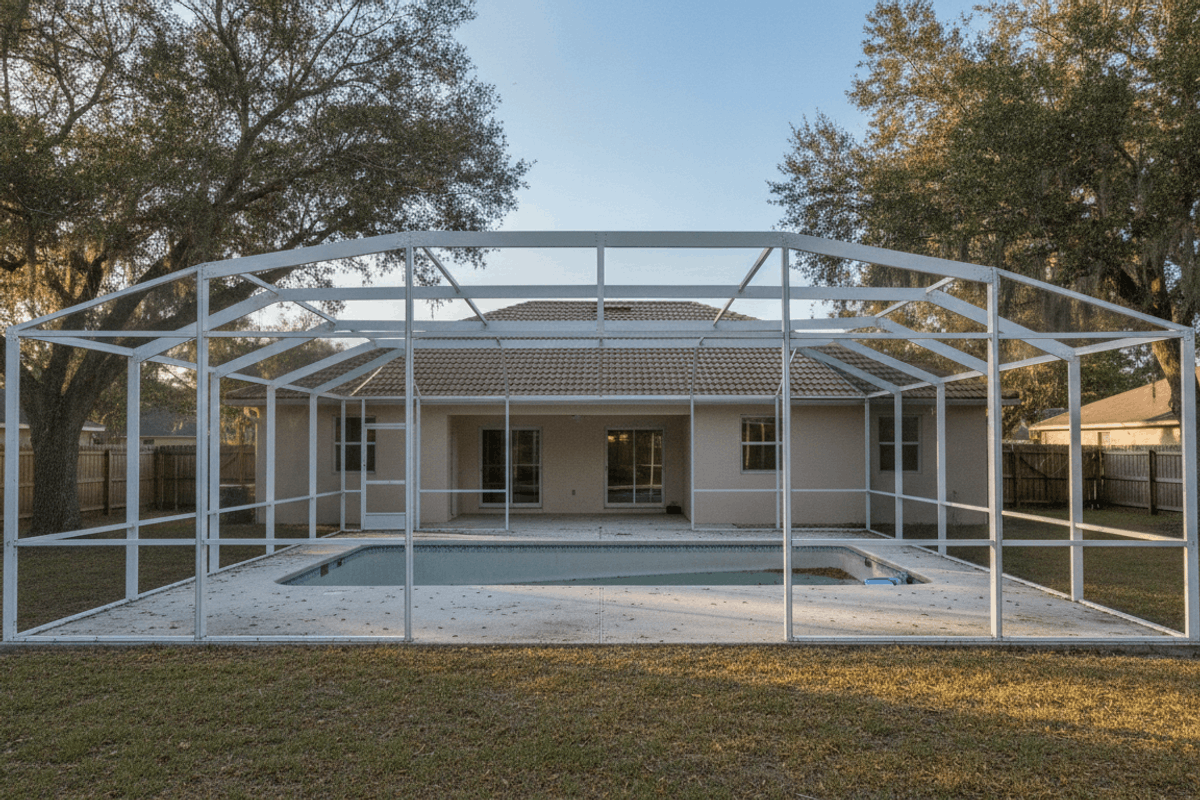
Screen enclosure work in Polk County has a shape that makes the abandonment paragraph unusually relevant. Materials are ordered to size, deposits are real money, and the frame goes up weeks before the mesh does. A cage that sits half-framed through two months of summer storms in Lakeland or out toward Lake Wales is exactly the fact pattern in 489.129(1)(g)(2): money paid ahead of completion, nobody coming back.
The paperwork that protects you is boring and it is all front-loaded. A current license you looked up yourself. A written contract carrying the recovery fund statement. A notice of commencement recorded and posted. A permit that actually exists, rather than the after-the-fact permit you discover later. Inspections called and passed, which is the difference between an approved job and a permit that never closed. None of it is exciting. All of it is what the statute asks you to produce later.
Frequently asked questions
What is the Florida Homeowners’ Construction Recovery Fund?
It is a state account created by F.S. 489.140 inside the Professional Regulation Trust Fund that can pay homeowners who lost money to a licensed contractor on a residential construction contract. DBPR describes it as “a last resort after all civil remedies have been exhausted.”
Do I need a court judgment before I can claim?
Under F.S. 489.141(1)(a), you need a final judgment from a Florida court, an arbitration award, or a Construction Industry Licensing Board final order directing restitution. The board may waive that requirement only where the licensee died or a bankruptcy court precluded a judgment after due diligence.
How long do I have to make a claim?
One year. F.S. 489.141(1)(f) says the claim must be made “within 1 year after the conclusion of any civil, criminal, or administrative action or award in arbitration based on the act.”
What is the maximum the fund will pay?
For Division I and Division II contracts entered into on or after July 1, 2024, F.S. 489.143(3) sets a $100,000 maximum per Division I claim and a $30,000 maximum per Division II claim. Older contracts fall under the earlier $50,000 and $15,000 tiers, and every payment is still limited to actual damages.
Can I claim if my contractor was unlicensed?
No. F.S. 489.141(2)(d) disqualifies a claim “based upon a construction contract in which the contractor did not hold a valid and current license at the time of the construction contract”. Verifying the license before signing is what preserves access to the fund.
Does the fund cover bad workmanship?
Only if the loss traces to one of the grounds named in F.S. 489.141(1)(b), which are F.S. 489.129(1)(g), (j) or (k) and F.S. 713.35. Those cover financial mismanagement, abandonment, and false statements about bonding, payment or insurance. A quality dispute that does not fit one of them is outside the fund.
Will the fund pay my court costs and interest?
No. F.S. 489.143(2) prohibits payment “Payment from the fund for other costs related to or pursuant to civil proceedings such as postjudgment interest, attorney fees, court costs, medical damages, and punitive damages is prohibited.”
My contract never mentioned the recovery fund. Does that matter?
It is a violation of F.S. 489.1425(1) for a residential contract above $2,500 in labor and materials to omit the statement. The board may fine the contractor up to $500 for a first violation and must fine $1,000 per violation after that, with the money going into the fund. The omission is a separate issue from whether a claim itself qualifies.
Before you sign, not after
At Lakeland Outdoor Pro, we connect Polk County homeowners with insured local aluminum crews. We do not perform licensed work and we do not provide legal advice.
Call (863) 777-5379 to talk through a screen room, pool cage, sunroom, carport, patio cover or rescreen, and ask the matched contractor for their license number and a written contract before any money moves.