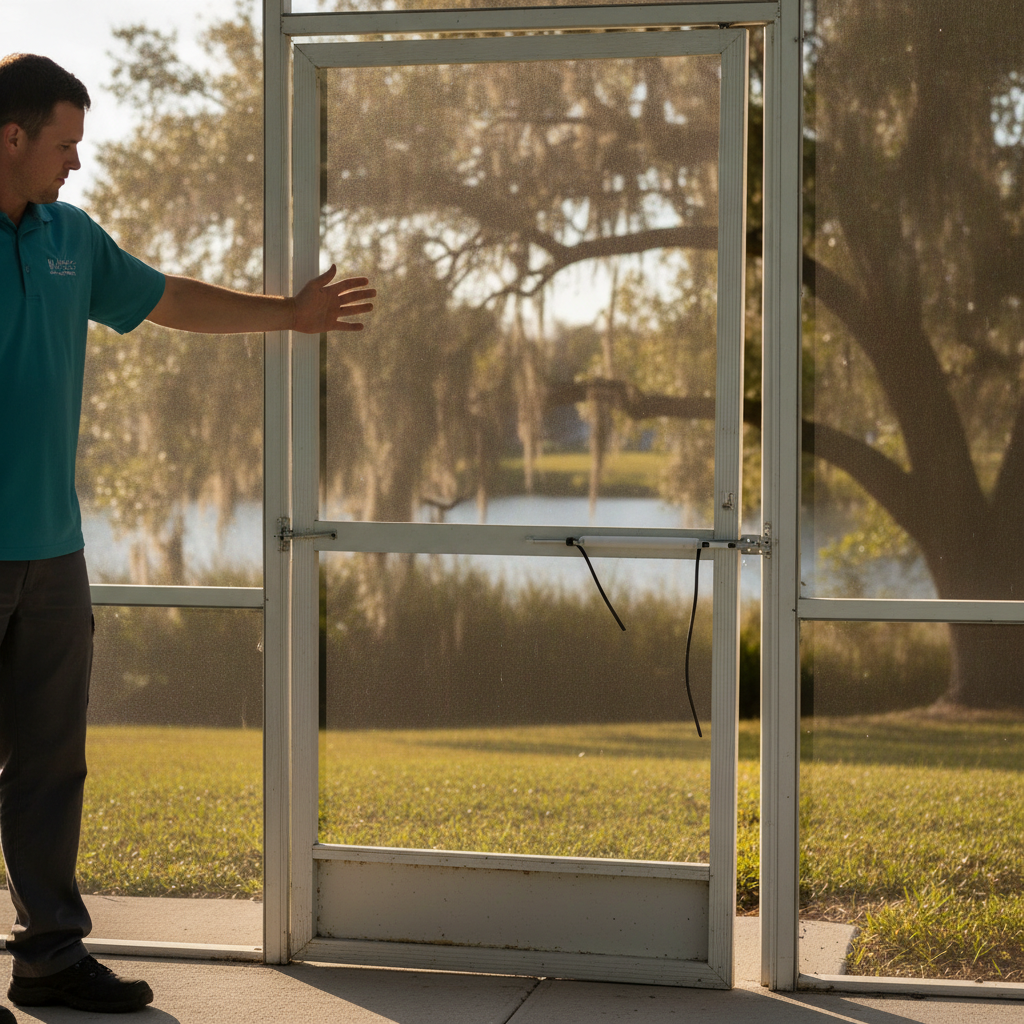
The closer on a Cypress Gardens pool cage sighs, the door drifts back open, and by noon the oak leaves are on the water. That is the usual call: a door that will not stay shut, not a cage that needs to come down. Most of the time the closer has given out, the latch no longer meets the strike, or the frame has racked just enough that a working latch hits air.
A closer and latch vs a new door
Hardware is the fix when the door still hangs square and the aluminum is straight. A new door is the fix when a stile is bent, the kick plate is kicked through, or the slab of the door has twisted so the latch cannot be made to meet the strike.
The closer is the arm at the top. It is a small hydraulic unit that pulls the door into the latch after you walk through. Central Florida sun cooks those seals, and it does it faster on the south and west faces of a cage, the same way it kills mesh there years before the shaded north side looks tired. A closer that has lost its punch lets the door stop an inch short of the strike. A closer cranked down too tight slams the door and still misses, because slamming is not the same as lining up.
The latch and strike are the other half. If the door has sagged on worn hinges, the latch hits high or low. You can see it: a bright scratch on the strike plate, or a latch that only catches if you lift the handle as you close. Rehanging the door and replacing the hinges, the closer, and the latch is still screen door work. On this site that work, a rehang, a rebuild with new hardware, or a full replacement, runs $180 to $500.
A new door enters the conversation when the door itself has lost its shape. Dogs and kids hit the bottom rail. On a 1990s cage around Winter Haven and the Chain of Lakes, that lower panel is often the original kick plate, now creased or torn. A bent kick plate will keep a new latch from lining up no matter how many times someone bends the strike with a screwdriver. At that point the crews we send are not tuning hardware on a door that already failed. They are hanging a new door in the existing opening. Pool cage door replacement is that job.
A torn screen in the door is a smaller call. Screen sits in a channel, held by a rubber spline, and a single door panel can come out and go back in without touching the rest of the cage. Individual screen panels run $35 to $90 each. If the mesh on the walls is already brittle, fixing the door screen and leaving the rest is a short pause. Screen in Central Florida lasts roughly seven to twelve years, and it fails unevenly because sun exposure kills mesh on the south and west elevations years before the shaded north side. That is a pool cage rescreening conversation, not a door conversation.
Phifer PetScreen is the mesh the crews we send put in a door or a lower wall when a dog is the reason the last panel failed. It is pet-resistant screening, built to resist tearing and puncture from most dogs and cats, and the maker calls it out for patio and porch enclosures as well as windows and doors. There is no published mesh count on that product. The useful question is whether the dog is still going to hit that same panel.
Pool-barrier hardware
A door on a screen room over a Dixieland patio is a nuisance when it will not latch. Leaves blow in. Mosquitoes follow. The same failure on a pool cage is a different conversation, because that door is often the gate in the enclosure wall, and Florida writes rules for how a pool gate has to behave.
Florida’s Residential Swimming Pool Safety Act lists the ways a residential pool may be made safe. One option, in section 515.27, is an enclosure that meets the pool barrier requirements of section 515.29. Other options in that same list include an approved safety pool cover, exit alarms on the house doors and windows that open to the pool, a self-closing and self-latching device on those house doors with the release no lower than 54 inches above the floor, and a pool alarm. The 54-inch release is a house-door rule under that option. It is not the cage-gate rule. The statute does not name “screen enclosure” as a category. A screened structure only satisfies that first option when it independently meets the barrier specifications, and whether a particular cage does is a determination for the building official reviewing the permit.
Section 515.29 is the specification list. The barrier must be at least 4 feet high on the outside. It may not have gaps, openings, indentations, protrusions, or structural components that could let a young child crawl under, squeeze through, or climb over. Gates that provide access to swimming pools must open outward away from the pool, be self-closing, and carry a self-latching locking device. The release has to sit on the pool side of the gate, placed so a young child cannot reach it over the top or through any opening or gap. The barrier has to sit far enough from the water that a child who did get through is not immediately in the pool, and it may not be placed where a permanent object becomes a ladder.
That is why a closer that no longer pulls the door shut is not only a leaf problem. If this door is the gate, a closer that dies and a latch that does not catch are the self-closing and self-latching functions failing in real life. Swapping a closer from a spring kit, moving the strike, or changing which way the door swings is gate hardware. Gate hardware on a pool enclosure is not a weekend project. The crews we send handle that work. Whether the finished door does what 515.29 asks is what the building official signs off on. There is a longer walk through the same hardware in pool cage door hardware and the pool barrier.
What repair includes
The visit starts with the door, then widens. A closer can be replaced in an opening that is still square. Hinges that have worn oval holes in the aluminum need a rehang, not another screw in the same hole. The latch and strike have to meet without lifting the door. The kick plate has to be flat. The screen in the door has to be tight in its channel, because a baggy panel will take wind and pop the spline the first time a summer thunderstorm rolls across Winter Haven.
If the jamb of the cage around the door has moved, hardware will not save it. Live oak roots along Lake Morton and in Dixieland have been lifting thin 1950s patio slabs for decades, and a cage that was square when it was built can rack just enough that the door hits the head of the opening. South Lakeland lots along US-98 are a different picture: longer cages, west-facing doors that take the afternoon sun, closers that cook through. In Davenport and Four Corners the call is often a builder-covered lanai that got a door as an afterthought, and the hardware was never the heavy closer a pool gate uses. Out on the Lake Wales Ridge, the cage often sits a long walk from the house on a rural parcel, and a door that stands open all afternoon is how the heat and the palmetto bugs move in.
Storm season is part of the diagnosis. The Atlantic hurricane season runs from June 1 to November 30, and the daily summer storm well before that will test a door that already stands open. Wind under a loose panel pops spline. A door left ajar is an opening, and the mesh around it takes the abuse. Repairing the door and ignoring a wall of brittle screen is how the same house calls back in a month.
A new door cut into a wall of screen is a different job from a closer on a door that is already there. Cutting a new opening means adding infill framing, and screening of any space that requires structural or infill framing is on both published permit lists: Polk County’s Building Division FAQ, and the City of Lakeland Building Inspection permit requirements. The city runs its own Building Inspection division and publishes its own list. Replacing a closer in an existing opening is not adding framing. Replacing a door in an existing opening is still an existing opening. If the job grows into new posts, new infill, or a changed swing that alters how the enclosure is built, that is a question for the Building Division on the specific design. Inside city limits, ask Lakeland. In unincorporated Polk, ask the county. A crew that mostly works the county can hit friction inside city limits, and that is worth saying out loud before anyone orders parts.
The crews we send are licensed and insured. Florida law says a person must be certified or registered in order to engage in the business of contracting in this state. Several license classes lawfully build and repair aluminum structures, so the useful move is to ask which class the contractor holds and verify it yourself at myfloridalicense.com.
Common questions
How much does pool cage screen door repair cost?
Screen door work on this site, a rehang, a rebuild with new hardware, or a full replacement, runs $180 to $500. A torn screen in the door, treated as an individual panel, runs $35 to $90. What moves a job toward the top of the door range is a bent frame, a kick plate that has to come off with the door, or hardware that only works after the opening is rehung square.
How much to rescreen a pool cage?
A full-cage rescreen runs $1,400 to $3,200. Standard fiberglass, priced per square foot of screen, is about $2.50 to $4.00 installed. Individual panels are the $35 to $90 figure above. A door repair does not become a rescreen unless the walls are already in the same condition as the door mesh.
How long do pool cage screens last in Central Florida?
Roughly seven to twelve years, and they do not fail all at once. The south and west elevations go brittle years before the shaded north side looks tired. That is why a cage in Cypress Gardens can need a new south wall and a new door screen while the north wall still holds spline.
Can a retractable screen door be repaired?
A retractable unit is a cassette and a mesh track. A pool cage door is a hinged aluminum door in the enclosure wall, with a closer, a latch, and usually a kick plate. This page is the cage door. The crews we send repair and replace that hinged door. A cassette that will not retract is a different product.
When to call us
When the door is the gate on a pool enclosure, closer and latch work belongs with a licensed contractor, not a weekend hardware run. Same if the frame is bent, the kick plate is torn through, or the door has been standing open through storm season. Call us at (863) 777-5379.